

Protein Synthesis Lesson

Presentation
•
Biology
•
9th - 12th Grade
•
Practice Problem
•
Easy
Standards-aligned

Samah Al-hamadi
Used 14+ times
FREE Resource
21 Slides • 19 Questions
1


Protein Synthesis
Transcription & Translation
2


Central Dogma of Genetics
•Genetic information flows in one direction for
gene expression
•DNA🡪 RNA🡪 Protein
3

4

5
6


How does DNA tell the cell to make
a specific kind of protein?
* First: Transcription
* Second: Translation
* Called PROTEIN SYNTHESIS
* There are 2 major steps in this process
7

How does DNA tell the cell to make
a specific kind of protein?
Transcription : Process in which mRNA is
synthesized from the DNA template.
Major Player: mRNA(messenger RNA) transfers the recipe for
making proteins from the DNA to to the ribosome
Remember that RNA replaces the T in DNA with a U!

8
Open Ended
What is the RNA compliment of the following DNA strand?
TAGCGA
9
The correct answer is
DNA: TAGCGA
RNA: AUCGCU
10
Multiple Choice
Creating an mRNA strand from a DNA strand is called _______.
Transcription
Replication
Translation
Translocation
11
Open Ended
THINK! Why would mRNA need to exist? As in, why is another player besides DNA needed for protein synthesis?
12

Why is Transcription Necessary?
•DNA cannot leave the nucleus
•DNA must remain secure!
•DNA is used repeatedly as a template
•DNA cannot not bind to ribosomes for translation (second step of protein synthesis)
translation (second step of protein
synthesis)
13
Multiple Choice
Perform transcription for the following DNA strand:
TACCGA
AUGGCU
ATCCGT
CGTAAG
UAGGCU
14
Multiple Choice
What is the purpose of mRNA?
To create a short, single strand of one gene for translation
To store genetic information in nitrogen bases for the cell
To add amino acids in order to create peptide bonds and create a protein
To replicate DNA for cell division for organism growth and repair
15
Multiple Choice
What is transcription?
Creating RNA from DNA
Converting DNA into proteins
Replication of genetic material
Modifying the structure of proteins
16


to be added to the growing
RNA chain
•Termination
•The enzyme reaches the
stop codon and falls off the
DNA chain, allowing the
double helix to return back
to shape


17

Now What?...Translation!
Translation: Process in which mRNA attaches to
the ribosome and a protein is
assembled/made.
* Codon: 3 base code in DNA or RNA
Words to know:
ACG ATA CGG CTT
18

Now What?...Translation!
Translation: Process in which mRNA attaches to
the ribosome and a protein is
assembled/made.
* Codon: 3 base code in DNA or RNA
Words to know:
* Amino Acid: Small monomer subunits joined together
to build proteins
There are 20 different Amino Acids.
Different combination of Amino Acids make
different kinds of proteins.
19
20


#1. AUG GCA UCC UGA
Methionine, Alanine, Serine, Stop
#2. AUG CCC GGU UAG
Methionine, Proline, Glycine, Stop
#3. AUG AAG GUG UGA
Methionine, Lysine, Valine, Stop
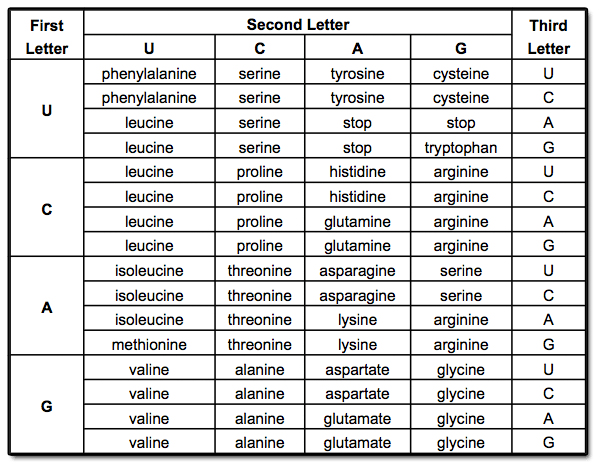
Translating mRNA codes into amino
acids to create polypeptide chains
(protein chains)
21


What is the amino acid for the
following codons?
AAU
Asparagine
(Asn)
GUG
Valine
(Val)
UGG
Tryptophan
(Trp)
22
Multiple Choice
How many codons are in the sequence below?
UCGAAAUCG
3
1
2
9
6
23
Match

Match the following amino acids to their RNA sequence
CCU
AAC
GCC
UGA
UCU
Proline
Asparagine
Alanine
Stop
Serine
Proline
Asparagine
Alanine
Stop
Serine
24

Now What?...Translation!
Translation: Process in which mRNA attaches to
the ribosome and a protein is
assembled/made.
* Codon: 3 base code in DNA or RNA
Words to know:
* Amino Acid: Compounds joined by peptide bonds
to build proteins
* Ribosome: “Reads” mRNA recipes so it can
synthesize/make proteins
25


Now What?...Translation!
* tRNA: (transfer RNA) Type of RNA that
transports amino acids to the ribosome
More Words to know:
tRNA
26


Now What?...Translation!
More Words to know:
* Anticodon: Complementary codons on tRNA that can pair that with the codons on the mRNA
tRNA
27

What happens during
translation?
Ribosome
Peptide chain/
Protein Chain
tRNA
Amino
Acid
Anticodon
Codon
28


Steps of Translation
29
30
Match
Match the following processes with their location within the cell.
Replication
Transcription
Translation
Nucleus
Nucleus
Ribosome
Nucleus
Nucleus
Ribosome
31
Match
Match the following processes with their end product.
Replication
Transcription
Translation
DNA
mRNA
Protein
DNA
mRNA
Protein
32
Multiple Choice
33
Multiple Choice

The mRNA leaves the ________ to find the ribosome to make proteins.
cell
nucleotide
nucleus
mitochondrion
34
Multiple Choice
DNA holds the code for making
lipids
carbohydrates
proteins
sugars
35
Multiple Choice
Choose the sequence of the mRNA strand that would be match up with to the following strand:
GTAGTCA
UATUAGA
ACGACTG
CAUCAGU
CATCAGT
36
Multiple Choice
37
Multiple Choice

38
Multiple Choice
39
Multiple Choice
40
Multiple Choice
Protein Synthesis
Transcription & Translation
Show answer
Auto Play
Slide 1 / 40
SLIDE
Similar Resources on Wayground

35 questions
Balancing Chemical Equations
Presentation
•
9th - 12th Grade
36 questions
SAVOIR vs Connaitre
Presentation
•
9th - 12th Grade
37 questions
East Asia History & Culture
Presentation
•
9th - 12th Grade
35 questions
Carbohydrates Lesson
Presentation
•
9th - 12th Grade
34 questions
cell organelles 2023
Presentation
•
9th - 12th Grade
38 questions
RNA and Protein Synthesis Lesson
Presentation
•
9th - 12th Grade
32 questions
Cell Membrane & Transport
Presentation
•
9th - 12th Grade
38 questions
Classification terms part 1
Presentation
•
9th - 12th Grade
Popular Resources on Wayground
24 questions
PBIS-HGMS Day 10

Quiz
•
6th - 8th Grade
10 questions
HCS SCI 03 Summer School Review 3
Quiz
•
3rd Grade
11 questions
Home Scope
Quiz
•
7th - 8th Grade
15 questions
HCS SCI 05 Summer School Assessment 3 Review
Quiz
•
5th Grade
35 questions
Lufkin Road Middle School Student Handbook & Policies Assessment
Quiz
•
7th Grade
18 questions
Geo 11.3 Area of Circles and Sectors
Quiz
•
9th - 11th Grade