
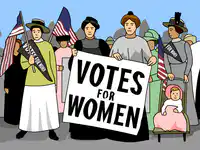
14-15 Suffrage

Presentation
•
Social Studies
•
8th Grade
•
Practice Problem
•
Hard

JAMES JEFFERIS
Used 3+ times
FREE Resource
13 Slides • 0 Questions
1

Lesson: Women's Suffrage
1/13
2

https://www.youtube.com/watch?v=XsKGGZuesS8&ab_channel=AmandaRose
Lesson: Women's Suffrage
2/13
3

Quiz
BP-Women's Suffrage
Lesson: Women's Suffrage
3/13
4

A suffragist is a person who fights for:
Gender equality
Abolition
Voting rights
An end to all suffering
Lesson: Women's Suffrage
4/13
5

In the early 1800s, most women did not:
Sign their own contracts
Own their own property
Make political speeches
Do any of the above
Lesson: Women's Suffrage
5/13
6

How are the abolition and women's suffrage movements
connected?
Both movements had the same leaders
Many suffragists became abolitionists
Both movements fought for women’s rights
Some abolitionists became suffragists
Lesson: Women's Suffrage
6/13
7

At the Seneca Falls Convention, the idea of women’s suffrage
was considered:
Extreme
Praiseworthy
Optional
Unnecessary
Lesson: Women's Suffrage
7/13
8

Sojourner Truth’s speech highlighted the connection between:
Strength and grit
Men and women
Race and gender
Gender and age
Lesson: Women's Suffrage
8/13
9

The 14th and 15th amendments gave the vote to
Men of color
White women
All women
Immigrants
Lesson: Women's Suffrage
9/13
10

When did the Constitution give all adult men the right
to vote?
From the beginning
Before the Civil War
After the Civil War
During World War I
Lesson: Women's Suffrage
10/13
11

How did it benefit western territories to grant women
suffrage?
It gave politicians a voting advantage
It eased the local suffragist protests
It prompted unruly male settlers to leave
It helped them qualify to join the union
Lesson: Women's Suffrage
11/13
12

The 19th Amendment said a person’s right to vote did not
depend on:
Their age
Their gender
Their race
Their wealth
Lesson: Women's Suffrage
12/13
13

What convinced President Woodrow Wilson to back women’s
suffrage?
A political march on Washington
Hunger strikes
Women’s war effort during World War I
Fear of losing the 1912 presidential elections
Powered by TCPDF (www.tcpdf.org)
Lesson: Women's Suffrage
13/13
Lesson: Women's Suffrage
1/13
Show answer
Auto Play
Slide 1 / 13
SLIDE
Similar Resources on Wayground

10 questions
Adjectives
Presentation
•
8th Grade
11 questions
Washington's Farewell Address
Presentation
•
8th Grade
8 questions
John Adams' Presidency 7.4 (Slides 11 & 12_
Presentation
•
7th - 8th Grade
10 questions
Physical Geography-Regions of Texas
Presentation
•
7th Grade
9 questions
Patriots and Loyalists
Presentation
•
8th Grade
10 questions
Infinitives Review & Practice
Presentation
•
8th Grade
10 questions
Operations in scientific Notation Word Problems
Presentation
•
8th Grade
10 questions
The Dreams
Presentation
•
8th Grade
Popular Resources on Wayground
10 questions
HCS SCI 03 Summer School Review 4

Quiz
•
3rd Grade
11 questions
HSMS - Standard Response Protocol
Quiz
•
6th - 8th Grade
16 questions
1.1-1.2 Quiz Review
Quiz
•
9th - 12th Grade
12 questions
Exponent Expressions
Quiz
•
6th Grade
20 questions
Adding and Subtracting Integers
Quiz
•
6th - 7th Grade
11 questions
Northeast States
Quiz
•
3rd - 4th Grade
10 questions
Characterization
Quiz
•
3rd - 7th Grade
10 questions
Common Denominators
Quiz
•
5th Grade