

6th Grade Science Study Guide

Presentation
•
Science
•
6th Grade
•
Practice Problem
•
Hard
+6
Standards-aligned

Alexandra Jimenez
Used 1+ times
FREE Resource
27 Slides • 0 Questions
1
Science Study Guide
by Mrs Alexandra Jimenez
2



Any science that deals with matter, energy and their interrelations and transformations, or with objectively measurable phenomena.
Life science and physical science
Natural Sciences
Any branch of science that deals with human behavior in its social and cultural aspects.
Cultural (or social) anthropology, sociology, psychology, political science and economics.
Social Sciences
A "formal science" is an area of study that uses formal systems to generate knowledge, such as in Mathematics and Computer Science. Formal sciences are important subjects because all of quantitative science depends on them.
Formal Sciences
3

The application of scientific knowledge to the practical aims of human life or, as it is sometimes phrased, to the change and manipulation of the human environment.
Technology
4
Accuracy and Precision
Accuracy and precision are both ways to measure results.
Accuracy: measures how close results are to the true or known value.
Precision: measures how close results are to one another.
5
Accuracy
Accuracy measures how close the result is to the actual value you were trying to achieve. In other words, it’s how closely you hit what you’re aiming for. Whether that’s a strategic goal or a personal win, high accuracy is when you land directly on your target value. Low accuracy is when you’re way off the mark. You can determine accuracy after a single event, although repeatability will be critical to determining if this can be maintained as a long-term success.
6
Precision
Precision measures how close your results are to one another. While accuracy can be used in one instance, precision will be measured over time. This is because precision requires repeatability to determine the degree of closeness between each set of measurements. High precision is when your results are similar to each other, while low precision is when they’re all over the map.
7
Significant Digits
Significant figures (or significant digits) are the number of digits in a given value or a measurement, necessary to decide the accuracy and precision of measurement.
They are important in scientific or technical measurements.
“Significant” means important. They refer to the reliable digits in the given number, which are sufficient to convey accurate information. They also help us round off measurement values or the outcome of a calculation.
8
Significant digits in math convey the value of a number with accuracy. They are considered substantial figures that contribute to the precision of a number.

9
Certain rules help us determine the number of significant figures.
Rules for Significant Digits

10
Kinetic Energy
Kinetic energy is the energy of motion. An object that has motion - whether it is vertical or horizontal motion - has kinetic energy. There are many forms of kinetic energy - vibrational (the energy due to vibrational motion), rotational (the energy due to rotational motion), and translational (the energy due to motion from one location to another).
11
12
Relation of Speed, Mass and Height with Kinetic Energy
Speed has the most direct and significant effect on kinetic energy due to its squared relationship in the formula.
Mass also affects kinetic energy directly and linearly.
Height affects kinetic energy indirectly through its conversion from potential energy during processes like free fall.
13
Mechanical Wave
A mechanical wave is a disturbance or oscillation that travels through matter (medium), transferring energy from one point to another. Unlike electromagnetic waves, which can travel through a vacuum, mechanical waves rely on particles in a medium to transport their energy.
14
The crest of a wave is the point on the medium that exhibits the maximum amount of positive or upward displacement from the rest position. Points C and J on the diagram represent the troughs of this wave.
The trough of a wave is the point on the medium that exhibits the maximum amount of negative or downward displacement from the rest position.
The Anatomy of a Wave

15
The amplitude of a wave refers to the maximum amount of displacement of a particle on the medium from its rest position. In a sense, the amplitude is the distance from rest to crest. Similarly, the amplitude can be measured from the rest position to the trough position. In the diagram above, the amplitude could be measured as the distance of a line segment that is perpendicular to the rest position and extends vertically upward from the rest position to point A.
A wave can be described as a disturbance that travels through a medium from one location to another location.
The Anatomy of a Wave
16
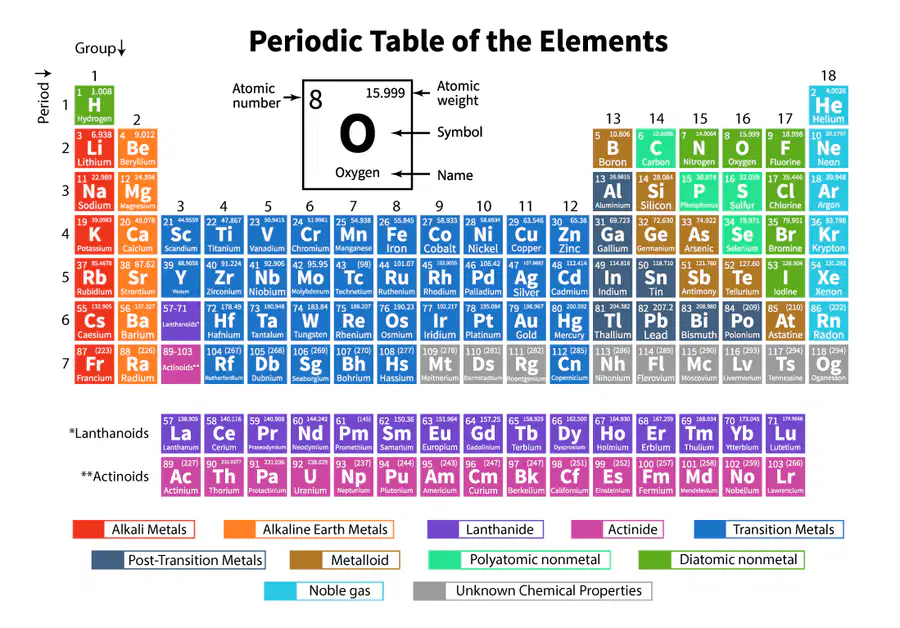
The Periodic table of elements is a systematic arrangement of 118 known chemical elements. These chemical elements are organized in order of increasing atomic number. The horizontal rows from left to right are called periods, while the vertical columns from top to bottom are called groups in a periodic table.
Periodic Table of Elements
17
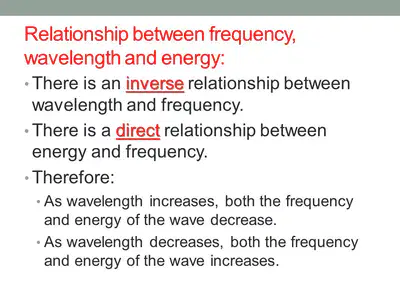
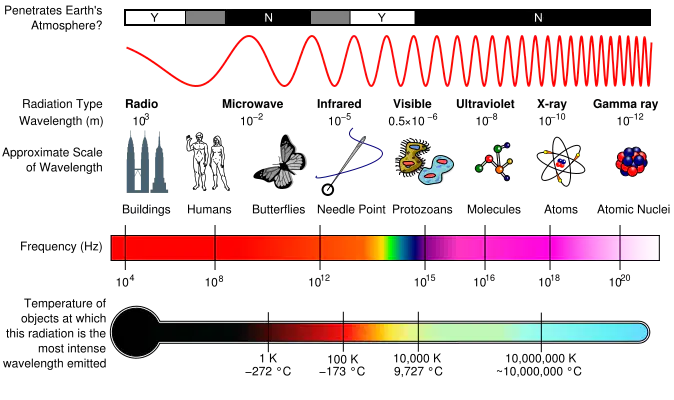
Energy, Frequency and Wavelength - Relationship
18

High energy waves such as X-rays and gamma rays are transmitted through body tissues with very little absorption. This makes them ideal for internal imaging. X-rays are absorbed by dense structures like bones, which is why X-ray photos are used to help identify broken bones.
X-ray imaging is also used for scanning the internal structure of objects and in airport security scanners.
X-Rays
19
Ohm's Law
Ohm's Law is a formula used to calculate the relationship between voltage, current and resistance in an electrical circuit.
To students of electronics, Ohm's Law (E = IR) is as fundamentally important as Einstein's Relativity equation (E = mc²) is to physicists.
E = I x R
When spelled out, it means voltage = current x resistance, or volts = amps x ohms, or V = A x Ω.
What is the voltage in the circuit?
E = I x R = (5A)(8Ω) = 40 V
When Ohm published his formula in 1827, his key finding was that the amount of electric current flowing through a conductor is directly proportional to the voltage imposed on it. In other words, one volt of pressure is required to push one amp of current through one ohm of resistance.
20
The basic sciences of circuits
Circuits, like all matter, are made of atoms. Atoms consist of subatomic particles:
Protons (with a positive electrical charge)
Neutrons (no charge)
Electrons (negatively charged)
Atoms remain bound together by forces of attraction between an atom's nucleus and electrons in its outer shell. When influenced by voltage, atoms in a circuit begin to reform and their components exert a potential of attraction known as a potential difference. Mutually attracted, loose electrons move toward protons, creating a flow of electrons (current). Any material in the circuit that restricts this flow is considered resistance.
21
What is pitch?
Pitch is a perceptual property of sounds that allows their ordering on a frequency-related scale, or more commonly, pitch is the quality that makes it possible to judge sounds as "higher" and "lower" in the sense associated with musical melodies.
Pitch can be taken as the measure of sound frequency, expressed in terms of Hertz.
Higher the frequency, higher the pitch. All kinds of sound produce some waves that are measured with respect to the frequency it carries. Pitch can also be expressed as the position of a musical note in a musical scale. So note in the lower side is a low pitch sound and vice versa.
22
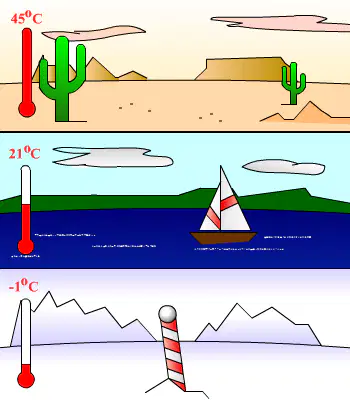
Temperature is also a condition that affects the speed of sound. Heat, like sound, is a form of kinetic energy. Molecules at higher temperatures have more energy, thus they can vibrate faster. Since the molecules vibrate faster, soundwaves can travel more quickly. The speed of sound in room temperature air is 346 meters per second. This is faster than 331 meters per second, which is the speed of sound in air at freezing temperatures.
How does temperature affect the speed of sound?
23
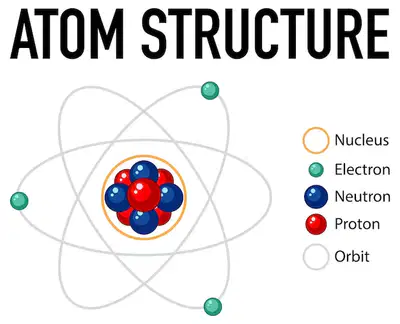
An atom is the smallest unit of matter that retains all the chemical properties of an element.
An atom consists of two regions. The first is the tiny atomic nucleus, which is in the center of the atom and contains positively charged particles called protons and neutral, uncharged, particles called neutrons. The second, much larger, region of the atom is a “cloud” of electrons, negatively charged particles that orbit around the nucleus. The attraction between the positively charged protons and negatively charged electrons holds the atom together. Most atoms contain all three of these types of subatomic particles—protons, electrons, and neutrons. Hydrogen (H) is an exception because it typically has one proton and one electron, but no neutrons. The number of protons in the nucleus determines which element an atom is, while the number of electrons surrounding the nucleus determines which kind of reactions the atom will undergo.
What is the smallest unit of matter that retains all of its properties?
24
25
Pure Substance vrs Mixture
In chemistry:
a pure substance consists only of one element or one compound
a mixture consists of two or more different substances, not chemically joined together
26
What is faster: light or sound?
The speed of light as it travels through air and space is much faster than that of sound; it travels at 300 million meters per second or 273,400 miles per hour. Visible light can also travel through other things besides through air and through space. Visible light can also travel through certain types of glass, plastics, water, and other materials. Because of the physical differences in the makeup of the materials, light actually travels slower through water and glass.
Light waves travel much faster than sound waves. Light waves do not need a medium in which to travel, but sound waves do.
27
Science Study Guide
by Mrs Alexandra Jimenez
Show answer
Auto Play
Slide 1 / 27
SLIDE
Similar Resources on Wayground

20 questions
Layers of the earth Lesson
Presentation
•
6th Grade
20 questions
Thermal Energy and Heat Transfer
Presentation
•
6th Grade
20 questions
Review: Air Masses
Presentation
•
6th Grade
22 questions
Graphing motion and speed calculations
Presentation
•
6th Grade
22 questions
Winds: Local and Global
Presentation
•
6th Grade
22 questions
The Atmosphere
Presentation
•
6th Grade
22 questions
Weathering Erosion & Deposition
Presentation
•
6th Grade
19 questions
Cycles in Nature
Presentation
•
6th Grade
Popular Resources on Wayground
24 questions
PBIS-HGMS Day 10

Quiz
•
6th - 8th Grade
10 questions
HCS SCI 03 Summer School Review 3
Quiz
•
3rd Grade
11 questions
Home Scope
Quiz
•
7th - 8th Grade
15 questions
HCS SCI 05 Summer School Assessment 3 Review
Quiz
•
5th Grade
35 questions
Lufkin Road Middle School Student Handbook & Policies Assessment
Quiz
•
7th Grade
18 questions
Geo 11.3 Area of Circles and Sectors
Quiz
•
9th - 11th Grade