

1.1.6 Greetings and Goodbyes

Presentation
•
World Languages
•
12th Grade
•
Easy

Putu Lestari
Used 4+ times
FREE Resource
10 Slides • 4 Questions
1

exchange basic greetings with peers
say goodbye
express basic courtesy
Lesson Overview
2
3
Basic Japanese Greetings

While listening to the audio, shadow the Japanese pronunciation of each greeting word.
4
Labeling
Listen to the audio.
What greetings are being used in ①–④?
① ichi, ② ni, ③ san, ④ yon
こんにちわ konnichiwa
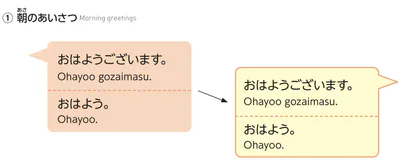
おはようございます ohayou gozaimasu
こんばんは konbanwa
おはよう ohayou
5
Basic Japanese Greetings



6
7
Draw

What goodbyes are being used in ①–④?
Match the goodbyes given in A–G with ア–コ.
Listen to the voice carefully.
A : じゃあ、また。Jya, mata.
B : おやすみ。Oyasumi.
C : おやすみなさい。Oyasuminasai.
D : しつれいします。Shitsureishimasu.
E : おさきにしつれいします。Osaki ni shitsureishimasu.
F : おつかれさま。Otsukaresama.
G : おつかれさまでした。Otsukaresama deshita.
8
Japanese Goodbyes

Saying goodbye when you are leaving
ア、イ、ウ、ク:じゃあ、また。Jyaa, mata.
エ:しつれいします。Shitsureishimasu.
Saying goodbye at night
ケ:おやすみ。Oyasumi.
コ:おやすみなさい。Oyasuminasai.
Saying goodbye at work
オ:おさきにしつれいします。Osaki ni shitsureishimasu.
キ:おつかれさま。Otsukaresama.
カ:おつかれさまでした。Otsukaresama deshita.
we will review this on tommorow's lesson
9
じゃあ、また Jyaa, mata. / またね Mata ne (more casual and formal than じゃあ、また Jyaa ,mata)
Translation: "See you later."
Explanation: This is a casual way of saying goodbye, similar to "See you" or "Later" in English. It is often used among friends or peers.
しつれいします Shitsureishimasu.
Translation: "Excuse me." or "I'm leaving (now)."
Explanation: This phrase is used to politely excuse oneself, often when entering or leaving a room, interrupting someone, or when leaving work for the day.
おつかれさま Otsukaresama.
Translation: "Good job." or "Thank you for your hard work."
Explanation: This is used to acknowledge someone's effort and hard work. It can be said at the end of the day or after completing a task.
おつかれさまでした Otsukaresama deshita.
Translation: "Thank you for your hard work (past tense)."
Explanation: This is a slightly more formal way to express appreciation for someone's hard work, often used at the end of the workday or after a project is completed. The past tense "deshita" indicates the action is finished.
おやすみ Oyasumi (Casual) / おやすみなさい Oyasuminasai (Polite)
Translation: "Good night."
Explanation: "おやすみなさい" (oyasumi nasai) and "おやすみ" (oyasumi) are primarily used to say "good night" before going to bed. However, they can also be used in other situations where someone is leaving to rest or sleep, such as: Nap time or when someone is going to rest because they are unwell or tired. These greetings are specifically associated with resting or ending the day.
さようなら Sayounara
Translation: "Goodbye" or "Farewell"
Explanation: It's used in formal situations when you are parting ways for a longer period or when you may not see the person again for a while. In everyday casual conversations, "さようなら" is less commonly used. Instead, people prefer more casual and less formal expressions like "またね" (mata ne) or "じゃあ、また" (jaa, mata).
we will review this on tommorow's lesson
10
Expressions of Courtesy
11
Basic Expressions of Courtesty
どうぞ Douzo
"Douzo" (どうぞ) is a versatile Japanese word that can convey several meanings depending on the context.
Offering something politely: It's used to politely offer something to someone. For example, when giving someone a gift or offering a seat, you might say "Douzo" to indicate that they should take it.
Inviting someone to go ahead or do something: It's used to invite someone to go ahead or take an action. For instance, when someone is hesitating to enter a room, you might say "Douzo" to invite them in.


ありがとうございます Arigatou gozaimasu / ありがとう Arigatou
"ありがとうございます" and "ありがとう" are both expressions of gratitude in Japanese:
ありがとうございます: Formal "thank you" used in polite or formal situations.
ありがとう: Informal "thank you" used with friends, family, or in casual settings.
12

どうぞ Douzo and ありがとう Arigatou
Let's watch these video to see the different ways of using "どうぞ douzo"
NOTE:
To respond to someone thanking you, you can say:
どういたしまして Douitashimashite
You're welcome
13
Labeling
Based on the image, please place these words in the correct positions to create a short conversation.
ありがとうございます Arigatou gozaimasu
どうぞ Douzo
14
Poll
Choose the option that best reflects your thoughts about today's lesson!
"Loved it! I’m excited to use Japanese with my family!" 🎉
"It was okay, but I need a bit more practice." 🤔
Great lesson! My sentences are looking good!" 👍
"I’m confused. Can we review it again?" 🔄
exchange basic greetings with peers
say goodbye
express basic courtesy
Lesson Overview
Show answer
Auto Play
Slide 1 / 14
SLIDE
Similar Resources on Wayground

14 questions
1.1.10 Meeting New Friends
Presentation
•
12th Grade
13 questions
「IDN」 Lesson Elementary Unit 1 私と家族
Presentation
•
University
11 questions
てしまいました(失敗・残念)
Presentation
•
University
9 questions
Treasure Hunt, Unit 14
Presentation
•
12th Grade
17 questions
¡Aprendamos japonés!
Presentation
•
KG
10 questions
2.1.7 Everywhere We Go
Presentation
•
12th Grade
13 questions
1.2.5 What Do You Like to Do?
Presentation
•
12th Grade
9 questions
Capitolo 16
Presentation
•
University
Popular Resources on Wayground
10 questions
Safety Day 2026 – Student Review

Quiz
•
9th Grade
21 questions
Continents and Oceans
Quiz
•
6th Grade
20 questions
Parts of Speech
Quiz
•
5th Grade
16 questions
Subject & Predicate
Quiz
•
5th Grade
25 questions
Multiplication Facts
Quiz
•
5th Grade
12 questions
Map Skills
Quiz
•
3rd Grade
22 questions
Continents and Oceans
Quiz
•
5th Grade
15 questions
Rounding Decimals
Quiz
•
5th Grade
Discover more resources for World Languages
21 questions
Los paises hispanohablantes y sus capitales
Quiz
•
12th Grade
10 questions
Spanish Greetings and Goodbyes!
Presentation
•
6th Grade - University
25 questions
Preterito regular
Quiz
•
10th - 12th Grade
28 questions
Ser vs estar
Quiz
•
9th - 12th Grade
18 questions
Subject Pronouns in Spanish
Quiz
•
9th - 12th Grade
20 questions
Preterite vs Imperfect usage
Quiz
•
9th - 12th Grade
16 questions
Subject pronouns in Spanish
Quiz
•
9th - 12th Grade
20 questions
Los pronombres personales
Quiz
•
8th - 12th Grade