

Microscope class notes

Presentation
•
Science
•
9th - 12th Grade
•
Easy
+4
Standards-aligned

Aguado Angelica
Used 12+ times
FREE Resource
9 Slides • 1 Question
1
2

A microscope is an instrument that is used to magnify small objects.
examples:
Bacterial stains
parasites
Plant organelles
What is a microscope?
3
Typically, a compound microscope is used for viewing samples at high magnification (40 - 1000x), which is achieved by the combined effect of two sets of lenses: the ocular lens (in the eyepiece) and the objective lenses (close to the sample).

4
Compound Light Microscope
Uses a series of lenses to magnify images
Use stains and dyes to see cells better
Electron Microscope
Create an image with a beam of electrons
Transmission Electron Microscope
Scanning Electron Microscope
Scanning Tunneling Microscope

5
Ocular Lens
Stage
Objective Lenses
Diaphragm
Coarse Adjustment Knob
Fine Adjustment Knob
Light

6
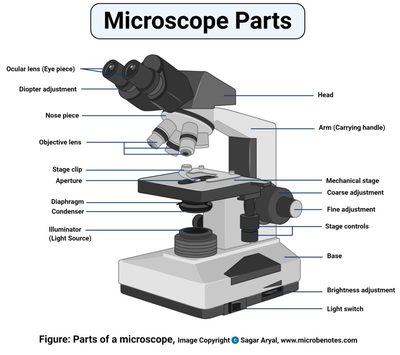
Objective Lens = Lens closest to the specimen; directs light to the ocular.
Ocular = Eyepiece; Lens in eye piece
Revolving Nosepiece = Holds the objective lenses; allows for adjustment of objective lenses to higher or lower magnification.
7
4. Stage = holds the specimen to be viewed
5. Stage Clips = keeps the microscope slide in place
6. Diaphragm = adjusts the amount of light that passes through the specimen
7. Light source = source of light on the microscope
8. Arm = holds the ocular and revolving nosepiece; carry using the arm
8
9. Coarse Adjustment knob = allows for focus of the specimen at low magnification; only use on low magnification
10. Fine adjustment knob = used to focus specimen at high magnification
11. Base = the bottom of the microscope; put one hand under the base to carry
9
Labeling
Label all the parts of the microscope
Diaphragm
Light
Objective Lens
Coarse Focus Knob
Rotating Nosepiece
Fine Focus Knob
base
Eye Piece
Arm
Stage
10
Start with lowest power objective lens (eg. 4x)
Look through the eyepiece and move the coarse adjustment knob until the image comes into focus.
Move the microscope slide around until the sample is in the center of the field of view (what you see).
Use the fine adjustment knob to focus with the clearest image
Show answer
Auto Play
Slide 1 / 10
SLIDE
Similar Resources on Wayground

7 questions
Learn OC.8a Vocabulary
Presentation
•
9th - 12th Grade
7 questions
Cloud Formation
Presentation
•
9th - 12th Grade
11 questions
Voltage, current & resistance
Presentation
•
9th - 12th Grade
6 questions
Life Cycle of the Stars
Presentation
•
9th - 12th Grade
8 questions
USING OF SOUND
Presentation
•
9th - 12th Grade
7 questions
PLC (10/16)
Presentation
•
9th - 12th Grade
6 questions
Human Impact Reinforcement
Presentation
•
9th - 12th Grade
7 questions
Hydrologic Cycle
Presentation
•
9th - 12th Grade
Popular Resources on Wayground
10 questions
Safety Day 2026 – Student Review

Quiz
•
9th Grade
21 questions
Continents and Oceans
Quiz
•
6th Grade
20 questions
Parts of Speech
Quiz
•
5th Grade
16 questions
Subject & Predicate
Quiz
•
5th Grade
25 questions
Multiplication Facts
Quiz
•
5th Grade
12 questions
Map Skills
Quiz
•
3rd Grade
22 questions
Continents and Oceans
Quiz
•
5th Grade
15 questions
Rounding Decimals
Quiz
•
5th Grade
Discover more resources for Science
10 questions
Exploring Chemical and Physical Changes

Interactive video
•
6th - 10th Grade
20 questions
Atomic Structure
Quiz
•
9th Grade
10 questions
Exploring the Electromagnetic Spectrum for Middle School Science
Interactive video
•
6th - 10th Grade
10 questions
Exploring Force and Motion Concepts
Interactive video
•
6th - 10th Grade
10 questions
Exploring Air Masses and Weather Fronts
Interactive video
•
6th - 10th Grade
14 questions
Periodic Trends
Interactive video
•
11th Grade
10 questions
Exploring the States of Matter
Interactive video
•
6th - 10th Grade
10 questions
Exploring Forces: Net Force, Normal Force, Gravity, and Friction
Interactive video
•
6th - 10th Grade