

Originis of the UNiverse

Presentation
•
Science
•
9th - 12th Grade
•
Practice Problem
•
Easy
+13
Standards-aligned

Joseph Mallin
Used 11+ times
FREE Resource
15 Slides • 12 Questions
1
The Big Bang Theory

2
Open Ended
What do you know about the origins of the universe?
3
Lesson Objectives:
Recognize that the universe is expanding.
Identify a model that illustrates the Big Bang theory.
Create a model that shows how the universe is expanding.

4
All existing matter and space considered as a whole; the cosmos. The universe is believed to be at least 10 billion light years in diameter and contains a vast number of galaxies; it has been expanding since its creation in the Big Bang about 13 billion years ago.

5
The Big Bang Theory is how astronomers explain the way the universe began. It is the idea that the universe began as just a single point, then expanded and stretched to grow as large as it is right now—and it is still stretching!

6
Scientists believe that before the Big Bang space and time didn't exist and all that existed was energy
The Big Bang occurred when all of this energy was concentrated into a single point called 'singlularity'
Space began to expand quickly and the temperature was hot (an estimated 100 million trillion trillion degrees!)

7
When the universe began, it was just hot, tiny particles mixed with light and energy. It was nothing like what we see now
As everything expanded and took up more space, it cooled down.

8
The first stars created bigger atoms and groups of atoms. That led to more stars being born.
At the same time, galaxies were crashing and grouping together.
As new stars were being born and dying, then things like asteroids, comets, planets, and black holes formed!

9
Multiple Choice
The Big Bang Theory is the most widely accepted theory about the origin of the universe.
true
false
10
Multiple Choice
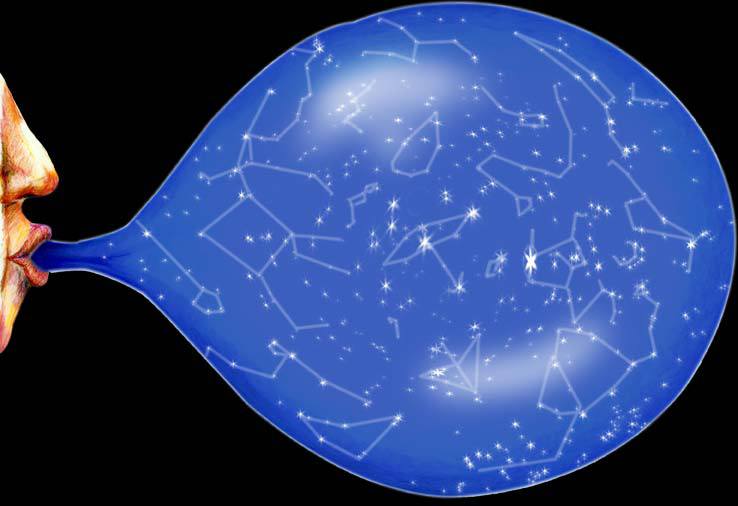
11
The universe is still expanding
If things were moving apart, it meant that long ago, everything had been close together
Everything we can see in our universe today—stars, planets, comets, asteroids—they weren't there at the beginning.

12

13

14
Multiple Choice
How does red-shift support the Big Bang theory?
15
Multiple Choice
Which statement is true?
The galaxies are moving toward us.
The galaxies are moving away from us.
The universe remains static or unchanged in motion.
None of the above
16

17
Open Ended
How is looking into the sky like staring into the past?
18

19
Multiple Choice
How long is an astronomical unit?
9.5 trillion kilometers
85 billion miles
93 million miles
93 billion miles
20

21
Fill in the Blanks
Edwin Hubble found evidence that galaxies were moving
Type answer...
22
Multiple Choice
How old is the universe?
13.7 million years old
13.7 billion years old
9.5 million years old
93 billion years old
23
Big Bang Theory suggests that the universe was a very hot place and that as it expands, the gas within it cools
As the universe began to cool, radiation began to fill the universe as a remnant of the heat left over - this is called 'Cosmic Microwave Background'
The cosmic microwave radiation is like an 'afterglow' of radiation

24
Evidence: Cosmic Background Radiation

25
Multiple Choice
26
Open Ended
What is a model you could use to show the big bang?
27
Open Ended
Describe the universe.
The Big Bang Theory
Show answer
Auto Play
Slide 1 / 27
SLIDE
Similar Resources on Wayground

20 questions
Forces Mastery Lesson 8.9A
Presentation
•
KG - University
21 questions
Dimensional Analysis
Presentation
•
10th - 12th Grade
21 questions
Periodic Trends
Presentation
•
9th - 12th Grade
24 questions
Cell Cycle: Checkpoints and Cancer
Presentation
•
9th - 12th Grade
21 questions
Climate Part 1: Spheres of the Earth
Presentation
•
9th - 12th Grade
19 questions
Ionic Compounds
Presentation
•
9th - 12th Grade
23 questions
Forensics: Observation
Presentation
•
9th - 12th Grade
23 questions
Plastic Pollution Awareness
Presentation
•
KG - 12th Grade
Popular Resources on Wayground
10 questions
Safety Day 2026 – Student Review

Quiz
•
9th Grade
21 questions
Continents and Oceans
Quiz
•
6th Grade
20 questions
Parts of Speech
Quiz
•
5th Grade
16 questions
Subject & Predicate
Quiz
•
5th Grade
25 questions
Multiplication Facts
Quiz
•
5th Grade
12 questions
Map Skills
Quiz
•
3rd Grade
22 questions
Continents and Oceans
Quiz
•
5th Grade
15 questions
Rounding Decimals
Quiz
•
5th Grade
Discover more resources for Science
10 questions
Exploring Chemical and Physical Changes

Interactive video
•
6th - 10th Grade
20 questions
Atomic Structure
Quiz
•
9th Grade
10 questions
Exploring the Electromagnetic Spectrum for Middle School Science
Interactive video
•
6th - 10th Grade
10 questions
Exploring Force and Motion Concepts
Interactive video
•
6th - 10th Grade
10 questions
Exploring Air Masses and Weather Fronts
Interactive video
•
6th - 10th Grade
14 questions
Periodic Trends
Interactive video
•
11th Grade
10 questions
Exploring the States of Matter
Interactive video
•
6th - 10th Grade
10 questions
Exploring Forces: Net Force, Normal Force, Gravity, and Friction
Interactive video
•
6th - 10th Grade