

How to use table G

Presentation
•
Chemistry
•
12th Grade
•
Practice Problem
•
Medium
Standards-aligned

NAUDIA LAWRENCE
Used 4+ times
FREE Resource
27 Slides • 10 Questions
1

2

The ability of a Solute to dissolve in a Solvent
Solubility
3

Title: Solubility Curves at Standard Pressure
Table G -
Reference Tables
4
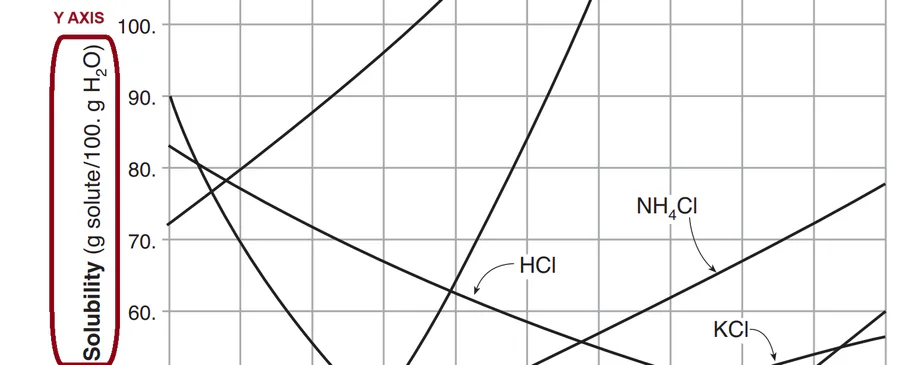
Solubility is the amount of solute dissolve in a specific amount of solvent
SOLUBILITY
(g of solute/100g H2O)
5
Solubility is dependent on TEMPERATURE. Changing the temperature changes the amount od solute that will dissolve
Temperature
( OC )

6

you used
2,4, 6 and 8 g /5g H20 on the y axis with temperature on the X Axisand got the followin g curve
Lab
Solubility and temperature
7
Shows the solubility of many differnt substances in 100g of water and how their solubility changes with temperature 1O to 100O C.
Table G -
Reference Tables
8
Can you find the Solubility Curve for KNO3 on Table G?
Table G -
Reference Tables
9
10
Most of the substances on this table are Solids.
Table G -
Reference Tables
11
Solids have a positive slope (lines that go up.) on a solubility Graph.
Table G -
Reference Tables
12

Particles move faster (have more kinetic energy) as temperature increases.
So, particles collide more often and dissolving happens faster.
HOT
COLD
13
Gases have a Negative slope (lines that go downwards) on a solubility Graph.
Table G -
Reference Tables
14

In a Hot environment gas particles are quick to escape the can.
In a colder environment gas particles move slowly and will stay in solution longer.
HOT
COLD

15
Multiple Choice

How many Gases are found on Table G
7
10
4
3
16
Multiple Choice
Based on the slope of the KCl line, this substance is a
Gas
Liquid
solid
17
Multiple Choice
Based on the slope of the HCl line, this substance is a
Gas
Liquid
solid
18
Multiple Choice
Based on the slope of the NaCl line, this substance is a
Gas
Liquid
solid
19

How to determine the solubility of a substance at a given temperature.
20
How many grams of KClO3 will dissolve in 100 grams of water at 50 OC


21
How many grams of KCl will dissolve in 100 grams of water at 10 OC
22
How many grams of NaCl will dissolve in 50 grams of water at 90 OC
23
How many grams of NaCl will dissolve in 200 grams of water at 90 OC
24
Multiple Choice

How many grams of SO2 can dissolve in 100g H2O at 50 ⁰C?
5g
20g
10
39g
25
How many grams of SO2 will dissolve in 100 grams of water at 50 OC
26
Multiple Choice
How many grams of KClO3 can dissolve in 50g H2O at 30 ⁰C?
12g
6g
24g
30g
27
Solubility is refered to in three terms
Unsaturated
Saturated and
Supersaturated
28

Video Vocabulary
Carefully read the video guide questions
Look for the answers to these questions a sthe video plays
Enter your answers into quizizz on the upcoming slides
29
Qiestions
1. How is a supersaturated solution made?
2. Which of the following is NOT true regarding solubility curves?
3. How is solubility determined?
4. Which of the following statements best describes a supersaturated solution?
30
31
Qiestions
1. How is a supersaturated solution made?
2. Which of the following is NOT true regarding solubility curves?
3. How is solubility determined?
4. Which of the following statements best describes a supersaturated solution?
32
Multiple Choice
How is a supersaturated solution made?
By making a saturated solution, heating it up and adding more solvent, then cooling the solution.
By making a saturated solution, heating it up and adding more solute, then cooling the solution.
By making a saturated solution and then heating it up.
By making an unsaturated solution, then cooling it down.
33
Multiple Choice
Which of the following is NOT true regarding solubility curves?
The solid line represents saturated solutions.
The solubility of all substances increase with temperature
Every substance has its own curve.
Solubility is plotted against temperature.
34
Multiple Choice
How is solubility determined?
By determining the mass of a solute in 100g of a solvent.
By determining the maximum mass of a solute that can be dissolved in 100g of a solvent at a given
temperature.
By determining the maximum mass of a solute that can be dissolved in 100g of a solvent at any
temperature.
By determining the maximum mass of a solvent that can be dissolved in 100g of a solute at a given
temperature.
35
Multiple Choice
Which of the following statements best describes a supersaturated solution?
A solution that contains more than the maximum amount of dissolved solute than a saturated solution
under the same conditions.
A solution that contains the maximum amount of a dissolved solute under different conditions.
A solution that contains less than the maximum amount of dissolved solute.
A solution that contains the maximum amount of dissolved solute.
36
How to determine solubilty from a solubility curve
37

On the curve - solution is saturated
Under the curve - solution is unsaturated
Above the curve - Solution is supersaturated
Finding types of solutions on the graph
Show answer
Auto Play
Slide 1 / 37
SLIDE
Similar Resources on Wayground

31 questions
Fingerprints
Presentation
•
12th Grade
29 questions
Writing Chemical Equations from Word Equations
Presentation
•
12th Grade
33 questions
Estrategias de comprensión lectora
Presentation
•
KG
28 questions
Solubility Rules
Presentation
•
11th - 12th Grade
35 questions
Chap 5: Electronic Configuration
Presentation
•
12th Grade
29 questions
Atomic Theory History
Presentation
•
12th Grade
25 questions
Nuclear Chemistry Review
Presentation
•
12th Grade
34 questions
8.3 Survey of the Solar System
Presentation
•
12th Grade
Popular Resources on Wayground
10 questions
Safety Day 2026 – Student Review

Quiz
•
9th Grade
21 questions
Continents and Oceans
Quiz
•
6th Grade
20 questions
Parts of Speech
Quiz
•
5th Grade
16 questions
Subject & Predicate
Quiz
•
5th Grade
25 questions
Multiplication Facts
Quiz
•
5th Grade
12 questions
Map Skills
Quiz
•
3rd Grade
22 questions
Continents and Oceans
Quiz
•
5th Grade
15 questions
Rounding Decimals
Quiz
•
5th Grade
Discover more resources for Chemistry
20 questions
electron configurations and orbital notation
Quiz
•
9th - 12th Grade
20 questions
Physical or Chemical Change/Phases
Quiz
•
8th Grade - University
15 questions
Periodicity Module Exam Practice Quiz
Quiz
•
9th - 12th Grade
8 questions
Label Energy Diagram
Quiz
•
9th - 12th Grade
10 questions
Endothermic/Exothermic
Quiz
•
9th - 12th Grade
6 questions
Energy Change
Quiz
•
9th - 12th Grade
20 questions
Physical & Chemical Properties & Changes
Quiz
•
9th - 12th Grade
6 questions
Collision Theory
Quiz
•
9th - 12th Grade