

Double Object Pronouns

Presentation
•
World Languages
•
10th Grade
•
Practice Problem
•
Hard

Ina Shengjergji
FREE Resource
9 Slides • 0 Questions
1

7A.3-1
Punto di partenza
You learned how to use direct object pronouns in
Lezione5A and indirect object pronouns in Lezione5B.
Now you will learn how to use these pronouns together.
Compro il vaso per voi.
I’m buying the vase for you.
Ve lo compro.
I’m buying itfor you.
DIRECT
OBJECT
INDIRECT
OBJECT
INDIRECT
OBJECT
PRONOUN
DIRECT
OBJECT
PRONOUN
© 2016 by Vista Higher Learning, Inc. All rights reserved.
2
7A.3-2
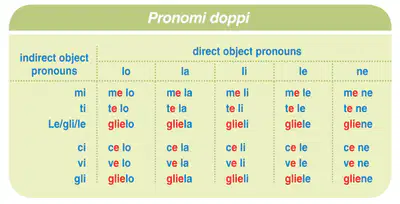
• To use both pronouns in one sentence, place the
indirect object pronoun first, followed by the direct
object pronoun. Note that the -i in mi, ti, ci, and vi
changes to an -e when these pronouns are used in
combination with another pronoun. Le, gli, and le all
combine with the direct object pronouns to form a single
word beginning with glie-.
© 2016 by Vista Higher Learning, Inc. All rights reserved.
3

7A.3-3
Domenico ti porta una lampada.
Perché te la porta?
Domenico is bringing you a lamp.
Why is he bringing it to you?
Leo mi deve pagare l’affi tto.
Non me lo paga mai in tempo!
Leo needs to pay me the rent. He
never pays it to me on time!
© 2016 by Vista Higher Learning, Inc. All rights reserved.
4
7A.3-4
• Use context to clarify to whom the indirect object refers.
Maria manda i soldi al figlio.
Glieli manda domani.
Maria is sending money to her son.
She'll send it to him tomorrow.
Il figlio comprerà un tappeto per
lei. Glielo comprerà presto.
Her son is going to buy her a rug.
He’ll buy it for her soon.
Ecco il gelato peri bambini.
Glielo puoi dare in cucina?
Here’s the ice cream for the
kids. Can you give it to them in
the kitchen?
Professore, non Le posso dare i
compiti. Glieli darò domani.
Professor, I can’t give you my
homework. I’ll give it to
you tomorrow.
© 2016 by Vista Higher Learning, Inc. All rights reserved.
5

7A.3-5
Ti porto i biscotti in soggiorno.
Te ne porto due o tre?
I’ll bring you the cookies in the
living room. Should I bring you
two or three of them?
Leo non mi vuole dare l’affitto.
Deve darmelo! (Melo deve dare!)
Leo doesn’t want to give me the rent.
He has to give it to me!
• Like single object pronouns, double object pronouns
precede conjugated verbs or are attached to
infinitives. When pronouns are attached to the end
of a verb, they form a single word.
© 2016 by Vista Higher Learning, Inc. All rights reserved.
6

7A.3-6
Ecco il caffè. Non vuole portarloloro Luisa? Lo lascerò loro in cucina.
Here is the coffee. Luisa doesn’t want to bring it to them? I’ll leave it for them
in the kitchen.
• The indirect object pronoun loro can also be used in
double pronoun constructions, but it follows different
rules. Always place loro after the verb and never
attach it to other pronouns. With conjugated verbs,
loro follows the verb and the direct object pronoun
precedes the verb.
© 2016 by Vista Higher Learning, Inc. All rights reserved.
7
7A.3-7
Lia si rade le gambe ogni giorno.
Se le rade in bagno.
Lia shaves her legs every day. She
shaves them in the bathroom.
Mi lavo i capelli adesso. Non
voglio lavarmeli stasera.
I’m washing my hair now. I don’t
want to wash it tonight.
• Reflexive pronouns follow the pattern of indirect
object pronouns when used in double pronoun
constructions. The reflexive pronoun si changes to
se when adding a direct object pronoun.
© 2016 by Vista Higher Learning, Inc. All rights reserved.
8
7A.3-8
Ho dato quella poltrona ad Anna.
Gliel’ho data ieri.
I gave that armchair to Anna. I gave
it to her yesterday.
Non si è lavata i capelli oggi.
Se li è lavati ieri.
She didn’t wash her hair today.
She washed it yesterday.
• Remember that when direct object pronouns are
used in the passato prossimo, the past participle
must agree with the direct object.
Double object pronouns ending in -lo
or -la are shortened before a vowel sound.
© 2016 by Vista Higher Learning, Inc. All rights reserved.
9

7A.3-9
Quanti studenti ci sono?
How many students are there?
Cene sono trenta.
There are thirty of them.
• When the adverb ci (there) is used in combination
with ne, it becomes ce and precedes ne.
© 2016 by Vista Higher Learning, Inc. All rights reserved.
7A.3-1
Punto di partenza
You learned how to use direct object pronouns in
Lezione5A and indirect object pronouns in Lezione5B.
Now you will learn how to use these pronouns together.
Compro il vaso per voi.
I’m buying the vase for you.
Ve lo compro.
I’m buying itfor you.
DIRECT
OBJECT
INDIRECT
OBJECT
INDIRECT
OBJECT
PRONOUN
DIRECT
OBJECT
PRONOUN
© 2016 by Vista Higher Learning, Inc. All rights reserved.
Show answer
Auto Play
Slide 1 / 9
SLIDE
Similar Resources on Wayground

6 questions
Articles
Presentation
•
10th Grade
6 questions
Reported
Presentation
•
10th Grade
6 questions
error Analysis
Presentation
•
10th Grade
7 questions
Weight and Capacity
Presentation
•
KG
7 questions
Descriptive - Comparison
Presentation
•
10th Grade
8 questions
REFLEXIVE AND INTENSIVE PRONOUNS
Presentation
•
10th Grade
8 questions
Grammar: Lesson 3.20
Presentation
•
10th Grade
6 questions
Trilogy 1 Unit 1 Talking About French Lesson
Presentation
•
9th Grade
Popular Resources on Wayground
24 questions
PBIS-HGMS Day 10

Quiz
•
6th - 8th Grade
10 questions
HCS SCI 03 Summer School Review 3
Quiz
•
3rd Grade
11 questions
Home Scope
Quiz
•
7th - 8th Grade
15 questions
HCS SCI 05 Summer School Assessment 3 Review
Quiz
•
5th Grade
35 questions
Lufkin Road Middle School Student Handbook & Policies Assessment
Quiz
•
7th Grade
18 questions
Geo 11.3 Area of Circles and Sectors
Quiz
•
9th - 11th Grade