

Chapter 20

Presentation
•
Biology
•
University
•
Practice Problem
•
Easy

Ria Mohan
Used 1+ times
FREE Resource
20 Slides • 10 Questions
1

Chapter 20 (last preceptor session so free snacks!!)
2
Key Terms
Tissues are a collection of cells that work together toward a common function
Extracellular Matrix (ECM): secreted by cells, it's what holds all of the cells together
complex network of polysaccharides & proteins
acts as a structural component of tissues
Cell junction: links cells together, directly touching and linking
3
connective
lots of ecm present
epithelial
nervous
muscular
Animal cells (Tissues)
cell wall
cellulose microfibers give plant tensile strength
synthesized on the surface by cellulose synthase complexes
Plant cells (ECM)
Plants vs Animal Cells
4
Multiple Choice
What is the difference between the extracellular matrix in plant and animal cells?
Plant cells have an extracellular matrix made of cellulose and pectin, while animal cells have an extracellular matrix composed of proteins like collagen
5
Connective Tissue
Found in bone, cartilage, tendons, and skin
There is LOTS of ECM in this tissue, which makes it super tough and strong
All the strength comes from the protein collagen
Collagen is a huge family of proteins and is very good at providing strength
The type of collagen, amount, and other molecules interwoven determine the type of connective tissue
6
Multiple Choice
What is a key characteristic of connective tissue?
7
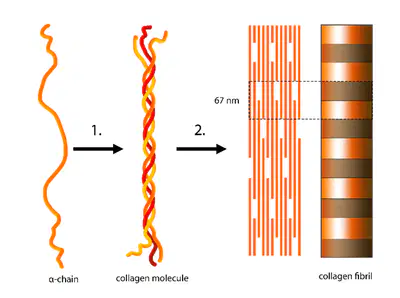
Collagen fibrils
Polypeptide bonds (made of amino acids) are formed
The bundles are super thick and tough
They are VERY large
Ehlers danlos syndrome: lack of the enzyme that converts procollagen to collagen, causing stretchy skin
Defects in collagen breakdown can lead to arthritis or cancer
8
Multiple Choice
What triggers ehlers danlos syndrome?
9
Fibroblasts
A fibroblast is a type of cell that contributes to the formation of connective tissue, a fibrous cellular material that supports and connects other tissues or organs in the body.
Fibroblasts secrete collagen proteins that help maintain the structural framework of tissues.
10
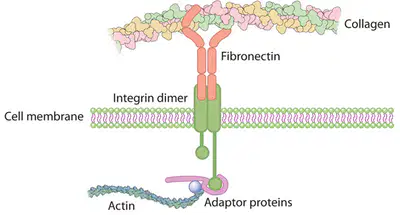
Integrins
Integrins are cell surface receptors
“Grabs” fibronectin to pull and move the cell within the ECM
The connections to the intracellular cytoskeleton stop it from being “ripped out”
Fibronectin: reach out to grab the collagen
Integrin dimers: connect to ECM and help with the movement
Plasma membrane: does not take any weight
Actin filament: this is the part of the cytoskeleton that all of this connects to
11
Multiple Choice
What are integrins?
12
Integrins = signalling molecules
relay messages between ECM and cell
binding causes conformational changes
signals for survival, differentiation, etc.
13
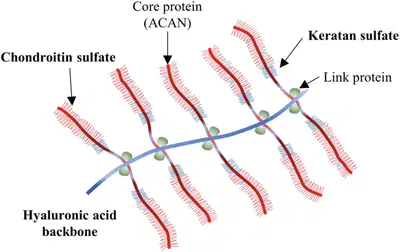
GAGs
Glycosaminoglycans form bottle brush-like structures that are hydrophilic and take up a lot of room
14
Multiple Choice
What kind of structure do glycosaminoglycans have?
Bottle brush structure
15
Epithelia
Cell joined together side-to-side
Stratified- sheet many cells thick(covering the skin)
Simple epithelium- only one cell thick(gut)
Keeps some molecules in and others out
Takes up nutrients and exports waste
Contains receptors for environmental signals, which makes them really good at signaling
Protects the interior of organisms and fluid loss
16
Epithelial cells are polar
Basal lamina: a strong distinct layer of ECM that contains collagen
Laminin binds to epithelial cell integrins allowing communication between the basal lamina and the epithelium
Epithelial cells are polarized
Basal layer: inside, near blood
Apical side: near the air
EX: lungs, the basal side will be on the outside of the lungs near the blood side, and the apical side is on the inside where the air is
17
Multiple Choice
What is laminin?
18
Junctions
Cell-cell junctions
Make the epithelium leakproof and separate apical and basal surfaces
The cells connect to one another
Adherens junctions
Can form a strong continuous “belt” around the epithelium
Cadherin molecule: what allows actin to join
Actin allows contraction, and can form tubes
19
Multiple Choice
What role does a cadherin molecule play?
20
“Hemi”- half
We have half a desmosome (aka one cell)
One cell is stapled to the basal lamina (ECM)
Anchor epithelial to other tissues via integrins
Hemidesmosomes
Connects intermediate filament in one with intermediate filaments in another
Intermediate filaments: thick and solid, super tough
STRONGEST
Cadherin: connects everything
Desmosomes
Desmosomes vs Hemidesmosomes
21
Gap Junctions
Gap junctions
Connexons: form channels across two plasma membranes
Pores through the cell that connects
Linking insides of one cell to the inside of others
Usually happens in the heart
Connexon: what connects everything
The holes don't stay open 24/7, they open and close depending on the cell type
Signaling can change the size and permeability of gap junctions to respond to the environment
Open: cell signaling is happening
Closed: the cells finished signaling
22
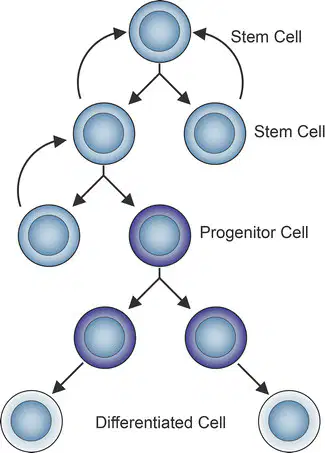
Stem cells
Many cells which need renewing can’t actually divide for themselves as they are “terminally differentiated”
Replacements are generated from a circulating stock of “proliferating precursor cells”
These are derived from small numbers of dividing stem cells
Stem cells can either divide without limits or become differentiated
Adult stem cells have undergone the first layer of differentiation to define progeny type
Not all cells divide, stem cells and precursors are dividing cells (they then turn to specific cell types)
23
Multiple Choice
What are terminally differentiated cells?
24
WNT pathway
Stem cell “status” is maintained by the WNT pathway
In differentiated cells, B-catenin (protein) is degraded before entering the nucleus
When WNT is expressed it triggers a signaling cascade that stops the degradation of B-Catenin which then activates the “stem cell-specific” gene transcription
25
Malignant growth
invade surrounding tissue
metastasis
formation of secondary tumors by entering bloodstream and invading tissues in other parts of the body
26
Multiple Choice
Why is metastasis harmful to our bodies?
27
Cancer cells
reduced dependence on signals from other cells for growth, survival, and division
less likely to undergo apoptosis
due to increased survival factor signaling
p53 mutation
can divide indefinitely (reactivate telomerase to maintain telomere length)
28
Cancer cells cont.
genetically unstable
increased mutation rate
different types of mutations can lead to activation of an oncogene
invasive
angiogenesis
ability to grow its own blood supply
29
Multiple Choice
What is angiogenesis?
30
Cancer treatments
surgery-> cut out tumor
radiotherapy
chemotherapy
block cell growth
gene therapy
program immune cells to attack cancer
Chapter 20 (last preceptor session so free snacks!!)
Show answer
Auto Play
Slide 1 / 30
SLIDE
Similar Resources on Wayground

22 questions
S.M.A.R.T Goals
Presentation
•
University
20 questions
Reproducción
Presentation
•
University
20 questions
Skeletal System
Presentation
•
12th Grade
20 questions
Nutrition in Plants
Presentation
•
12th Grade
25 questions
Science Test Quizzes
Presentation
•
KG
20 questions
Listen for emphatic expression of surprise (Agri B)
Presentation
•
University
25 questions
Domestication
Presentation
•
University - Professi...
20 questions
LESSON 2 NUTRITION _ Fat
Presentation
•
KG - University
Popular Resources on Wayground
10 questions
HCS SCI 03 Summer School Review 4

Quiz
•
3rd Grade
11 questions
HSMS - Standard Response Protocol
Quiz
•
6th - 8th Grade
16 questions
1.1-1.2 Quiz Review
Quiz
•
9th - 12th Grade
12 questions
Exponent Expressions
Quiz
•
6th Grade
20 questions
Adding and Subtracting Integers
Quiz
•
6th - 7th Grade
11 questions
Northeast States
Quiz
•
3rd - 4th Grade
10 questions
Characterization
Quiz
•
3rd - 7th Grade
10 questions
Common Denominators
Quiz
•
5th Grade