

Populations

Presentation
•
Biology
•
7th Grade
•
Medium
+8
Standards-aligned

Stephanie Klug
Used 2+ times
FREE Resource
36 Slides • 41 Questions
1

Example
Group of organisms of the same species.
2
Multiple Choice
An example of a population is...
all trees in a forest
all plants in a forest
all animals in a forest
all maple trees in a forest
3
4
The number of organisms in a population

5
the number of individuals of the same species that live in a given unit of area.

6
Population Dispersion
Pattern of distribution of organisms in a population.

7
Multiple Choice
The density of a population is ___.
the number of individuals born every year
the proportion of males and females
the number of individuals living in cities
the number of individuals per unit area
8

9
Immigration
Moving to live permanently in a foreign country.

10
Emigration
Leaving one's own country to settle permanently in another.

11
Multiple Choice
Which two factors can increase the size of a population?
birth rate and emigration
birth rate and immigration
death rate and emigration
death rate and immigration
12
Multiple Choice
Which of the following would most likely cause a decrease in population size?
emigration and increased birth rate
emigration and increased death rate
immigration and increased death rate
immigration and increased death rate
13

14

15

16
May also be a small "wave"
Follows a period of exponential growth; a J-shaped curve where the population keeps increasing
The line represents population size, so it decreases in response to a limiting factor

17

18

19
Multiple Choice
Carrying capacity is...
The maximum number of individuals that can fit into an area
The greatest # of individuals an area can support over time.
Ability of an area to accommodate a growing population
The maximum number of species that can co-exist in an area
20
Multiple Choice
A population always stays exactly at its carrying capacity.
True
False
21
Multiple Choice

What happens if a population grows past its carrying capacity?
The population keeps growing
The population starts to die off
The entire species will go extinct
The carrying capacity just increases
22
Multiple Choice
Which graph depicts exponential growth in a population?
23
Multiple Choice
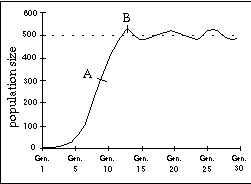
What is the carrying capacity of the graph?
around 500
more than 800
less than 300
around 700
24
Multiple Choice

What point on the graph represents the carrying capacity?
A
B
C
D
25
Multiple Choice

What type of growth is represented behind?
exponential
logistics
a good kind
representative
26
Multiple Choice
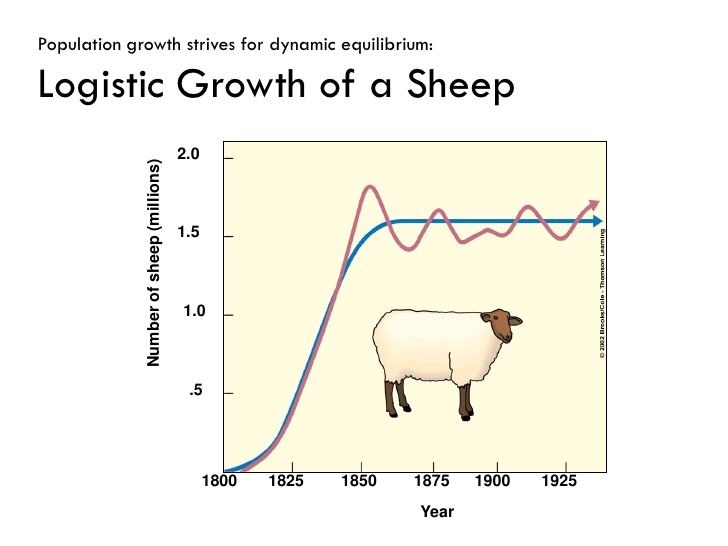
What is the carrying capacity for this sheep population?
1.8 million
1.25 million
1.6 million
1.o million
27
Multiple Choice
Logistic growth has 3 phases. In Phase 1, the population grows rapidly. In Phase 2, population grows slowly. In Phase 3, growth stops. What causes growth to stop in the 3rd phase of logistic growth?
Emigration
Immigration
Exponential Growth
Carrying Capacity
28
Multiple Choice
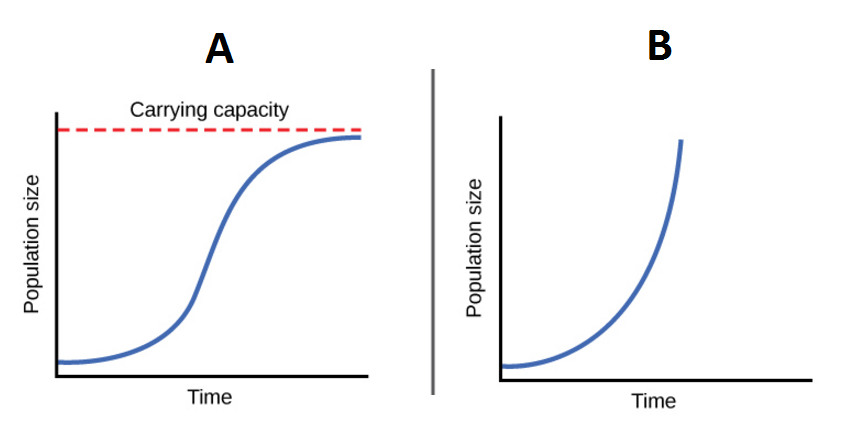
What type of growth model is shown in image A?
Exponential
Logistic
29
Multiple Choice

30
Multiple Choice
Which kind of growth does the human population follow? It is described as a J-shaped curve.
Exponential Growth
Logistic Growth
Outstanding Growth
Minimal Growth
31

32
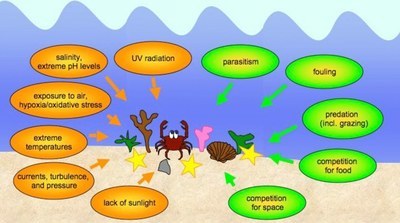
May be a resource, another species, the environment, etc.
Example: food is a limiting factor because you can't have more individuals than food to feed them
33
Include climate, weather, natural disasters, and pollution
Affect all populations the same, whether they are large or small

34
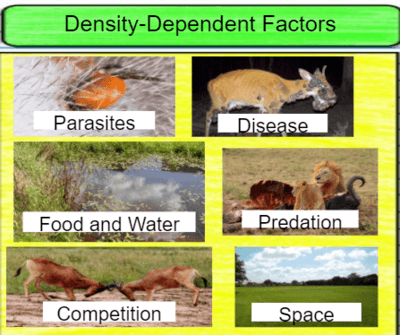
Includes natural resources (food, water, space), diseases, and predators
Tend to have a greater effect on large, dense populations because of increased competition and more opportunity to attract predators and disease
35

36
Multiple Choice
An environmental factor such as storms and extreme heat or cold that decrease a population are considered to be -
density-dependent factor
population density
dispersion
density-independent factor
37
Multiple Choice
This may cause a population to increase
increase of food supply
removal of predators
removal of disease
all of these
38
Multiple Choice

Something that regulates the size of a population is called...
a limiting measure
a limiting factor
carrying capacity
biodiversity
39
Multiple Choice

40
Multiple Select
Which of the following are examples of a density independent factors?
forest fire
seasonal cycles
storms
disease
41
Multiple Select
Which of the following are density dependent factors?
competition for resources
predation
disease
natural disasters
42
Multiple Choice
Any thing or organism that regulates the size of a population of another organism is known as __________.
a limiting measure
a limiting factor
factorization
materialization of precipitation
43

44
Multiple Choice
Can two different species occupy the same habitat and have the same niche?
Yes! Many species do this easily!
Yes, but with accommodations to share resources.
No, this never happens.
45
Fill in the Blanks
If two different species occupy the same habitat and share the same ecological niche,
Type answer...
46

47

48
A keystone species is an organism that helps define an entire ecosystem.
Without its keystone species, the ecosystem would be dramatically different or cease to exist altogether.
The removal of a keystone species REDUCES the BIODIVERSITY of the ecosystem.

49
The keystone species in this habitat is the sea otter.
The sea otter eat urchins and therefore keep the population of sea urchins low. Sea otters also build dams which create wetlands for other organisms to live in.
Without sea otters, sea urchins over populate and eat all of the kelp. Wetlands are destroyed and biodiversity decreases.

50
Multiple Choice

Which of the following parts of a community helps hold the food web together and has a disproportionate impact on ecosystem compared to the number of organisms present?
keystone species
dominant species
foundation species
endangered species
51
Multiple Choice
the variety of life in the world or in a particular habitat or ecosystem
biodiversity
demography
carrying capacity
poaching
52
Multiple Choice
Why are some sharks considered a keystone species?
Because they are a top predator
They scare off smaller fish that may overgraze an area of sea grass
They are tertiary consumers
They are cartilaginous
53
Multiple Choice
Why are bees considered a keystone species?
The honey they make supports the bear population
They pollinate flowers that produce fruit which supports the ecosystem
They sting when threatened
They live in hives
54
Multiple Choice

What is a keystone species?
A species that helps to hold an ecosystem together
A species that lives in or around rocks
Keys and stones have nothing to do with ecology
A keystone isn't a living thing, it's just a stone
55
Multiple Choice
A species form that supports an entire ecosystem.
Keystone Species
Herbivores
Umbrella Species
Predators
56
Invasive species, or a species that causes harm to a new environment.
Invasive species have traits that give them a competitive advantage over native species.
Invasive species can directly (prey on native species) or indirectly (change food webs) impact native species.

57
The zebra mussel was carried to the Great Lakes in the mid-1980s from Eastern Europe in ships.
They have become invasive species whose growth produces huge populations.
They upset aquatic food webs, filtering so much plankton from the water that some native fishes and shellfish starve.

58
Cane Toads are native to Central and South America.
Cane Toads were introduced to Australia and other countries to control insects (beetles) that damaged sugar cane plantations.
The poisonous toads have caused severe damage to local wildlife wherever they were introduced.

59
Multiple Choice
60
Multiple Choice
61
Multiple Choice
When taken to a new habitat, non-native plants often threaten native plants of the new habitat. Why do they do this?
Non-native plants are able to mutate rapidly
Non-native plants cause native animals to relocate
Non-native plants are able to be used for medicine
Non-native plants compete with native plants for resources
62
The variety of plants and animals and other living things in a particular area or region.
Also means the number, or abundance of different species living within a particular region

63

High biodiversity - Many plants and animals in an area.
Low biodiversity - Low amount of plants and animals in an area
Some text here about the topic of discussion.
Biodiversity
64
Multiple Choice
We live in a desert. What type of biodiversity do we have here?
High biodiversity
Low biodiversity
65
Multiple Choice
How do you know we have low biodiversity?
We have a lot of different types of plants and animals
We have a low amount of different types of plants and animals
We have a lot of people who live in Las Vegas
Nothing grows here
66
Poll
What else could low biodiversity mean?
The organisms that live here suffer
Our ecosystem is healthy and can recover from disruption quickly
A disruption to our ecosystem won't recover as quickly
Disruptions happen all the time and can easily be fixed
67


High - Many variations in DNA between members of the same species
Low - Few variations in DNA between members of the same species
Genetic Diversity
High - Many type of different species in the same area
Low - Few types of different species in the same area
Species Diversity
High - Many types of habitats for organisms to live
Low - Few types of habitats for organisms to live
Ecosystem Diversity
68
Multiple Choice

This is an example of
High species diversity
Low species diversity
High genetic diversity
High ecosystem diversity
69

What can genetic diversity protect against?
Genetic Diversity
The more variation in DNA between members in a species, the more protections they have from changes to their environment.
In this picture, the brown fish and the green fish has the highest genetic diversity. If water oxygen changes, they have the best chance at surviving.
70


Different DNA means some organisms have the ability to fight disease better.
Disease
As environments change, some organisms will be able to adapt to their new environment easier
Climate Change
Different DNA means some organisms will be able to survive their predators better.
Predator Survivability
71


Before the industrial revolution, most moths were white and speckled black. Only some were black
1848
This white and black speckles gave them camoflauge on trees
1848
As the Britshed burned coal, their buildings and trees turned black and so did the moths.
1900
Why did the white ones start to disappear?
1900
72
Multiple Choice

Why did the white ones start to disappear?
The coal turned the white moths black
They are actually different species and the white ones went extinct
The white ones got a disease that the black ones didn't
Predators ate the white ones at a higher rate.
73
Biodiversity is essential to supporting and enhancing life on Earth.
Humans depend on resources and other benefits provided by diversity.
There are economic reasons for preserving biodiversity.
74
A healthy biosphere provides many services to humans and other organisms.
For example plants provide oxygen and remove carbon dioxide.
Healthy ecosystems can also provide protection from floods and drought and regulate local climates.
Indirect Economic Value
Humans depend on plants and animals to provide food, clothing, energy, medicine, and shelter.
Direct Economic Value
75
Habitat Loss and Change
Invasive Species
Pollution
Overharvesting
Climate Change

76
Drag and Drop
77
Multiple Choice
Which of the following is NOT a threat to biodiversity?
pollution
planting trees
overhunting or fishing
habitat destruction
introduction of invasive species
Example
Group of organisms of the same species.
Show answer
Auto Play
Slide 1 / 77
SLIDE
Similar Resources on Wayground

68 questions
Respiratory system
Presentation
•
6th - 8th Grade
69 questions
Food slides
Presentation
•
7th Grade
73 questions
1.2 Múltiplos y divisores
Presentation
•
6th Grade
72 questions
Memoria-Nivel 2
Presentation
•
KG
73 questions
Earth+Moon Review and Practice
Presentation
•
7th Grade
70 questions
Asia Power Point (1)
Presentation
•
7th Grade
70 questions
1.3 The elements of group 1
Presentation
•
7th Grade
74 questions
1.5 The elements of Group 0
Presentation
•
7th Grade
Popular Resources on Wayground
10 questions
Safety Day 2026 – Student Review

Quiz
•
9th Grade
21 questions
Continents and Oceans
Quiz
•
6th Grade
20 questions
Parts of Speech
Quiz
•
5th Grade
16 questions
Subject & Predicate
Quiz
•
5th Grade
25 questions
Multiplication Facts
Quiz
•
5th Grade
12 questions
Map Skills
Quiz
•
3rd Grade
22 questions
Continents and Oceans
Quiz
•
5th Grade
15 questions
Rounding Decimals
Quiz
•
5th Grade
Discover more resources for Biology
10 questions
Exploring the Phases of Mitosis and Cell Division

Interactive video
•
6th - 10th Grade
14 questions
Autosomal Pedigree
Quiz
•
7th Grade
10 questions
Exploring Evidence of Evolution
Interactive video
•
6th - 10th Grade
6 questions
Levels of Organization
Presentation
•
7th Grade
10 questions
Exploring Cell Membrane Transport Mechanisms
Interactive video
•
6th - 10th Grade
13 questions
Fast and Curious: Cell Discovery and Cell Basics
Quiz
•
7th Grade
16 questions
Cellular Respiration
Quiz
•
7th - 8th Grade
40 questions
Human Body Systems
Quiz
•
7th Grade