Heredity and Evolution Review
Presentation
•
Biology
•
6th - 8th Grade
•
Easy
+5
Standards-aligned
Felicia Powers
Used 3+ times
FREE Resource
16 Slides • 20 Questions
1
Heredity and Evolution Review
TEST Tomorrow
2
Traits are passed from parents to offspring through genes in DNA.
3
DNA is a type of molecule that carries the inherited information passed from parents to offspring.
4
A gene is a segment of DNA that contains the instructions for building a product, usually a protein.
5
A chromosome is a cell structure that contains an organism’s DNA. Each chromosome is made up of one long molecule of DNA that includes many genes along its length.
6
Inside a cell, there is an enclosed structure called the nucleus. The nucleus contains the cell’s chromosomes.
7
Multiple Choice
Where can you find the chromosomes in your cells?
in the cytoplasm
in the membrane
in the nucleus
8
Fill in the Blanks
How many pairs of chromosomes do humans have?
Type answer...
9
Fill in the Blanks
Chromosomes are really long strands of
Type answer...
10
Multiple Choice
Number 5 in the diagram shows a section of the DNA in a chromosome. This section if DNA represents a ____
allele
gene
genome
heredity
11
Reorder
Order the following from smallest to largest (left to right)
Gene
DNA
Chromosome
Nucleus
Organism
12
Purpose: Growth and Repair.
1 division
2 cells
46 chromosomes in each cell.
13
Purpose: Create gametes
2 divisions
4 cells
23 chromosomes in each cell.
14
Meiosis
15
Multiple Choice
Why is greater genetic diversity important for a species?
the species is more likely to survive disasters
the population of the species will never get too large
there will be less competition with other species
16
Multiple Choice
Asexual reproduction and sexual reproduction both involve one parent
Sexual reproduction involves making clones and asexual reproduction creates diverse/different offspring
Asexual reproduction creates clones and sexual reproduction creates diverse/different offspring
17
Categorize
2 cells
4 cells
Sexual reproduction
Forms gametes
Asexual reproduction
Growth and repair
18
two different alleles
Ex: Aa
heterozygous
Same alleles
Ex: AA or aa
AA= homozygous dominant
aa= homozygous recessive
Homozygous
19
Multiple Select
Which of the following traits can be inherited?
Height
good manners
blood type
neatness
20
Multiple Choice
Identify the homozygous dominant genotype:
FF
Ff
ff
21
Multiple Choice
Which of these is homozygous recessive?
Rr
RR
Ba
bb
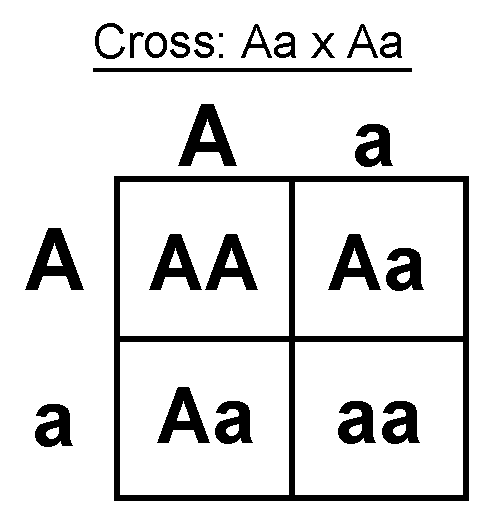
22
23
Multiple Choice
50 % Brown Hair and 50% Blond Hair
25 % Brown Hair and 75% Blond Hair
75 % Brown Hair and 25% Blond Hair
0% Brown Hair and 100% Blond Hair
24
Multiple Choice
25%
50%
0%
75%
25
Symbols
• Circle = female
• Square = male
• Normal or without
trait = unshaded
• Trait = shaded
26
Generations
• Each generation
is (often) labeled
with a Roman
numeral.
• Oldest generation
at top of pedigree
• Current
generation at
bottom
27
Multiple Choice
How many generations are represented in the pedigree?
2
3
4
5
28
Multiple Choice
In the diagram, individual III-3 indicates
a female with no freckles
a male with no freckles
a male with freckles
a female with freckles
29
Multiple Choice
What is the Genotype of individual I-1?
FF
Ff
ff
Can't know for sure
30
is the gradulal change in organisms over time
31
Fossils of ancient organisms have similar structures and DNA than that of organisms today, suggestiing they are ancestors of living organisms.
32
Nature selects those with desirable traits, and those survive and reproduce. Over time, the desirable trait becomes the most common because it has been past down generation after generation.
33
Multiple Select
The following evidence supports the theory of evolution: Check all that apply.
similar body structures in organisms
Similar DNA in organisms
population trends
ancient fossils revealing adaptations of organisms
natural selection
34
Multiple Choice
True or False? In Natural selection an animal chooses to adapt in a single generation, and survives.
true
false
35
Multiple Choice
What is the gradual change in species over time?
Evolution
Adaptation
Natural Selection
36
Multiple Choice
Which one of the following is not a reason why species adapt and change?
too much food available
producing too many young
producing too many offspring
competition for the same resources
Heredity and Evolution Review
TEST Tomorrow
Show answer
Auto Play
Slide 1 / 36
SLIDE

Similar Resources on Wayground
31 questions
Evolution and Natural Selection
Presentation
•
6th - 8th Grade
29 questions
The Region of Sumer
Presentation
•
6th - 8th Grade
28 questions
Thermal Energy Transfer
Presentation
•
6th - 8th Grade
25 questions
Interactions in Ecosystems (Background)
Presentation
•
6th - 9th Grade
27 questions
Measures of Central Tendency
Presentation
•
6th - 8th Grade
31 questions
Physical and Chemical Changes Review
Presentation
•
6th - 8th Grade
31 questions
Primary and Secondary Sources
Presentation
•
6th - 8th Grade
Popular Resources on Wayground
10 questions
Safety Day 2026 – Student Review
Quiz
•
9th Grade
21 questions
Continents and Oceans
Quiz
•
6th Grade
20 questions
Parts of Speech
Quiz
•
5th Grade
16 questions
Subject & Predicate
Quiz
•
5th Grade
25 questions
Multiplication Facts
Quiz
•
5th Grade
12 questions
Map Skills
Quiz
•
3rd Grade
22 questions
Continents and Oceans
Quiz
•
5th Grade
15 questions
Rounding Decimals
Quiz
•
5th Grade
Discover more resources for Biology
10 questions
Exploring the Phases of Mitosis and Cell Division
Interactive video
•
6th - 10th Grade
14 questions
Autosomal Pedigree
Quiz
•
7th Grade
10 questions
Exploring Evidence of Evolution
Interactive video
•
6th - 10th Grade
6 questions
Levels of Organization
Presentation
•
7th Grade
10 questions
Exploring Cell Membrane Transport Mechanisms
Interactive video
•
6th - 10th Grade
13 questions
Fast and Curious: Cell Discovery and Cell Basics
Quiz
•
7th Grade
5 questions
Q2W1- DNA MINI QUIZ 2024
Quiz
•
8th Grade
16 questions
Photosynthesis and Cellular Respiration
Quiz
•
8th Grade