
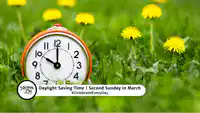
Daylight savings

Presentation
•
English
•
12th Grade
•
Practice Problem
•
Hard

Tara Noe
FREE Resource
9 Slides • 0 Questions
1

2

Hours of Daylight
In the UK, during summer, there are more hours
of daylight. The days are lighter for longer.
In the winter, there are less hours of daylight.
The days become darker earlier in the evening.
3

The Shortest and Longest Days
The day which has the fewest hours of daylight in
the year, is the 21st December. This is called the
winter solstice.
In the UK, the day which has the most hours of
daylight in the year, is the 21st June. This is
called the summer solstice.
JUNE
4

Clocks Forward, Clocks Back
When British Summer Time begins, everyone moves the time on their
clocks forward one hour. This is called ‘putting the clocks forward’.
When British Summer Time ends and autumn begins, everyone moves
the time on their clocks back by one hour. This is called ‘putting the
clocks back’.
But why do we do this?
Did you know…?
In the Royal Households across the UK, staff working
for the Queen spend 50 hours changing the time on
1000 clocks!
5

Making the Most of the Daylight
In 1914, a man called William
Willet decided that people should
make the most of the longer hours
of daylight in the summer.
He also pointed out that less coal
and candles would be used,
because people would have lighter
evenings.
6

First World War
In April 1916, Germany became the first country to switch to Daylight
Saving Time (DST). This saved fuel during the war.
In May 1916, Britain also switched to Daylight Saving Time.
7

Good Things and Bad Things
Good things about DST:
•Less traffic accidents, as people can
see more clearly in daylight.
•Saving energy as not as many
lights are on and so less electricity
is being used.
•More people exercise outside.
Not so good things about DST:
•Darker mornings can mean it is
less safe for children to walk to
school.
•Farmers get up early, so are
working in the dark for longer.
8

How to Remember
A great way to remember when the clocks go forwards
or back, is this little phrase:
Spring forward,
fall back.
‘Fall’ is the American term for autumn.
So in the spring, clocks go forward an hour and
in the autumn, they go back an hour.
9

Show answer
Auto Play
Slide 1 / 9
SLIDE
Similar Resources on Wayground

8 questions
ENGLISH - CAUSATIVE HAVE/GET
Presentation
•
12th Grade
7 questions
Present Perfect Tense
Presentation
•
12th Grade
8 questions
Oral Communication Activity (Application)
Presentation
•
11th - 12th Grade
6 questions
Will Smith Interview
Presentation
•
12th Grade
8 questions
LANCE YOURSELF
Presentation
•
12th Grade
8 questions
Daily Routines Review
Presentation
•
University
6 questions
Technology
Presentation
•
12th Grade
6 questions
Oliver Twist Chapter 3
Presentation
•
12th Grade
Popular Resources on Wayground
10 questions
Safety Day 2026 – Student Review

Quiz
•
9th Grade
21 questions
Continents and Oceans
Quiz
•
6th Grade
20 questions
Parts of Speech
Quiz
•
5th Grade
16 questions
Subject & Predicate
Quiz
•
5th Grade
25 questions
Multiplication Facts
Quiz
•
5th Grade
12 questions
Map Skills
Quiz
•
3rd Grade
22 questions
Continents and Oceans
Quiz
•
5th Grade
15 questions
Rounding Decimals
Quiz
•
5th Grade
Discover more resources for English
16 questions
Complete Sentences vs Fragments and Run-Ons
Presentation
•
5th - 12th Grade
28 questions
AP Vocab Group 7
Quiz
•
9th - 12th Grade
20 questions
Appositives & Commas
Quiz
•
9th - 12th Grade
20 questions
The Crucible Act 1 and 2 Quiz
Quiz
•
9th - 12th Grade
40 questions
Of Mice & Men Major Test Ch. 1-6
Quiz
•
9th - 12th Grade
20 questions
Ethos Pathos Logos
Quiz
•
9th - 12th Grade
21 questions
Evaluating Arguments 10th grade
Presentation
•
9th - 12th Grade
20 questions
SWBST (Summarizing)
Quiz
•
9th - 12th Grade