Search Header Logo
EoT2 - Review on Light

EoT2 - Review on Light

Assessment

Presentation

Science

8th Grade

Medium

Created by

Parisce Francis

Used 2+ times

FREE Resource

24 Slides • 24 Questions

1

media

2

media

3

media

4

media

5

media

6

media

7

media

8

media

9

media

10

Multiple Choice

Image behind the mirror is

1

virtual

2

real

3

upside down

4

upright

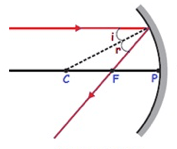
11

Multiple Choice

Question image

This ray diagram is for which mirror?

1

concave

2

convex

3

plane

4

window

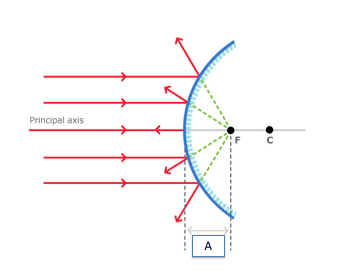
12

Multiple Choice

Question image

what is A on the diagram?

1

center of curviture

2

focal length

3

reflected ray

4

focal point

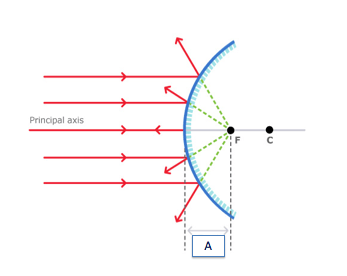
13

Multiple Choice

Question image

In the image, all the rays meet at F, What is F

1

focal length

2

focal point

3

center of curvature

4

reflection

14

Multiple Select

Question image

This image is showing a convex mirror because the image is (choose 2 answers)

1

rays meeting behind the mirror

2

rays meeting behind the mirror

3

image is real

4

image is virtual

15

media

16

media

17

media

18

media

19

media

20

media

21

media

22

media

23

media

24

media

25

Multiple Choice

Question image

Is a convex lens thicker or thinner in the middle?

1

Thicker

2

Thinner

26

Multiple Choice

What does the word "diverging" mean?

1

to spread apart

2

to come together

3

parallel

4

perpendicular

27

Multiple Choice

A converging lens is also known as a ____ lens.

1

convex

2

concave

3

double

4

refracted

28

Multiple Choice

Question image
Why does the pencil look broken?
1
Light is refracting
2
Light is reflecting
3
Light is absorbing
4

Light is Scattering

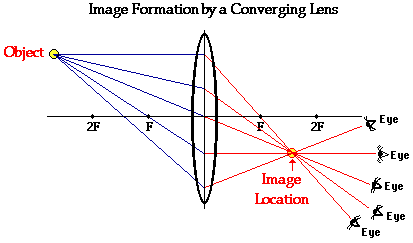
29

Multiple Choice

Question image

This image is.....

1

inverted and smaller

2

inverted and larger

3

not inverted and smaller

4

not inverted and larger

30

Multiple Choice

How does a concave lens differ from a convex lens?

1

A convex lens is another way to describe a plane mirror; a concave lens is curved

2

A concave lens is curved inward on both sides; a convex lens is on only one side

3

A convex lens has a thick center and thin edges, a concave lens has a thin center and thicker edges

4

A convex lens has a thin center and thick edges. a concave lens has a thick center and thinner edges

31

media

32

Multiple Choice

Question image
This part of the eye carries the message from your eye to the part of your brain that controls vision. 
1
cornea
2
lens
3
optic nerve
4
retina

33

Multiple Choice

Question image
The part of your eye that gives it its color.  It is a muscle that controls the size of your pupil.
1
cornea
2
lens
3
pupi
4
iris

34

Multiple Choice

Question image
The back of the eye;  an upside-down image of whatever you are looking at is projected here. 
1
lens
2
cornea
3
pupi
4
retina

35

Multiple Choice

Question image
The first part of the eye that light hits. 
1
lens
2
cornea
3
pupil
4
retina

36

media

37

media

38

media

39

media

40

Multiple Choice

Question image
Which color absorbs all light?
1
White
2
Black
3
Orange
4
Green

41

Multiple Choice

Question image
What is a piece of glass that bends white light?
1
Visible
2
Stain Glass
3
Prism

42

Multiple Choice

A material through which light does not pass

1

Transparent

2

Translucent

3

Opaque

43

Multiple Choice

The brightness of a light is determined by ______________.

1

intensity of light waves

2

wavelength

3

air temperature

4

wave speed

44

Multiple Choice

Electromagnetic energy travels in waves. When we describe electromagnetic waves, we often talk about frequency and energy. Which of these statements accurately describes the relationship between the frequency and energy of an electromagnetic wave?

1

If frequency increases. energy decreases

2

If frequency decreases, energy increases.

3

If frequency increases, energy increases.

4

If frequency remains constant, energy increases.

45

Multiple Choice

What are the three primary colours of light?
1
red, green, blue
2
red, yellow, blue
3
yellow, magenta, cyan
4
red, yellow, green

46

Multiple Choice

How is the color magenta produced?
1
by combining red and green light
2
by combining red and blue light
3
by combining yellow and green light
4
by combining green and blue light

47

Multiple Choice

How is the color cyan produced?
1
by combining red and blue light
2
by combining green and yellow light
3
It is not created. It is a primary color.
4
by combining blue and green light

48

Multiple Choice

A blue shirt looks blue because...
1
it absorbs blue and reflects all the colors
2
it reflects blue and absorbs all the other colors
3
it absorbs cyan and reflects all the other colors
4
it reflects cyan and absorbs all the other colors
media

Show answer

Auto Play

Slide 1 / 48

SLIDE