
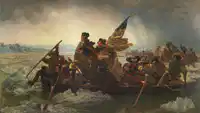
The Revolutionary War Objective 2

Presentation
•
History
•
•
Practice Problem
•
Medium

Christina Quattrone
Used 3+ times
FREE Resource
8 Slides • 9 Questions
1
Objective 2
Explain how the United States defeated Great Britain and the efffects of the war
2
The battles of Saratoga in 1777 and Yorktown in 1781 were two major turning points in the Revolutionary war. Both were American victories over the British, but with very different results. The British defeat at Saratoga prolonged the war, while the battle at Yorktown foretold its end.
Saratoga convinced the French to join the Americans against the British. Yorktown was a joint victory by the French and the Americans over the British. France and her allies continued to fight hard for two more years, but there was little fighting anymore on the American continent.
The colonists were motivated! They were fighting for a cause rather than against one.
3
Meanwhile, in England, the British citizens began to question if the war was even worth it anymore.
The Americans were assisted by the French, led by the Comte de Rochambeau. The battle took place in Yorktown, Virginia, near the York River. After the French fleet defeated a British fleet, Cornwallis was cut off and had to surrender to the French and the Continental Army. Eventually, it led to the Treaty of Paris in 1783, two years later.
fought from September 28 to October 19, 1781. It is considered the last major land battle of the American Revolutionary War. The Continental Army, led by General George Washington, won a decisive victory against the British Army, led by General Lord Charles Cornwallis. Cornwallis was forced to surrender after being surrounded by Washington's army.
aka "Seige of Yorktown"
4
The American War for Independence (1775-1783) was actually a world conflict, involving not only the United States and Great Britain, but also France, Spain, and the Netherlands.
The three American negotiators – John Adams, Benjamin Franklin, and John Jay – proved themselves ready for the world stage, achieving many of the objectives sought by the new United States. Two crucial provisions of the treaty were British recognition of U.S. independence and the delineation of boundaries that would allow for American western expansion.
The treaty is named for the city in which it was negotiated and signed.
IN THE END, THE COLONISTS LOST THE MOST BATTLES BUT WON THE WAR!
This treaty, signed on September 3, 1783, between the American colonies and Great Britain, ended the American Revolution and formally recognized the United States as an independent nation.
5
Multiple Choice
The most important aspect of the Treaty of Paris to the Americans was...
It stated that the United States shall remain under control of the British crown but may have some independence
It granted the United States complete independence from Great Britain.
It divided Canadian territories between the United States and Great Britain.
It acknowledged that the United States is now controlled by the French government.
6
Multiple Choice
What was the effect of the Battle of Yorktown on the British population?
It led to increased funding for the Redcoats in America.
It worsened suspicions between politicians and the public.
It created a wave of support for the Continental Army.
It encouraged anti-war feelings in the British public.
7
Multiple Choice
Which of the following correctly identifies the pattern of Continental victories?
The Continental Army won most battles, but lost the war.
The Continental Army lost most battles, but won the war.
The Continental Army won most battles and the war.
The Continental Army lost most battles and the war.
8
Multiple Choice
What motivation for fighting the war gave the Continental Army an advantage over the British?
They were fighting for a cause rather than against one.
They believed in the inherent superiority of Americans over the British.
They had a different understanding of human rights.
They had more passion for the land.
9
The Patriots lost more battles than they won and, like any war, the Revolution was filled with hard times, loss of life, and suffering. There were very few disabled soldiers as most of them died in battle.
In fact, the Revolution had one of the highest casualty rates - although the exact number of casualities is unknown- of any U.S. war; only the Civil War was bloodier.
10
However Congress faced the inability to pay, feed, and equip the army. Even after the war. Soldiers protested their lack of pay and poor conditions. Not only were soldiers angry, but officers also felt that the country did not treat them well. . When officers were denied a lifetime pension at the end of the war, some of them threatened to conspire against the Congress. General Washington, however, acted swiftly to halt this threat before it was put into action.
In order to develop a strong army, the Continental Congress required each state to provide a larger quota of men who would serve for longer terms, but would be monetarily compensated with a signing bonus and the promise of free land.
11
Multiple Choice
Exactly how many Americans died fighting the Revolutionary War?
25,000
30,000
100,000
It is impossible to provide an exact number.
12
Multiple Choice
Why did few disabled American soldiers return from the war?
Women camp followers treated injured soldiers very well.
Most died of their wounds.
Not many soldiers were wounded.
Medical treatment prevented permanent disabilities.
13
Multiple Choice
Why were soldiers dissatisfied after the Revolutionary War?
They were not allowed to keep their uniforms or weapons.
They wanted more money than they had been promised.
They had not been fully paid.
Their votes were considered less important than other citizens’.
14
slaves and women
The American Revolution produced a new outlook among its people that would have ramifications long into the future. Groups excluded from immediate equality such as slaves and women would draw their later inspirations from revolutionary sentiments. Americans began to feel that their fight for liberty was a global fight. Future democracies would model their governments on ours. There are few events that would shake the world order like the success of the American patriotic cause.
15
Even among Patriots there was a wide range of opinion about how the Revolution should shape the new nation. For example, soldiers often resented civilians for not sharing the deep personal sacrifice of fighting the war. Even among the men who fought, major differences often separated officers from ordinary soldiers.
Finally, no consideration of the Revolution would be complete without considering the experience of people who were not Patriots. Loyalists were Americans who remained loyal to the British Empire. Almost all Native American groups opposed American Independence. Slaves would be made legally free if they fled Patriot masters to join the British Army, which they did in large numbers.
16
Multiple Choice
Which of the following statements correctly explains the role of slaves in the Revolutionary War?
Slaves strongly supported the Continental fight for freedom from British rule.
Slaves attempted to remain neutral during the conflict so as not to risk their lives.
The Patriots offered them independence to fight the British, and many slaves escaped to do so.
The British offered them independence to fight the Patriots, and many slaves escaped to do so.
17
Multiple Choice
How did the American Revolution impact slaves and women?
It had little immediate effect, but eventually led to an expansion of their legal rights.
It had little to no impact on these groups.
Both groups immediately became more radical in the fight for their rights.
It immediately led to a significant expansion of their legal rights.
Objective 2
Explain how the United States defeated Great Britain and the efffects of the war
Show answer
Auto Play
Slide 1 / 17
SLIDE
Similar Resources on Wayground

10 questions
9/11
Presentation
•
9th - 12th Grade
10 questions
Plessy v. Ferguson
Presentation
•
12th Grade
12 questions
R.L.2.1 Asking and Answering Questions
Presentation
•
1st - 2nd Grade
12 questions
Declaration of Independence
Presentation
•
11th Grade
12 questions
Dissecting the Preamble to the U.S. Constitution
Presentation
•
6th - 12th Grade
11 questions
Christianity in the Roman Empire
Presentation
•
9th Grade
13 questions
The Civil Rights Movement
Presentation
•
4th Grade
11 questions
Fall of Rome
Presentation
•
6th - 8th Grade
Popular Resources on Wayground
10 questions
Safety Day 2026 – Student Review

Quiz
•
9th Grade
21 questions
Continents and Oceans
Quiz
•
6th Grade
20 questions
Parts of Speech
Quiz
•
5th Grade
16 questions
Subject & Predicate
Quiz
•
5th Grade
25 questions
Multiplication Facts
Quiz
•
5th Grade
12 questions
Map Skills
Quiz
•
3rd Grade
22 questions
Continents and Oceans
Quiz
•
5th Grade
15 questions
Rounding Decimals
Quiz
•
5th Grade
Discover more resources for History
20 questions
Disney Trivia
Quiz
•
University
15 questions
Unit 3 - Part 1 Road to Revolution
Quiz
•
8th Grade
15 questions
Jamestown Settlement
Quiz
•
4th - 5th Grade
25 questions
WWII Assessment
Quiz
•
8th Grade
15 questions
Jamestown
Quiz
•
4th Grade
25 questions
The American Revolution
Quiz
•
7th - 10th Grade
15 questions
The Bill of Rights
Quiz
•
8th - 12th Grade
18 questions
American Revolution Review
Quiz
•
8th Grade