Star Lesson
Presentation
•
Science
•
8th Grade
•
Medium
+9
Standards-aligned
Mrs Doxzon-Lewis
Used 6+ times
FREE Resource
28 Slides • 19 Questions
1
2
3
How do we classify them?
4
Open Ended
What are some things you know about stars?
5
6
https://www.youtube.com/watch?v=mkktE_fs4NA
7
Multiple Choice
All stars begin their life in a
Main Sequence
Nebula
Protostar
Black Dwarf
8
9
10
11
12
13
Multiple Choice
Most stars are made of which elements?
Hydrogen only
Hydrogen and Lithium
Hydrogen and Sodium
Hydrogen and Helium
14
15
16
17
18
19
20
21
22
23
Multiple Choice
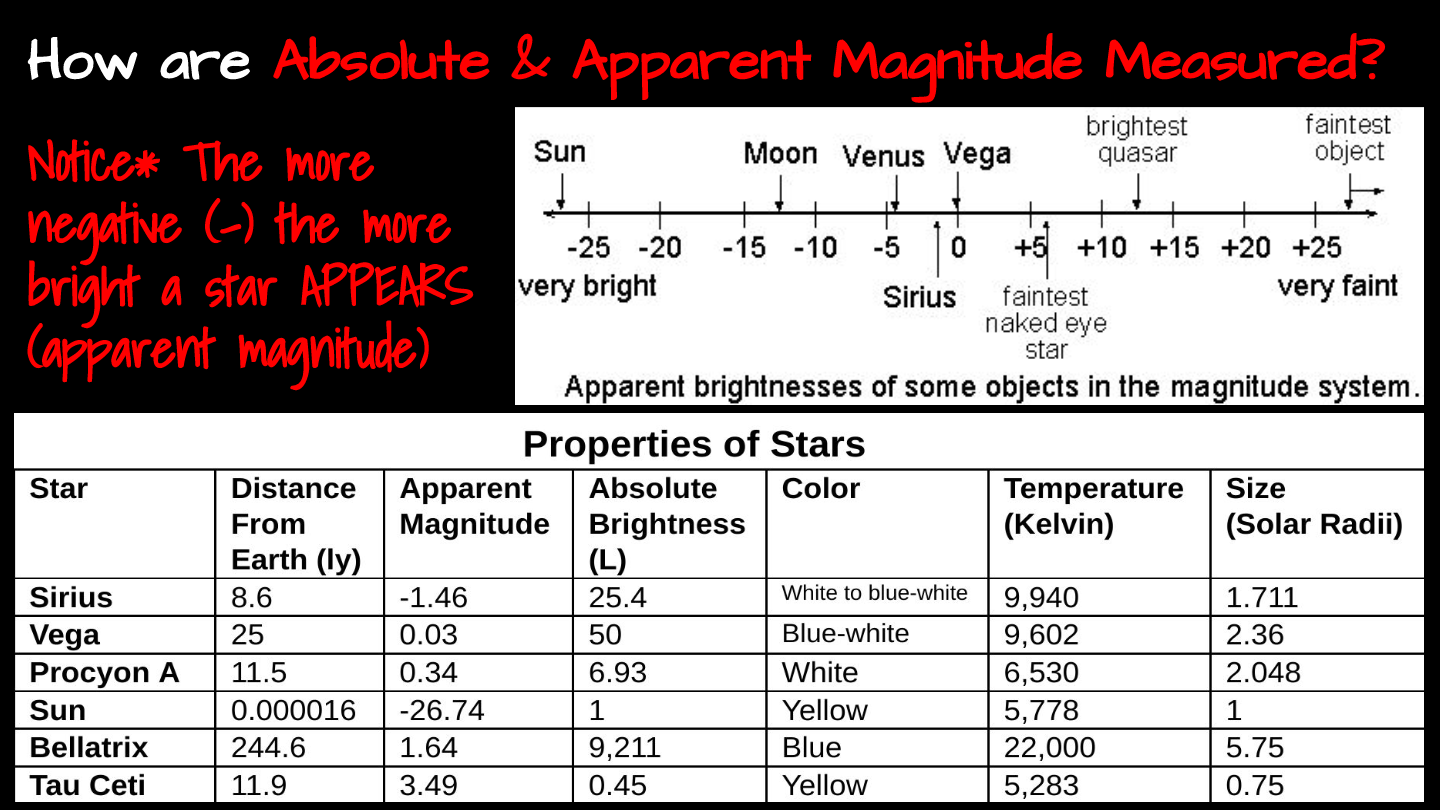
Which might change, depending on the DISTANCE to a star?
Absolute Brightness
Apparent Magnitude
24
25
Multiple Choice
If a scientist needs to calculate the luminosity of a star, what information would they need?
Distance
Apparent Magnitude
Temperature
Distance and Apparent Magnitude
26
27
Poll
Two stars are being compared. Star A has a greater luminosity than Star B. Star A and Star B have the same apparent magnitude. WHICH STAR IS MORE DISTANT?
Star A
Star B
28
Multiple Choice
The H-R diagram classifies stars based on what factors?
Temperature and luminosity
Number of planets
What constellation they're in
Temperature and fusion
29
Stars A & B have the same apparent magnitude in the sky.
Can we assume that they have the same absolute brightness? Why or why not?
What if, star A is 50 LY away & star B is 10 LY away? Which one has the highest luminosity?
30
Multiple Choice
Stars that are brighter are usually...
Hotter
Bigger
Smaller
31
32
Multiple Choice
Which star is the coldest?
Yellow Star
Red Star
Orange Star
Blue Star
33
We classify/organize stars on the Hertzsprung-Russell diagram OR HR Diagram.
Astronomers sort stars by their:
Temperature
Size or Mass
Both temperature and size/mass of a star help us understand the ABSOLUTE BRIGHTNESS or how bright a star actually is.
34
Multiple Choice
Our sun is yellow. A star colder than our sun would be...
Red
Yellow
White
Blue
35
Multiple Choice
What two quantitative measurements do we use to measure absolute brightness?
Temperature and Color
Color and Mass
Temperature and Mass
36
Multiple Choice
Compared to a red giant star, a blue supergiant is...
Hotter and brighter
Hotter and not as bright
Colder and brighter
Colder and not as bright
37
38
Multiple Choice
Our sun is what kind of star?
Blue giant
Red giant
Main sequence
White dwarf
39
40
Multiple Choice
Blue stars are the _____________.
hottest
coolest
smallest
41
42
Multiple Choice
Which is the correct order of stars from COOLEST to HOTTEST?
blue, white, yellow, orange, red
red, yellow, blue, white, orange
red, white, yellow, orange, blue
red, orange, yellow, white, blue
43
44
Multiple Choice
45
Multiple Choice
Which Star is the HOTTEST?
Blue
Red
Orange
Yellow
46
Multiple Choice
Infer:
Naos is a star in the Argos constellation. It has a very deep Blue color. What do you think is the approximate temperature of Naos?
Between 3,000 K - 5,000 K ( it is a cool star)
Between 25,000 K - 50,000 K ( it is a hot star)
47
Multiple Choice
Which Star is the COOLEST?
Blue
Red
Orange
Yellow
Show answer
Auto Play
Slide 1 / 47
SLIDE

Similar Resources on Wayground
44 questions
G1 Sc CA 1 Revision
Presentation
•
KG
40 questions
Thermal and Kinetic Energy
Presentation
•
8th Grade
43 questions
Intro to Scatterplots
Presentation
•
8th Grade
39 questions
Solar System and the Universe
Presentation
•
8th Grade
43 questions
Amplify Light Waves Ch 3 L 3.1
Presentation
•
8th Grade
42 questions
Tectonics and Geology
Presentation
•
7th - 9th Grade
45 questions
1a States of Matter
Presentation
•
8th Grade
39 questions
Parts of An Airplane Lesson Activity
Presentation
•
8th Grade
Popular Resources on Wayground
10 questions
Safety Day 2026 – Student Review
Quiz
•
9th Grade
21 questions
Continents and Oceans
Quiz
•
6th Grade
20 questions
Parts of Speech
Quiz
•
5th Grade
16 questions
Subject & Predicate
Quiz
•
5th Grade
25 questions
Multiplication Facts
Quiz
•
5th Grade
12 questions
Map Skills
Quiz
•
3rd Grade
22 questions
Continents and Oceans
Quiz
•
5th Grade
15 questions
Rounding Decimals
Quiz
•
5th Grade
Discover more resources for Science
20 questions
Newton's Laws of Motion
Quiz
•
8th Grade
15 questions
potential and kinetic energy
Quiz
•
8th Grade
21 questions
Newton's Laws of Motion
Quiz
•
8th Grade
20 questions
Elements, Compounds and Mixtures
Quiz
•
8th Grade
10 questions
Exploring Chemical and Physical Changes
Interactive video
•
6th - 10th Grade
20 questions
Physical vs Chemical Changes
Quiz
•
8th Grade
20 questions
Conduction, convection, and Radiation Practice
Quiz
•
8th Grade
21 questions
Waves and Wave Properties
Quiz
•
6th - 8th Grade