

Algebra II Final Exam - Exponential Functions and Logarithms

Presentation
•
Mathematics
•
10th Grade
•
Practice Problem
•
Medium
Standards-aligned

Bridger Stoney
Used 8+ times
FREE Resource
12 Slides • 10 Questions
1

Topic 2 Exponential
Functions and Logarithms
2


Basic Formula for Exponential Functions
An exponential function is defined by the
formula f(x) = a^x, where the input variable
x occurs as an exponent. The exponential
curve depends on the exponential function
and it depends on the value of the x.
3
Multiple Choice
What is the basic formula for an exponential function?
f(x)=bx
f(x)=bx
f(x)=xb
f(x)=bx
4


Transformations
Transformations include vertical shifts,
horizontal shifts, and graph reversals.
Changing the sign of the exponent will
result in a graph reversal or flip. A positive
exponent has the graph heading to infinity
as x gets bigger. A negative exponent has
the graph heading to infinity as x gets
smaller.
5
Multiple Choice
What is the equation for a horizontal (left-right) transformation of function f(x)?
h=f(x+h)
h=f(x-h)
f=y(x+h)
f=y(x-h)
Y=f(x+h)
Y=f(x-h)
f(x)=y+h
f(x)=y-h
6
Multiple Choice
What is the equation for a vertical (up-down) transformation of function f(x)?
f(x)=f(x)+k
f(x)=f(x)-k
h=f(x+k)
h=f(x-k)
f=y(x+k)
f=y(x-k)
Y=f(x+k)
Y=f(x-k)
7


Domain and Range
The domain of a function is the set of input
or x -values for which the function is
defined, while the range is the set of all the
output or y -values that the function takes.
8
Multiple Choice
What is the domain and range of function f(x)=bx
D=(∞,-∞)
R=(0,∞)
D=(0,∞)
R=(-∞,∞)
D=(0,∞)
R=(∞,-∞)
D=(-∞,∞)
R=(0,∞)
9


Determining Equations Given Two Points
Step 1: Identify two points on the graph,
Step 2: Find the slope between the two points found
in step 1 using the formula. Simplify completely.
Step 3: Set up a function using the slope from step 2.
Solve for the -intercept by substituting one of the
points from step 1 into the function.
Step 4: Write the function using the slope and
-intercept found in steps 2 and 3.
10
Multiple Choice
What is the equation for the line that passes through the points (3, 4) and (5,8)?
Y=2x+2
y=x+2
y=x-2
y=2x-2
11

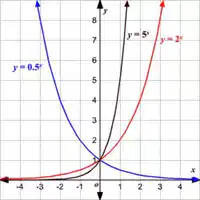
Graphs
An exponential graph is a curve that has a
horizontal asymptote and it either has an
increasing slope or a decreasing slope. It
starts as a horizontal line and then it first
increases/decreases slowly and then the
growth/decay becomes rapid.
12

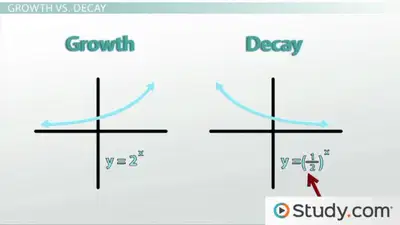
Growth and Decay
It's exponential growth when the base of
our exponential is bigger than 1, which
means those numbers get bigger. It's
exponential decay when the base of our
exponential is in between 1 and 0 and
those numbers get smaller. An asymptote
is a value that a function will get infinitely
close to, but never quite reach.
13
Multiple Choice
How do you express the exponential decay model?
y=a(1-r)^t
y=a(1+r)^t
y=a(r-1)^t
y=a(r+1)^t
14
Multiple Choice
What is the formula for exponential growth model?
y=a(1+r)^t
y=a(1-r)^t
y=a(r+1)^t
y=a(r-1)^t
15


Solving Exponentials
To solve exponential equations without
logarithms, you need to have equations with
comparable exponential expressions on either
side of the "equals" sign, so you can compare the
powers and solve. In other words, you have to
have "(some base) to (some power) equals (the
same base) to (some other power)", where you
set the two powers equal to each other, and
solve the resulting equation.
16
Multiple Choice
Evaluate 82810
812
88
816
84
17


Graphs of Logarithms
To graph a logarithmic function 𝑦=𝑙𝑜𝑔𝑏(𝑥) ,
it is easiest to convert the equation to its
exponential form, 𝑥=𝑏𝑦 . Generally, when
graphing a function, various 𝑥 -values are
chosen and each is used to calculate the
corresponding 𝑦 -value. In contrast, for this
method, it is the 𝑦 -values that are chosen
and the corresponding 𝑥 -values that are
then calculated.
18
Multiple Choice
Identify the domain and range: y=log6(x−1)−5
Domain: x > 1
Range: All Real Numbers
Domain: x > -1
Range: All Real Numbers
Domain: x > 2
Range: All Real Numbers
Domain: x > -2
Range: All Real Numbers
19


Properties of Logarithms
The properties of log are used to expand a
single logarithm into multiple logarithms
(or) compress multiple logarithms into a
single logarithm. A logarithm is just
another way of writing exponents. Thus,
the properties of logarithms are derived
from the properties of exponents.
20
Multiple Choice
Find the value of x if log(6x)−log(4−x)=log(3)
3/4
5/6
4/3
2/3
21


Change of Base
The change of base formula, as its name
suggests, is used to change the base of a
logarithm. We might have noticed that a
scientific calculator has only "log" and "ln"
buttons. Also, we know that "log" stands for a
logarithm of base 10 and "ln" stands for a
logarithm of base e. But there is no option to
calculate the logarithm of a number with any
other bases other than 10 and e.
22


Expanding and Condensing Logarithms
To expand logarithms, write them as a sum
or difference of logarithms where the
power rule is applied if necessary. Often,
using the rules in the order quotient rule,
product rule, and then power rule will be
helpful. The reverse process of expanding
logarithms is called combining or
condensing logarithmic expressions into a
single quantity
Topic 2 Exponential
Functions and Logarithms
Show answer
Auto Play
Slide 1 / 22
SLIDE
Similar Resources on Wayground

15 questions
Composition of Functions
Presentation
•
10th - 11th Grade
13 questions
Circumference and Area of Circles (Review)
Presentation
•
10th Grade
20 questions
Operations on Functions
Presentation
•
10th - 11th Grade
17 questions
Transformations Geometry
Presentation
•
10th Grade
15 questions
Lesson 11: Matrix Operations
Presentation
•
10th Grade
15 questions
Factoring the GCF
Presentation
•
10th Grade
18 questions
Direct Variation
Presentation
•
9th - 10th Grade
20 questions
Factoring Review Lesson
Presentation
•
10th Grade
Popular Resources on Wayground
10 questions
Safety Day 2026 – Student Review

Quiz
•
9th Grade
21 questions
Continents and Oceans
Quiz
•
6th Grade
20 questions
Parts of Speech
Quiz
•
5th Grade
16 questions
Subject & Predicate
Quiz
•
5th Grade
25 questions
Multiplication Facts
Quiz
•
5th Grade
12 questions
Map Skills
Quiz
•
3rd Grade
22 questions
Continents and Oceans
Quiz
•
5th Grade
15 questions
Rounding Decimals
Quiz
•
5th Grade
Discover more resources for Mathematics
10 questions
Exploring the Basics of Exponents

Interactive video
•
6th - 10th Grade
20 questions
Unit 5 Test RSC (25-26)
Quiz
•
10th Grade
12 questions
Identify Rigid Transformations
Quiz
•
8th - 12th Grade
10 questions
Complementary, Supplementary, Vertical, and Linear Pairs
Quiz
•
9th - 12th Grade
10 questions
Solving Two-Step Equations with Negatives
Interactive video
•
6th - 10th Grade
22 questions
Identify Vertical and Horizontal Translations
Quiz
•
9th - 12th Grade
10 questions
Exploring Equivalent Ratios and Ratio Tables
Interactive video
•
6th - 10th Grade
10 questions
Graphing Inequalities on a Number Line
Quiz
•
9th - 12th Grade