APES Population Review
Presentation
•
Science
•
12th Grade
•
Easy
+18
Standards-aligned
Evan Todd
Used 5+ times
FREE Resource
32 Slides • 94 Questions
1
2
3
4
5
6
7
8
9
10
11
12
13
14
15
16
17
18
19
20
21
22
23
24
25
26
27
28
29
30
31
32
33
Multiple Choice
What factor describes when populations decrease because animals are moving out of a population?
Emigration
Limiting Factors
Immigration
Exponential Growth
34
Multiple Choice
35
Multiple Choice
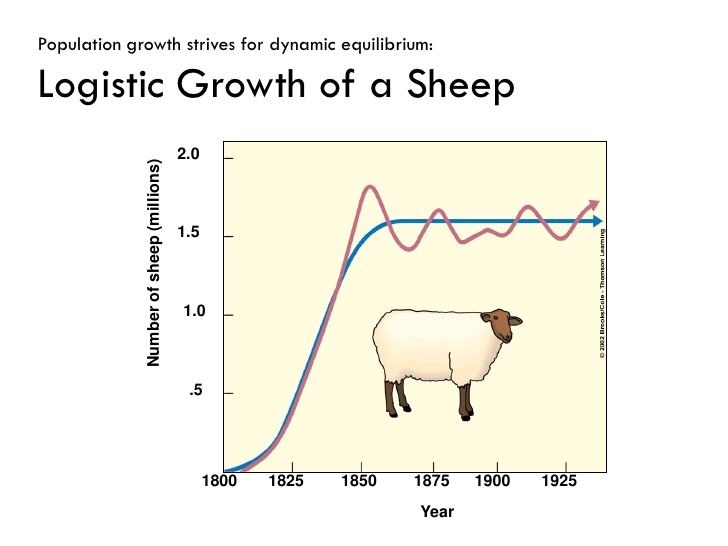
What growth model has an J-shaped curve?
Logistic
Exponential
36
Multiple Choice
37
Multiple Choice
What growth model has an S-shaped curve?
Logistic
Exponential
38
Multiple Choice
39
Multiple Choice
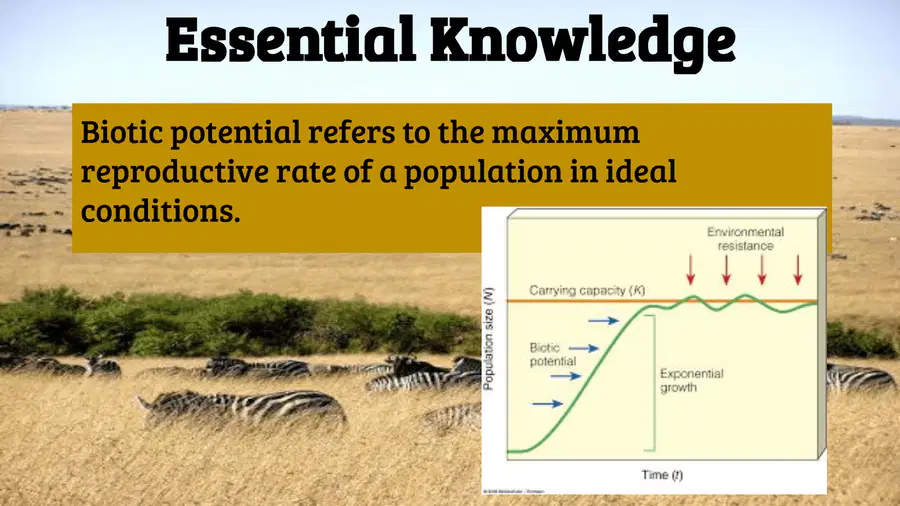
When a population has unlimited resources, and it continues to grow to its FULL LIVING POTENTIAL, it is called
Peak
Top shelf
Resource controlled limit
Biotic potential
40
Multiple Choice
41
Multiple Choice
factors that affect a population depending on its size
- these include food, predation, parasitism, and disease
Density-Dependent factor
Density-Independent factors
42
Multiple Choice
43
Multiple Choice
affect all populations similarly regardless of population size. Examples include: natural disasters, rapid climate changes (drought or floods), and human activity and disturbances
Density-Dependent factors
Density-Independent factors
44
Multiple Choice
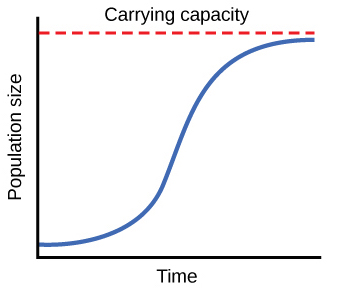
What point on the graph represents the carrying capacity?
A
B
C
D
45
Multiple Choice
Describes how many individuals of different ages make up a population
Age Structure
Age Layout
The youths collation
Age Spread
46
Multiple Choice
47
Multiple Choice
Which population has the greatest potential for rapid growth?
Populations with a large number of middle aged individuals
Older populations
Populations with large numbers of young offspring
None of these
48
Multiple Choice
A population is...
All members of one species in one area
All members of all species that live in one area
All of the living and nonliving things in an area
None of these
49
Multiple Choice
Population pyramids measure:
Age and Gender
Gender and Race
Age and Race
Land size
50
Multiple Choice
51
Multiple Choice
What age groups does the bottom of a population pyramid represent?
The elderly
The working adults
The children
Males
52
Multiple Choice
53
Multiple Choice
What growth rate does this population pyramid represent?
Rapid Growth
Slow Growth
Negative Growth
Zero Growth
54
Multiple Choice
55
Multiple Choice
Lower birth rate
More developed
Less developed
56
Multiple Choice
What is happening at the 'A' on the graph?
the population overshoots above the carrying capacity
the population stops growing
growth begins to slow down due to limited resources
growth is speeding up due to an abundance of resources
57
Multiple Choice
Is this country Developed or Developing?
Developed
Developing
58
Multiple Choice
59
Multiple Choice
60
Multiple Choice
61
Multiple Select
Which of the following are density dependent factors?
competition for resources
predation
disease
natural disasters
62
Multiple Choice
63
Multiple Select
Which of the following are examples of a density independent factors?
forest fire
seasonal cycles
storms
disease
64
Multiple Choice
65
Multiple Choice
66
Multiple Choice
What is the correct equation for calculating population growth rate?
Births + Deaths
Births - Deaths
Deaths / Births
Deaths x Births
67
Multiple Choice
68
Multiple Choice
69
Multiple Choice
What factor describes when populations decrease because animals are moving out of a population?
Emigration
Limiting Factors
Immigration
Exponential Growth
70
Multiple Choice
Which of these is not one of the properties of a population?
Density
Dispersion
Size
Degree
71
Multiple Choice
What point on the graph represents the carrying capacity?
A
B
C
D
72
Multiple Choice
73
Multiple Choice
74
Multiple Choice
Which of the following is not an example of exponential growth?
A.reindeer of the Probilof Islands after eating most of the Lichens
A.rabbit populations after being introduced to Australia
A.a bank account that earns interest
A.mold appearing on bread overnight
75
Multiple Choice
76
Multiple Choice
77
Multiple Choice
78
Multiple Choice
Type of dispersion of a large population of mallard ducks gathered together in a marsh?
flock dispersion
balanced dispersion
random dispersion
clumped dispersion
79
Multiple Choice
80
Multiple Choice
81
Multiple Choice
82
Multiple Choice
Which of the following variables increase population size?
Deaths
Emigration
Immigration
83
Multiple Choice
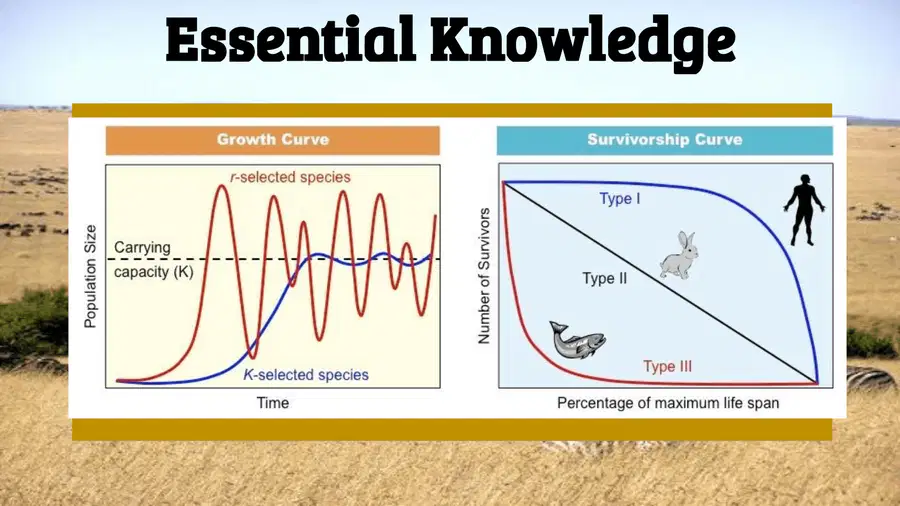
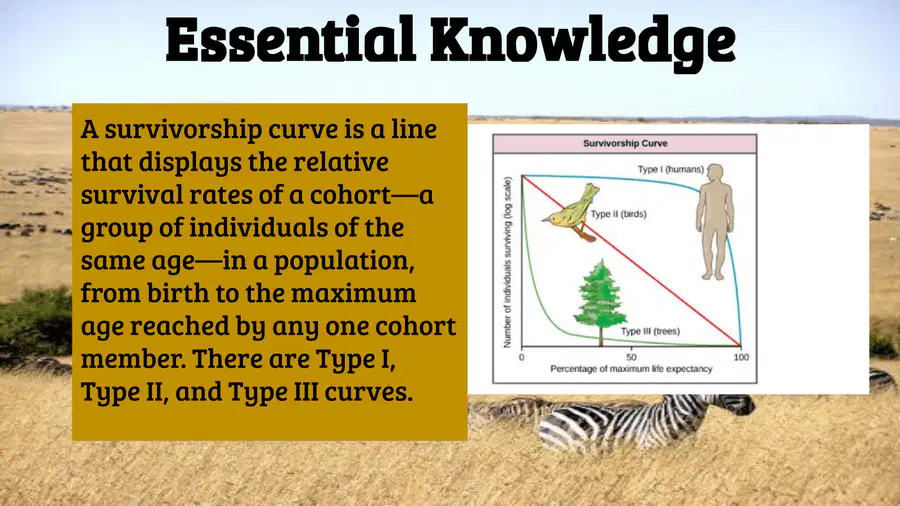
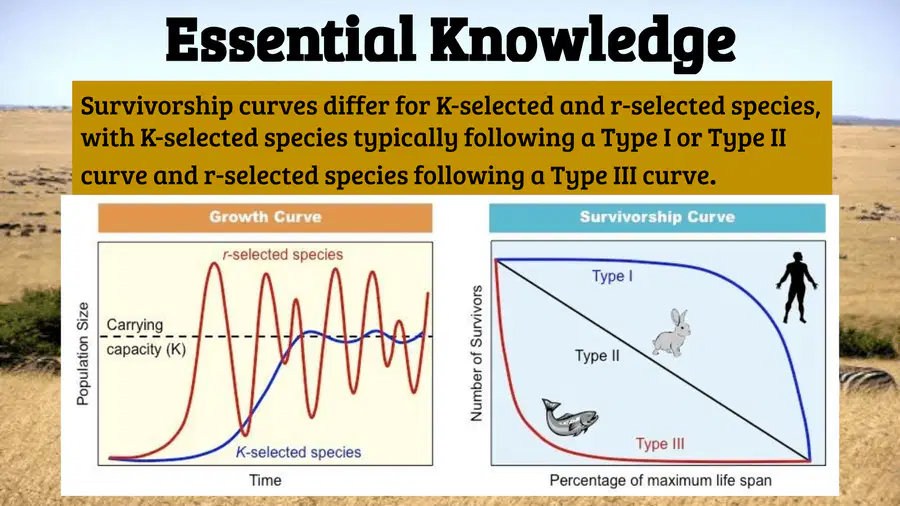
Tracks organisms that tend to live long lives (low death rate and high survivorship rate); toward the end of their life expectancies, however, there is a dramatic increase in the death rate.
Type I
Type II
Type III
Type IV
84
Multiple Choice
85
Multiple Choice
Describes organisms with a high death rate (or low survivorship rate) immediately following birth. Examples include bacteria, fishes, and invertebrates.
Type I
Type II
Type III
Type IV
86
Multiple Choice
87
Multiple Choice
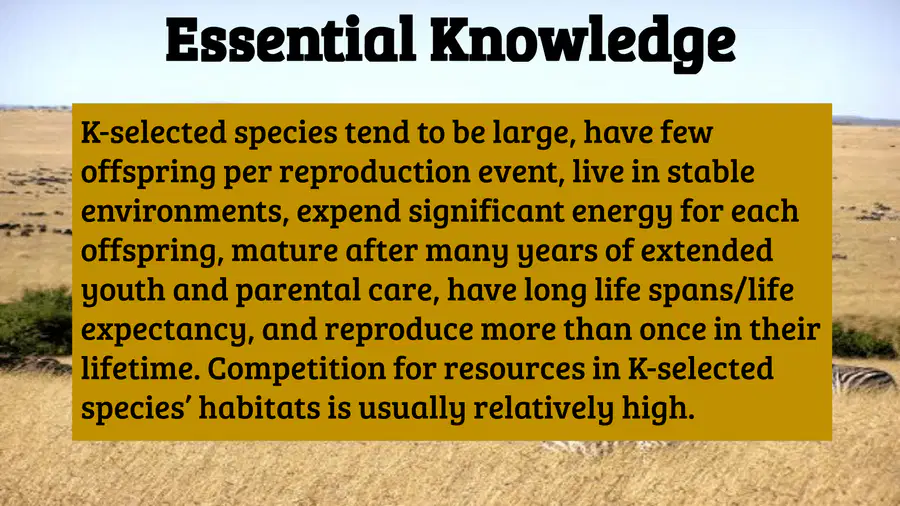
These organisms typically live in unstable, unpredictable environments & are able to reproduce rapidly (exponentially). They do not take care of their young & are subject to predation.
k-strategist
r-strategist
m-strategist
s-strategist
88
Multiple Choice
89
Multiple Choice
These organisms occupy stable environments, are larger in size and have longer life expectancies. They produce, during their life spans, fewer offspring, but place a greater investment in each.
k-strategist
r-strategist
m-strategist
s-strategist
90
Multiple Choice
91
Multiple Select
Click density dependent factor(s).
competition for resources
predator-prey relationships
parasitism and disease
weather
92
Multiple Choice
93
Multiple Select
Click density independent factor(s).
competition for resources
predator-prey relationships
parasitism and disease
weather, natural disaster and man made disturbances
94
Multiple Choice
95
Multiple Choice
A pattern of survival over time in which there is high survival throughout most of the life span, but then individuals start to die in large numbers as they approach old age.
Type i survivorship
Type ii survivorship
Type iii survivorship
96
Multiple Choice
97
Multiple Choice
A pattern of survival over time in which there is a relatively constant decline in survivorship throughout most of the life span.
Type ii survivorship
Type i survivorship
Type iii survivorship
98
Multiple Choice
What is happening at the 'A' on the graph?
the population overshoots above the carrying capacity
the population stops growing
growth begins to slow down due to limited resources
growth is speeding up due to an abundance of resources
99
Multiple Choice
A pattern of survival over time in which there is low survivorship early in life with few individuals reaching adulthood.
Type III survivorship
Type II survivorship
Type I survivorship
100
Multiple Choice
101
Multiple Choice
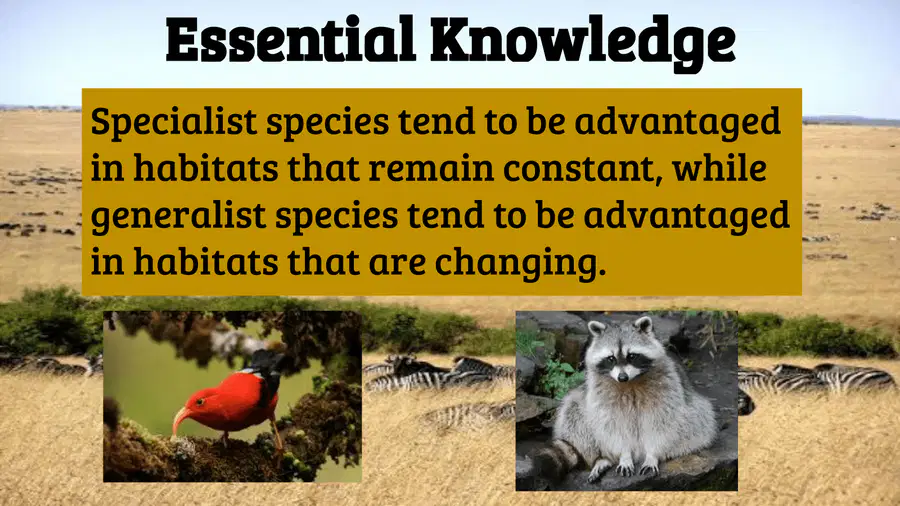
A generalist species is a species that generally has a wide range of things in their diets as well as a relatively large area of habitat.
Generalists
Specialist
102
Multiple Choice
103
Multiple Choice
Organisms adapted to narrow habitats, limited food resources, or other specific environmental conditions.
Specialist
Generalist
104
Multiple Choice
105
Multiple Choice
Human population growth in 2020 was 0.98 %. If this growth were to remain constant in what year will the human population double?
2051
2091
2109
9120
106
Multiple Choice
107
Fill in the Blanks
Human population growth of Mozambique in 2021 was 2.8. If growth remains constant, in what year will the human population double?
108
Multiple Choice
Two male Giraffes are fighting over the last green leaf of a tree that is dying.
Intraspecific Competition
Mutualsim
Predation
Commensalism
Interspecific Competition
109
Multiple Choice
In 2004 China's CBR was 11.8 the CDR was 6.3. what is the growth rate for China in 2004?
0.38%
0.49%
0.55%
0.68%
110
Multiple Choice
111
Multiple Choice
Which of the following is most typically associated with the transition form a rural to an urbanized society?
Reduced birth rates
Reduced need for sewage-treatment facilities
Increased rates of population growth
Increased air quality in urban areas
Increased stabilization of microclimate in urban areas.
112
Multiple Choice
113
Multiple Choice
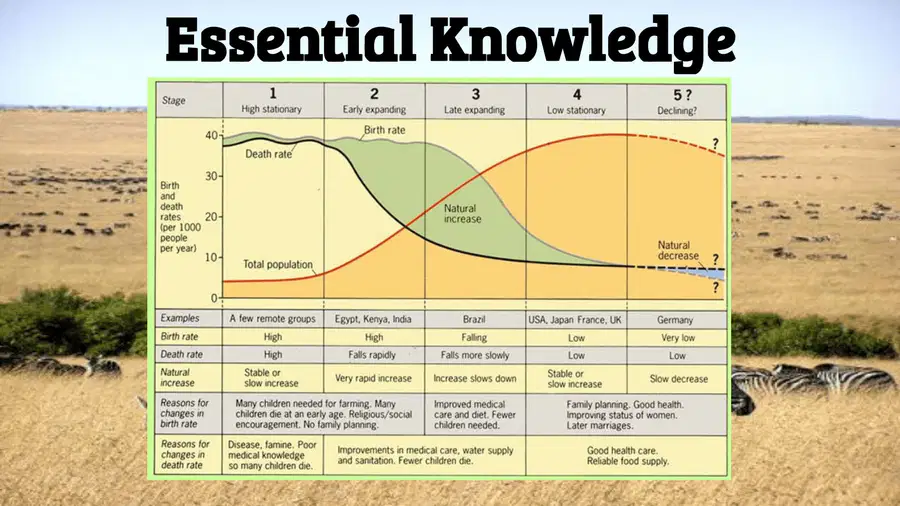
High birthrate and high death rate means the total population is low
stage 1
stage 2
stage 3
stage 4
stage 5
114
Multiple Choice
Population increases at a constant rate over time.
Exponential Growth
Logistic Growth
Stable Growth
Strategic Growth
115
Multiple Choice
Which describes the birth and death rate of Stage 3 of the DTM?
The death rate is decreasing and birth rate remains high
Both the death and birth rate are high
The death rate is low but the birth rate is high
Both the birth rate and death rate are decreasing
116
Multiple Choice
Which describes the birth and death rate of Stage 2 of the DTM?
The death rate is decreasing and birth rate remains high
Both the death and birth rate are high
The death rate is low but the birth rate is high
Both the birth rate and death rate are decreasing
117
Multiple Choice
In Stage 1, the birth rate is...
High
Falling
Low
118
Multiple Choice
In Stage 1, the death rate is...
High
Falling
Low
119
Multiple Choice
In Stage 2, the Total Population is...
Growing Slowly
Growing Quickly
Not Growing
120
Multiple Choice
In Stage 3, the Birth Rate is...
High
Dropping quickly
Low
121
Multiple Choice
In Stage 4, the Death rate is...
High
Rising
Low
122
Multiple Choice
In Stage 4, the Total Population is...
Growing Quickly
Leveling Out
Decreasing Quickly
123
Multiple Choice
In Stage 4, the Population Pyramid looks like...
124
Multiple Choice
What stage is this country in?
Stage 1
Stage 2
Stage 3
125
Multiple Choice
A characteristic of stage one of the Demographic Transition Model shows
High birth and death rates
Low death and high birth rates
Low birth and death rates
High death and low birth rates
126
Multiple Choice
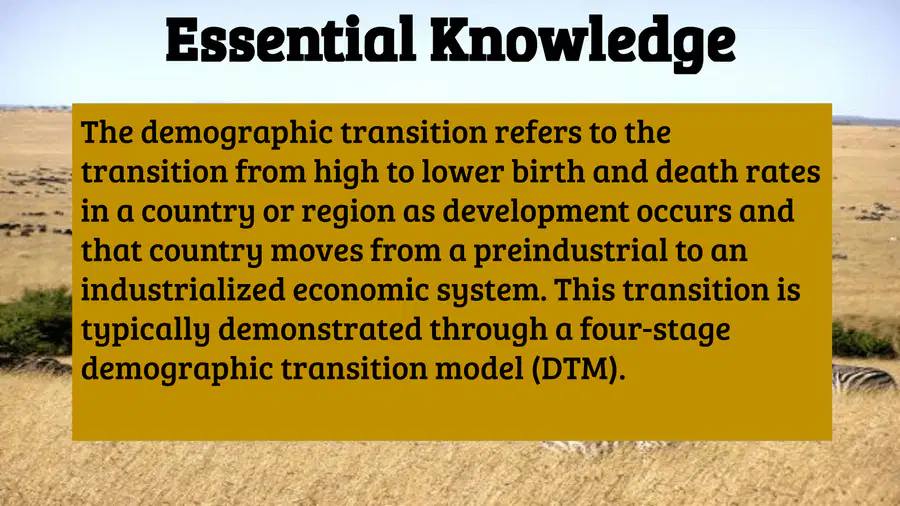
Which correctly describes the term demographic transition?
The transition from low birth rates and death rates to high birth rates and death rates as a country develops.
The transition from high birth rates and death rates to low birth rates and death rates as a country develops.
The transition from high birth rates to low death rates as a country develops.
The transition from low birth rates to high death rates as a country develops.
Show answer
Auto Play
Slide 1 / 126
SLIDE

Similar Resources on Wayground
121 questions
Why Big Data Matters?
Presentation
•
University
122 questions
Repaso Final Español
Presentation
•
University
116 questions
F6 E4 Unit 4.2 Manufacturing Industry ZDR
Presentation
•
12th Grade
123 questions
Writing Foundation 1
Presentation
•
University
119 questions
Topik 5 Larutan
Presentation
•
11th Grade
119 questions
AMINOACID CHEMISTRY
Presentation
•
University
118 questions
Unit 3 HSCCC Presentation
Presentation
•
12th Grade
123 questions
Health Skills Grade 12 Term 2 Chapter 7
Presentation
•
12th Grade
Popular Resources on Wayground
10 questions
Safety Day 2026 – Student Review
Quiz
•
9th Grade
21 questions
Continents and Oceans
Quiz
•
6th Grade
20 questions
Parts of Speech
Quiz
•
5th Grade
16 questions
Subject & Predicate
Quiz
•
5th Grade
25 questions
Multiplication Facts
Quiz
•
5th Grade
12 questions
Map Skills
Quiz
•
3rd Grade
22 questions
Continents and Oceans
Quiz
•
5th Grade
15 questions
Rounding Decimals
Quiz
•
5th Grade
Discover more resources for Science
7 questions
Newton's Laws Video Quiz
Interactive video
•
9th - 12th Grade
35 questions
Cell Transport/Enzyme/Cell/Macro Review
Quiz
•
9th - 12th Grade
13 questions
Explore Enzyme Functions and Interactions
Quiz
•
9th - 12th Grade
10 questions
Fact or Fiction: Microbes
Quiz
•
9th - 12th Grade
10 questions
Understand Cell Functions and Organelles
Quiz
•
9th - 12th Grade
19 questions
Explore Macromolecules in Living Organisms
Quiz
•
9th - 12th Grade
15 questions
Layers of Atmosphere passage
Passage
•
9th - 12th Grade
22 questions
Quiz Review Day 5 Water and Macromolecules
Quiz
•
9th - 12th Grade