
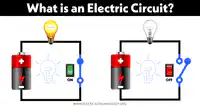
Electric Circuit

Presentation
•
Life Skills
•
9th Grade
•
Practice Problem
•
Easy

Jonalyn Cadavos
Used 4+ times
FREE Resource
28 Slides • 5 Questions
1

2

OBJECTIVES
1)
State the relationship between voltage, current and
resistance;
Apply ohm’s law in solving problems
problem
2)
3

Electric Current
Current is the rate of flow of
electrons/charge
- It is abbreviated as I
- It is measured in amperes
- One ampere is defined as one
coulomb of electrons flowing past a
point each second (Q/s)
4

VOLTAGE
- Voltage is a force that pushes/drives the electrons/
charge
- It is also referred to as electromotive force or difference in potential.
- It is abbreviated as E or EMF
- Voltage is measured in volts (v)
Voltage source will have a polarity (negative and
positive side)
Current flows from negative to positive (changing
conventions)
AC/DC: Alternating current (polarity of source
reverses) or Direct current (polarity is constant)
5

RESISTANCE
Resistances are the barriers to
the flow of charge
It is abbreviated as R
It is measured in ohms
6

ELECTRICAL CIRCUITS
7


The CELL
The cell stores chemical energy and transfers it to
electrical energy when a circuit is connected.
When two or more cells are
connected together we call this
a Battery.
The cells chemical energy is
used up pushing a current round
a circuit.
8

What is an electric current?
An electric current is a flow of microscopic particles
called electrons flowing through wires and
components.
+
-
In which direction does the current flow?
from the Negative terminal to the Positive terminal of a
cell.
9

simple circuits
Here is a simple electric circuit. It has a cell, a
lamp and a switch.
To make the circuit, these components are connected together with metal connecting wires.
cell
lamp
wires
switch
10

simple circuits
When the switch is closed, the lamp lights up. This is
because there is a continuous path of metal for the
electric current to flow around.
If there were any breaks in the circuit, the
current could not flow.
11

circuit diagram
cell
switch
lamp
wires
Scientists usually draw electric circuits using symbols;
12

circuit diagrams
In circuit diagrams components are represented by the following symbols;
cell
battery
switch
lamp
motor
ammeter
voltmeter
buzzer
resistor
variable
resistor
13


types of circuit
There are two types of electrical circuits;
SERIES CIRCUITS
PARALLEL CIRCUITS
14


The components are connected end-to-end, one after the other.
They make a simple loop for the current to flow round.
SERIES CIRCUITS
If one bulb ‘blows’ it breaks the whole circuit and
all the bulbs go out.
15


PARALLEL CIRCUITS
The current has a choice of routes.
The components are connected side by side.
If one bulb ‘blows’ there is still be a complete circuit to
the other bulb so it stays alight.
16

measuring current
Electric current is measured in amps (A) using
an ammeter connected in series in the circuit.
A
17

measuring current
A
This is how we draw an ammeter in a circuit.
SERIES CIRCUIT
A
PARALLEL CIRCUIT
18

measuring current
SERIES CIRCUIT
PARALLEL CIRCUIT
• current is the same
at all points in the
circuit.
2A
2A
• current is shared
between the
components
2A
2A
1A
1A
2A
19

copy the following circuits and fill in the
missing ammeter readings.
?
?
4A
3A
?
1A
?
3A
20

measuring voltage
The ‘electrical push’ which the cell gives to the current
is called the voltage. It is measured in volts (V) on a
voltmeter
V
21

Different cells produce different voltages. The
bigger the voltage supplied by the cell, the bigger the current
measuring voltage
Unlike an ammeter a voltmeter is connected across the components
Scientist usually use the term Potential Difference (pd) when they talk about voltage.
22

measuring voltage
V
This is how we draw a voltmeter in a circuit.
SERIES CIRCUIT
PARALLEL CIRCUIT
V
23

V
measuring voltage
V
V
V
24

series circuit
1.5V
• voltage is shared between the components
1.5V
3V
25

• voltage is the same in all parts of the circuit.
3V
parallel circuit
3V
3V
26
Multiple Choice

Identify the label of the electric circuit symbol presented.
Battery
switch
lamp
cell
27
Multiple Choice

Identify the label of the electric circuit symbol presented.
Battery
switch
lamp
cell
28
Multiple Choice

Identify the label of the electric circuit symbol presented.
Battery
switch
lamp
cell
29
Multiple Choice

Identify the label of the electric circuit symbol presented.
Battery
switch
lamp
cell
30
Multiple Choice

Identify the label of the electric circuit symbol presented.
Fuse
Lamp
Load
Electric Wires
31

measuring current & voltage
Assignment:
Copy the following circuits on the next two slides on 1/2 sheet of paper cross wise.
Complete the missing current and voltage readings.
Remember the rules for current and voltage in series and parallel circuits.
Submit next meeting.
32

measuring current & voltage
V
V
6V
4A
A
A
a)
33

measuring current & voltage
V
V
6V
4A
A
A
b)
A
Show answer
Auto Play
Slide 1 / 33
SLIDE
Similar Resources on Wayground

28 questions
ATP and Photosynthesis
Presentation
•
9th Grade
24 questions
El Verbo Tener
Presentation
•
9th Grade
26 questions
Inference & Observation
Presentation
•
9th Grade
26 questions
Nomenclature
Presentation
•
9th Grade
26 questions
Applications of Quadratics
Presentation
•
9th Grade
26 questions
Describing Data
Presentation
•
9th Grade
25 questions
Acceleration
Presentation
•
9th Grade
25 questions
Subject Verb Agreement
Presentation
•
9th Grade
Popular Resources on Wayground
10 questions
Safety Day 2026 – Student Review

Quiz
•
9th Grade
21 questions
Continents and Oceans
Quiz
•
6th Grade
20 questions
Parts of Speech
Quiz
•
5th Grade
16 questions
Subject & Predicate
Quiz
•
5th Grade
25 questions
Multiplication Facts
Quiz
•
5th Grade
12 questions
Map Skills
Quiz
•
3rd Grade
22 questions
Continents and Oceans
Quiz
•
5th Grade
15 questions
Rounding Decimals
Quiz
•
5th Grade
Discover more resources for Life Skills
20 questions
Budgeting
Quiz
•
9th - 12th Grade
20 questions
Investing
Quiz
•
9th - 12th Grade
20 questions
Managing Credit
Quiz
•
9th - 12th Grade
20 questions
Career
Quiz
•
9th - 12th Grade
20 questions
Taxes
Quiz
•
9th - 12th Grade
20 questions
Paying for College
Quiz
•
9th - 12th Grade
20 questions
Types of Credit
Quiz
•
9th - 12th Grade