
U5L4 - Lecture Notes - Metallic Bonds and Properties of Metals

Presentation
•
Chemistry
•
9th - 12th Grade
•
Practice Problem
•
Easy
Standards-aligned

Bryan Vaughan
Used 15+ times
FREE Resource
7 Slides • 10 Questions
1
2
3
Multiple Choice
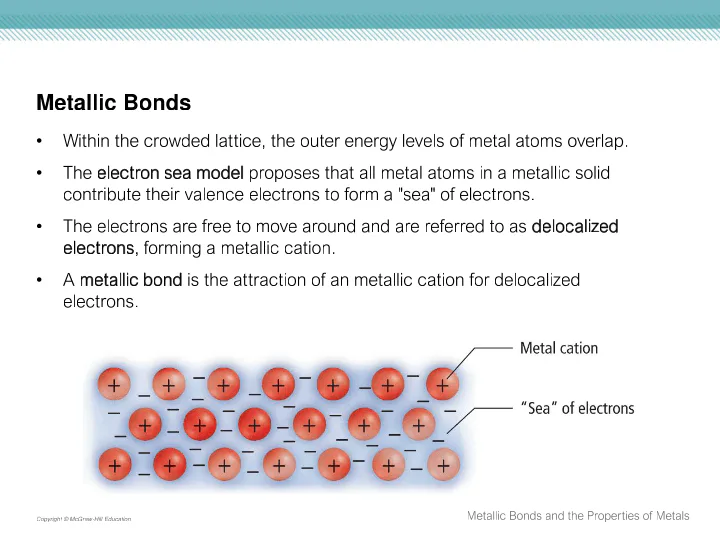
Which is the model that proposes that all the metal atoms in a metallic solid contribute their valence electrons to form a "sea" of electrons that surrounds the metal cations in the lattice?
the electron sea model
the metal lattice model
the cation sea model
4
Fill in the Blanks
The attraction of a metallic cation for delocalized electrons is a(n)________ ____ .
5
6
Multiple Choice
True or False: Metals are not ionic but share several properties with ionic compounds
True
False
7
Multiple Select
Which properties do metals and ionic compounds share?
Multiple select question.
They conduct electricity in the solid state.
They involve bonds between cations and anions.
They involve bonding that is based on the attraction of unlike charges.
They form lattice structures in the solid state.
8
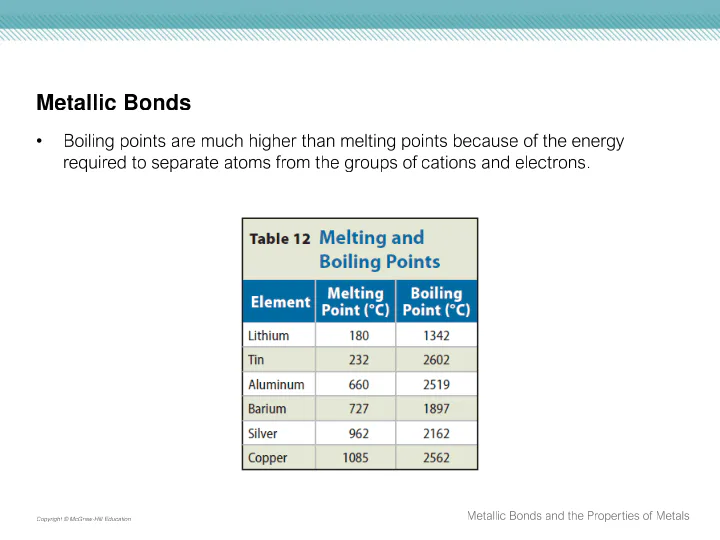
9
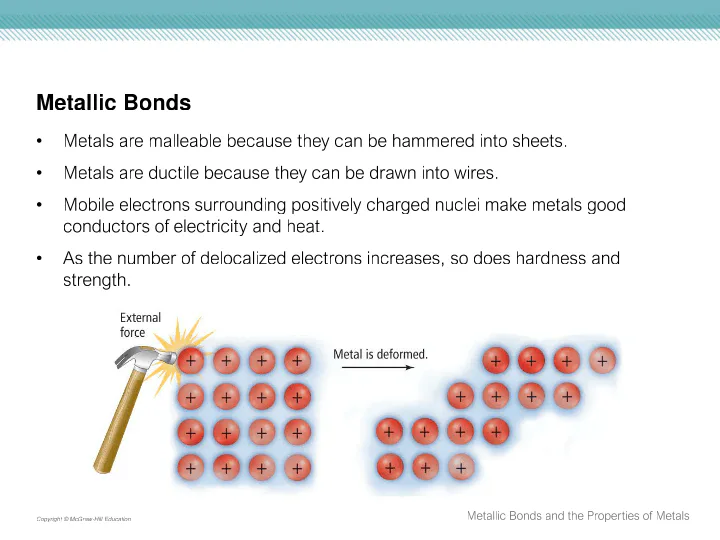
10
Fill in the Blanks
Metals are good thermal and electrical conductors because their
11
Fill in the Blanks
Metals are malleable and ductile because the cations and electrons involved in metallic bonding are
Type answer...
12

13
Multiple Choice
Compared with the properties of iron, its main component, the properties of steel ______.
are mostly similar, with some differences, such as added strength
are exactly the same, with the exception of appearance
are completely different, with the exception of chemical properties
14
Fill in the Blanks
A mixture of elements that has metallic properties is called a(n)
15
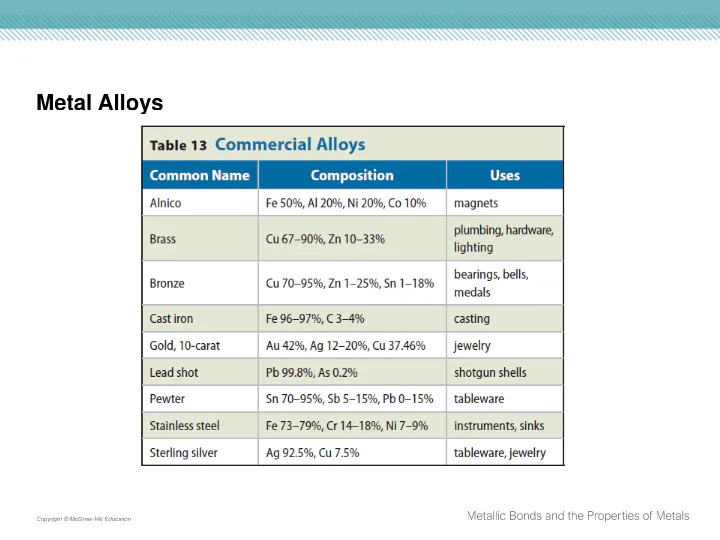
16
Multiple Select
The two basic types of alloys are ____________ alloys and ____________ alloys.
interstitial
substitutional
transitional
superstition
17
Match
Match each alloy with its description.
alnico
bronze
stainless steel
brass
pewter
iron, aluminum, nickel, cobalt; magnets
copper, zinc, tin; bearings, bells
iron, chromium, nickel; instruments,sink
copper and zinc;
plumbing, lighting
tin, antimony, and lead;
tableware
iron, aluminum, nickel, cobalt; magnets
copper, zinc, tin; bearings, bells
iron, chromium, nickel; instruments,sink
copper and zinc;
plumbing, lighting
tin, antimony, and lead;
tableware
Show answer
Auto Play
Slide 1 / 17
SLIDE
Similar Resources on Wayground

13 questions
Congruent Triangles
Presentation
•
9th - 12th Grade
11 questions
Spanish-speaking countries
Presentation
•
9th - 12th Grade
11 questions
Inverse Trig Functions
Presentation
•
9th - 12th Grade
13 questions
Spanish Double Object Pronouns
Presentation
•
9th - 12th Grade
12 questions
Significant Digits
Presentation
•
9th - 12th Grade
13 questions
Ch. 5.3 - Physics and the Quantum Mechanical Model
Presentation
•
9th - 12th Grade
12 questions
Word Choice,: Figurative, Connotative, and Impact
Presentation
•
9th - 12th Grade
11 questions
Teenager 5 Session 22: Pronunciation & Speaking
Presentation
•
KG
Popular Resources on Wayground
10 questions
Safety Day 2026 – Student Review

Quiz
•
9th Grade
21 questions
Continents and Oceans
Quiz
•
6th Grade
20 questions
Parts of Speech
Quiz
•
5th Grade
16 questions
Subject & Predicate
Quiz
•
5th Grade
25 questions
Multiplication Facts
Quiz
•
5th Grade
12 questions
Map Skills
Quiz
•
3rd Grade
22 questions
Continents and Oceans
Quiz
•
5th Grade
15 questions
Rounding Decimals
Quiz
•
5th Grade
Discover more resources for Chemistry
20 questions
electron configurations and orbital notation
Quiz
•
9th - 12th Grade
20 questions
Periodic Table Trends
Quiz
•
11th Grade
25 questions
Writing and Naming Binary Ionic compounds
Quiz
•
10th Grade
20 questions
COUNTING ATOMS
Quiz
•
10th Grade
50 questions
Unit 3: Atomic Assault Summative Review
Quiz
•
11th Grade
20 questions
Physical or Chemical Change/Phases
Quiz
•
8th Grade - University
15 questions
Periodicity Module Exam Practice Quiz
Quiz
•
9th - 12th Grade
20 questions
Naming Ionic Compounds
Quiz
•
10th Grade