Mirrors Part 1
Presentation
•
Science
•
8th Grade
•
Easy
Derrick Thompson
Used 5+ times
FREE Resource
28 Slides • 22 Questions
1
I can identify two kinds of reflections.
I can describe the types of images produced by plane, concave, and convex mirrors.

2
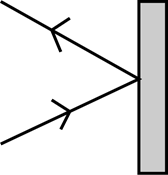
Regular Reflection: occurs when parallel rays of light hit a smooth surface. All rays reflect at the same angle and produce a clear image.
Diffuse Reflection: occurs when parallel rays of light hit an uneven surface and reflect at diferent angles producing an unclear image.
3
Top Image: Regular Reflection
Bottom Image: Diffuse Reflection
4
Multiple Choice
What type of reflection will this image produce?
Regular Reflection
Diffuse Reflection
5
An Image is a copy of the object formed by reflected or refracted light rays.
There are two types of Images: Virtual and Real
6
Virtual images are right side up
Virtual images have the left and right side reversed.
Virtual images form where light seems to come from (like behind the mirror)
Virtual images cannot be projected onto a screen
7
Real images are upside down
Real images form at the focal point where light rays meet
Real images can be projected onto a screen
8
Multiple Choice
What type of image is upside down?
real
virtual
9
Multiple Choice
What type of image can be projected onto a screen?
real
virtual
10
Multiple Choice
Which type of image is right side up but left and right are reversed?
real
virtual
11
There are three types of mirrors that we will discuss: Plane, Concave, and Convex.
12
Flat mirrors like the one you have in your bathroom. Creates an image that is:
Virtual and Same Size as the object
13
Curved (like the inside of a spoon)
Real or Virtual Images
(Virtual Image when object is between the focal point and the mirror)
(Real Image when object is beyond the focal point)
Size can be larger, smaller, or same (the closer to the focal point the larger it will appear)
14
15
virtual image smaller than the object
advantage is that it allows you to see a larger area but disadvantage is the image is reduced in size.
Used in driver side mirrors and on ceilings in stores for security.
16
17
There are two types of reflections: Regular and Diffuse
There are three types of mirrors (Plane, Concave, and Convex)
These mirrors can produce two types of images: Real or Virtual
Virtual Images are right side up
Real Images are upside down
18
Multiple Choice
Now I get it! There are two types of reflections: __________ and ____________
Diffuse and Regular
Real and Virtual
19
Multiple Choice
An ___________ is a copy of an object formed by the reflected or refracted rays of light.
Image
Convex
concave
plane
20
Multiple Choice
A ___________ mirror can produce both real and virtual images.
plane
concave
convex
21
Multiple Choice
What kind of image does a convex mirror produce?
real but smaller
virtual but smaller
22
Multiple Choice
What kind of image does a plane mirror produce?
real and same size
virtual and same size
23
Multiple Choice
What do you call a flat mirror?
plane mirror
convex mirror
concave mirror
24
25
26
27
28
29
30
31
32
33
34
35
36
37
38
Draw the image then share with class
39
Multiple Choice
Why it is written in this manner?
Mirrors in front vehicles invert it upside down
Mirrors in front vehicles invert it left to right
Mirrors wont invert
40
Multiple Choice
True or False: This diagram shows the correct position of the mirrors so that the light hits the target
True
False
41
Multiple Choice
In the illustration, the light ray striking the object is-
42
Multiple Choice
If the angle of incidence in the diagram is 80°, the angle of reflection will be:
10°
100°
90°
80°
43
Multiple Choice
An imaginary line that is drawn at a right angle (90 degrees) to a mirror (Green line)
Reflection Ray
Normal
Incidence Ray
Light Ray
44
Multiple Choice
The angle between the reflected ray and the normal (labelled Y on the diagram).
Angle of Incidence
Angle of Reflection
Angle of Normal
Angle of Light
45
Multiple Choice
The angle between the incident ray and the normal. (X on the diagram)
Angle of X-Ray
Angle of Reflection
Angle of Incidence
Angle of Normal
46
Multiple Choice
The ray that bounces off the mirror.
Angle of Reflection
Incidience Ray
Reflected Ray
Angle of Reflection
47
Multiple Choice
The ray of light that strikes a mirror
Reflected Ray
Incidence Ray
Angle of Incidence
Angle of Reflection
48
Multiple Choice
The angle of incidence is equal to the angle of reflection
Law of Reflection
Law of Light
Incidence Ray
The Normal
49
Multiple Choice
50
Multiple Choice
If the man is 4 m from the mirror, his image is how far from the mirror?
2 m
4 m
8 m
I can identify two kinds of reflections.
I can describe the types of images produced by plane, concave, and convex mirrors.

Show answer
Auto Play
Slide 1 / 50
SLIDE

Similar Resources on Wayground
44 questions
M1 Re-Test Q3 topics
Presentation
•
7th Grade
46 questions
Community Ecology Review
Presentation
•
9th Grade
42 questions
1-Chemistry Basics Lesson
Presentation
•
8th Grade
46 questions
Calculating Net Forces GuidedLesson
Presentation
•
6th - 8th Grade
49 questions
Ecology Review
Presentation
•
8th Grade
45 questions
7th Grade Final Review Part 1
Presentation
•
7th Grade
49 questions
reproduction Lesson 3
Presentation
•
8th Grade
45 questions
Chemical Reactions -Revision
Presentation
•
7th - 9th Grade
Popular Resources on Wayground
10 questions
Safety Day 2026 – Student Review
Quiz
•
9th Grade
21 questions
Continents and Oceans
Quiz
•
6th Grade
20 questions
Parts of Speech
Quiz
•
5th Grade
16 questions
Subject & Predicate
Quiz
•
5th Grade
25 questions
Multiplication Facts
Quiz
•
5th Grade
12 questions
Map Skills
Quiz
•
3rd Grade
22 questions
Continents and Oceans
Quiz
•
5th Grade
15 questions
Rounding Decimals
Quiz
•
5th Grade
Discover more resources for Science
20 questions
Newton's Laws of Motion
Quiz
•
8th Grade
15 questions
potential and kinetic energy
Quiz
•
8th Grade
21 questions
Newton's Laws of Motion
Quiz
•
8th Grade
20 questions
Elements, Compounds and Mixtures
Quiz
•
8th Grade
10 questions
Exploring Chemical and Physical Changes
Interactive video
•
6th - 10th Grade
20 questions
Physical vs Chemical Changes
Quiz
•
8th Grade
20 questions
Conduction, convection, and Radiation Practice
Quiz
•
8th Grade
21 questions
Waves and Wave Properties
Quiz
•
6th - 8th Grade