

Cognitive MASTER SLIDES

Presentation
•
History
•
11th Grade
•
Practice Problem
•
Hard

Mr. T.
FREE Resource
92 Slides • 0 Questions
1

The Cognitive Level of
Analysis
IB Psychology
2

“The Cognitive Revolution”
1. Around the 1950’s psychologists began to explore
cognition to further understand behavior.
2. Prior to this, ‘observable behavior’ was studied and
this shift was called the Cognitive Revolution.
3. Cognitive Psychologists suggested that humans form
internal mental representations to guide behavior.
4. Topics such as memory, perception, artificial
intelligence, amnesia and social cognition are studied.
3

Basic Information
Cognitive psychology is concerned with how
people acquire, store, transform, use and
communicate information.
Cognitive psychologists rejected the behaviorist
assumption which stated that mental events or
states were unsuitable for scientific research.
Believe that one cannot fully explain behavior in
terms of stimulus-response connections
(behaviorism)
This approach deems the person as important
as environmental or biological stimuli alone.
4

Key Concepts of Cognitive Psych
Schema Theory
Information Processing
Memory
Heuristics and Problem Solving
Cognitive Dissonance
Perception, attention, memory, language
5

Basic Assumptions
1. Mental processes guide behavior!
- Psychologists see the mind as a complex
machine—rather like an intelligent,
information processing machine using
hardware (brain) and software (mental images
or representations).
- Cognitive processes actively organize and
manipulate information that we receive -
humans are NOT passive responders to
their environment.
- Reconstructive memories, perception and info-
processing arise out of this idea.
6

The Necker Cube: A visual test of perception.
Look at the object for a few seconds: Is the red dot on the near or far
corner? What happens if you stare at the red dot for a few seconds?
- The images has two meaningful representations and the brain switches
back and forth between them, because the brain does not know which
way to interpret it.
7

2. Mental processescanand should be
investigated scientifically.
- Cognitive Psychologists believe that you cannot
simply learn about behavior through stimulus-
response interactions.
- therefore cognitive psychologists develop
theories and use a number of scientific
research methods to learn about human
cognition
8

3. Cognitive Processes are influenced by
social and cultural factors.
- Ex. Frederic Bartlett, who coined the term schema, states
that cultural schemas influence remembering.
Schema: A mental representation of knowledge.
9

Cognitive Processes
The human mind is sophisticated and has the
ability to manipulate abstract symbols,
words and images
These mental representations are organized
into categories, and allow us to think about
situations and imagine what may happen.
Mental Representations are how we store
images and ideas in memory.
10

I. A Theory of Cognitive Process: Schema Theory
Created by Frederic Bartlett (1886-1969), he carried
out studies on reconstructive memory to show how
humans process information using pre-existing
“schemas”.
Read a Native American story “The War of the Ghosts” to
20 English participants and found that as the story was read
more to them their recall of the story dropped from 330
words to about 180 and often substituted bits of the story to
match previous experiences.
The recalled story gradually became more Western as items
such as the ‘canoe’ was changed to a ‘boat’. The ghosts
were often forgotten because they are not an important
feature of Western culture.
This indicates that memory is influenced by our existing
knowledge, which in turn is created by the culture in which
we live
11

Schema Theory is a cognitive process about information
processing. They are “organizational frameworks of the
mind”.
It can describe how specific knowledge is organized and
stored in memory so that it can be accessed and used
when it is needed.
One cannot see a schema inside someone else’s head,
but psychologists believe it gives us insight into the
mind nonetheless.
Schema theory suggests that humans are active
processors of informationand so when it a certain
situations we use our schemas as templates dictating
how to react or behave.
Cognitive Schema: can be defined as networks of knowledge,
beliefs, and expectations about particular aspects of the world.
12

Evaluation of Schema theory
Strengths:
It is clear that schema theory pertains to how
we categorize information and interpret
stories and make inferences.
It has contributed to our understanding of
“memory distortions” (Bartlett)
Social psychologists often refer to “social
schemas” in explaining the origins of
prejudice and stereotyping.
It supports the idea that culture can effect our
way of thinking (memory).
13

Limitations:
It is not clear how schemas are acquired in
the first place and how they actually
influence our cognitive processes.
Furthermore, some say that the concept of
schemas are too vague (Cohen, 1993) and
thus are not useful.
14

The Cognitive Level of Analysis
Discuss how social or
cultural factors affect
one cognitive process.
Identify and evaluate
schema theory with
reference to research
studies.
What short stories do you
remember from your
childhood?
Aim(s):
Do Now:
Homework:
See Agenda
15

REVIEW SLIDE: Schema theory
– Mental frameworks used to organize information.
Frederic Bartlett coined the term schema and stated that
cultural schemas influence remembering.
16

One cannot see a schema, but psychologists believe it
gives us insight into the mind.
Schema theory suggests that humans are active
processors of information.
REVIEW SLIDE: Schema Theory
17

See the handout and read through Bartlett’s Study on
Reconstructive Memory.
Summarize Bartlett’s contribution to Cognitive
Psychology
Identify and evaluate schema theory with reference
to research studies.
Bartlett’s Study of
Reconstructive Memory
18

Try to remember what is happening in the image
that will flash on the screen.
19

(Allport & Postman, 1947)
Many recalled that a white man had been
threatened with a razor by a black man.
20
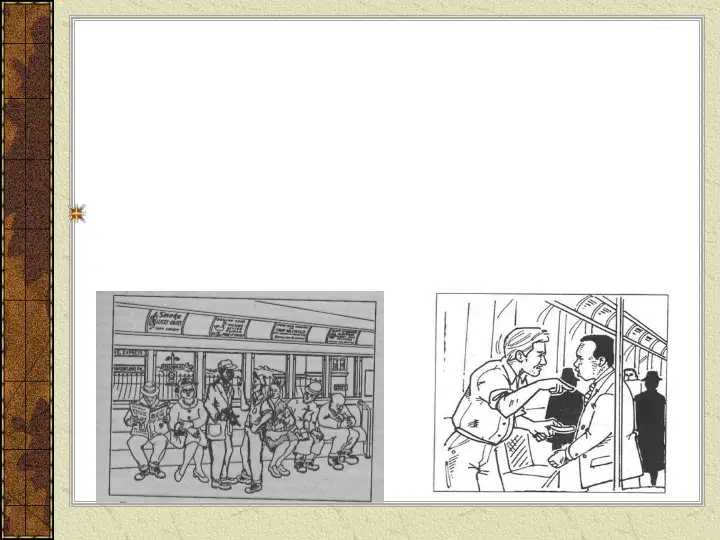
SCHEMA THEORY
Schema theory indicates that prior expectations
will influence our perceptions.
Stereotypes will lead to changes in how we
subsequently remember information.
21

REVIEW SLIDE:
Evaluation of Schema theory
Strengths:
Contributed to our understanding of “memory
distortions” (Bartlett)
“Social schemas” can explain the origins of
prejudice and stereotyping. (Cultural Impact)
22

Limitations
:
It is not clear how schemas are acquired in the first
place and how they actually influence cognitive
processes.
REVIEW SLIDE:
Evaluation of Schema theory
23

Big Idea
Explain how memory is shaped by
cultural factors.
24

The Cognitive Level of Analysis
Outline Principles that
define the Cognitive
L.O.A and explain how
these principles may be
demonstrated in
research.
(Principle/Assumption #2:
The mind can be studied scientifically
–
Using
the case of Loftus and Palmer, 1974)
What is eyewitness
testimony? Do you believe it
is reliable? Explain.
Aim:
Do Now:
Homework:
See Agenda
25
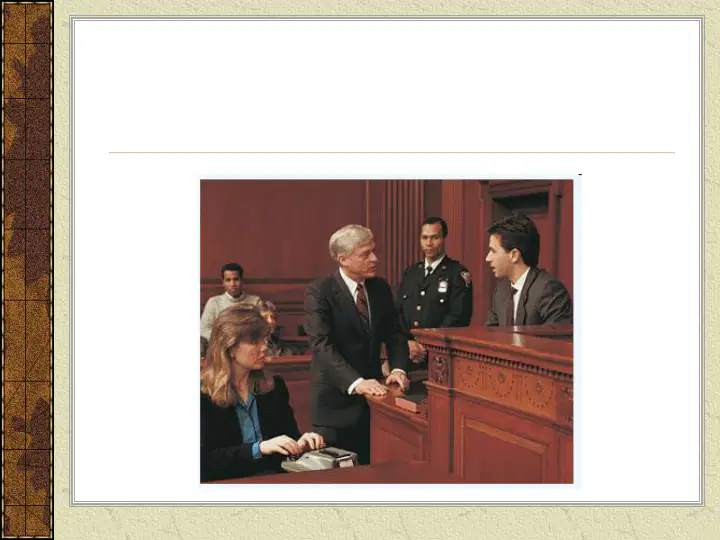
Loftus and Palmer, 1974
(The reliability of eye-witness testimony?)
The Study Overview (with video): http://www.simplypsychology.org/loftus-palmer.html
26
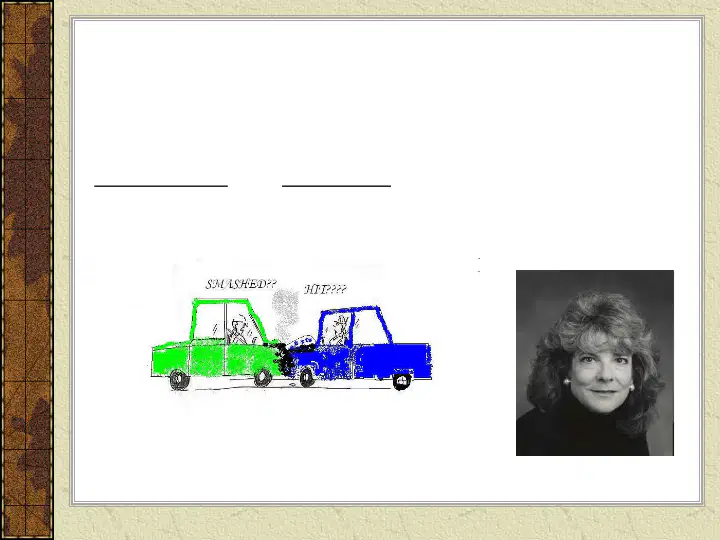
Elizabeth Loftus
Psychology professor and expert researcher on the
malleability and reliability of memory, an instrumental
figure in cognitive psychology.
27
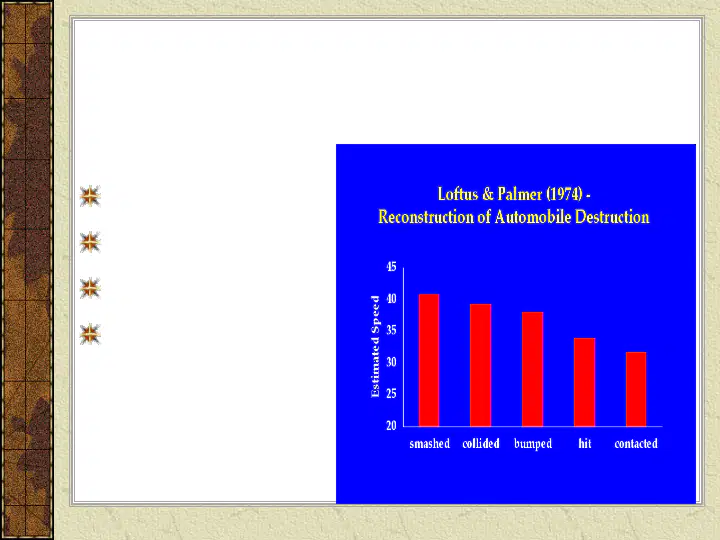
Loftus and Palmer
Smashed: 41
Collided: 39
Bumped: 38
Hit: 34
Contacted: 32
28
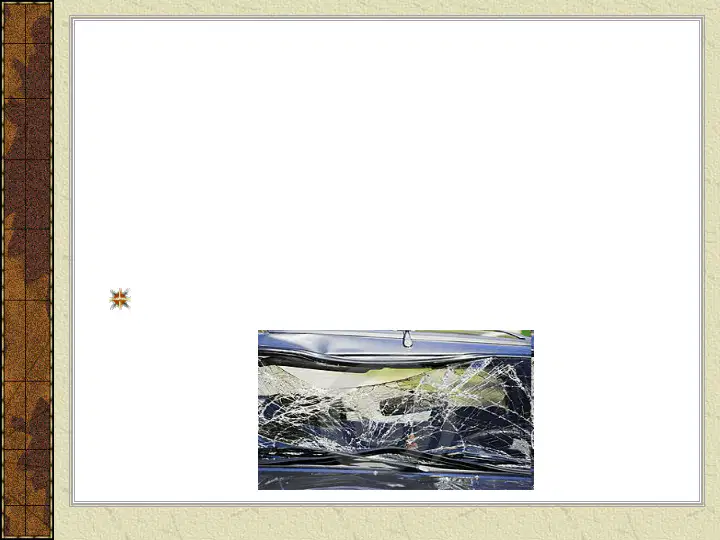
Follow up
One hundred and fifty participants
– Smashed:
– Hit:
– Not asked:
1 week later: Did you see broken glass?
29
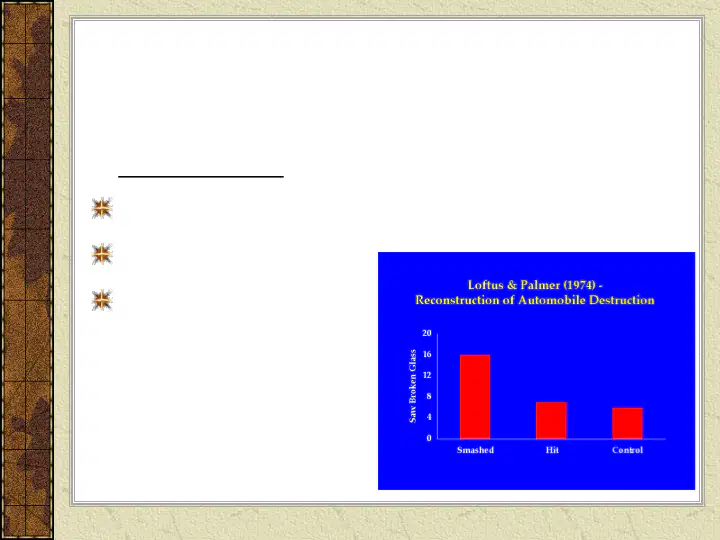
Follow up
1 week later: Did you see broken glass?
Smashed: 32%
Hit: 14%
Not asked: 12%
30
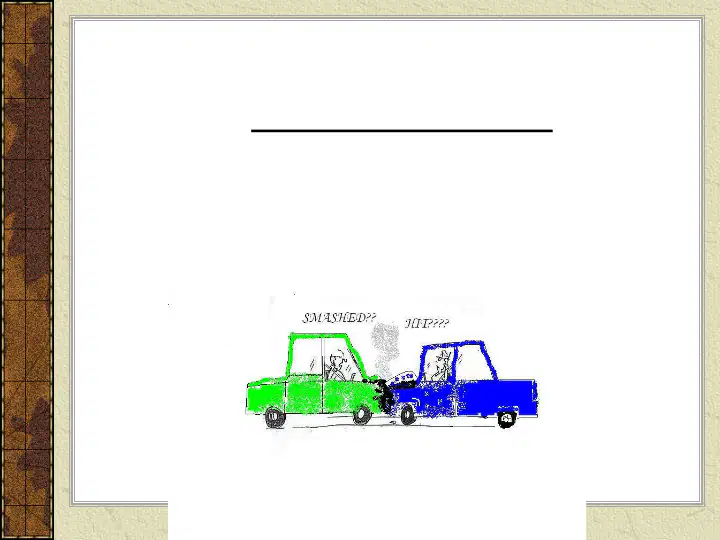
Criticisms - Method
LOW Ecological Validity
Why?
The experiment was not typical of real life situations.
31

Two kinds of information go into a person's
memory of an event:
1st:
the information obtained from an event
2nd: the information supplied after the event
Over time, the information from the two sources
may be integrated that we are unable to tell from
which source some specific detail is recalled. All
we have is one 'memory'. (Reconstructive
hypothesis)
32

ABC NEWS LIVE EXPERIMENT
Aired 11/10/17
The reliability of eye-witness testimony?
http://abcnews.go.com/GMA/video/expert-explains-eyewitness-testimonies-
unreliable-solving-crimes-51054920
33
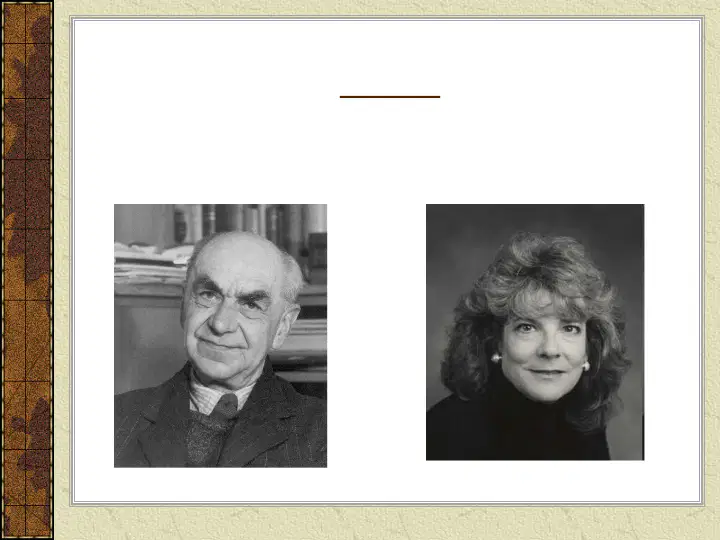
Close
How does Bartlett’s work relate to the work
of Elizabeth Loftus?
34

The Cognitive Level of Analysis
Evaluate two models or
theories of one
cognitive process:
Memory.
What lesson do you remember
most from this class, this
year? Why do you think that
is the case?
Aim:
Do Now:
Homework:
See Agenda
35

II
.
Evaluate two models or theories of one
cognitive process:
Memory
Most people take memory for granted
--
until they forget
something. Yet the fact that we remember more often than
we forget tends to lead us to overlook the underlying
complexity of memory as a cognitive process.
Many important researchers contributed to what we
understand about memory and how our brains store,
acquire and process memories.
Memory Games
(
http://www.exploratorium.edu/memory/dont_forget/index.html
)
36

Short
–
Term Memory
Information is selected by attention from
sensory memory into STM. This allows us to
retain information long enough to use it.
Peterson and Peterson
(1959) have
demonstrated that STM lasts approximately
between
15 and 30 seconds
, unless people
rehearse the material, while Miller (1956) has
found that STM has a limited capacity of
around 7+/
-
2 ‘chunks’ of information.
37

LTM provides the lasting retention of
information, from minutes to a lifetime. Long
term memory appears to have an almost
limitless capacity
. LT information seems to
be encoded mainly in terms of
meaning
.
Long Term Memory
38

A.
The “
Multi
-
Store Model
”
-
S
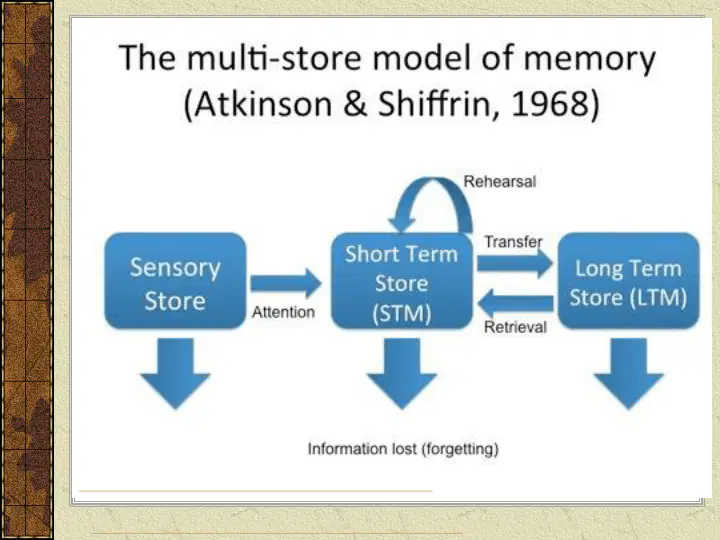
imilarly to the analogy that our brain processes information
similar to a
computer
,
Atkinson and
Shiffrin
(1968)
proposed a
three
-
stage processing
model of memory.
Sensory memory
→
short term memory
→
long term memory
Models are based on two assumptions
:
1.
M
emory consists of a # of separate “stores”
2.
M
emory processes are sequential :
attention
→
coding
→
rehearsal
39
http://www.youtube.com/watch?v=vW5zAY4RhOs
http://www.youtube.com/watch?v=egzvLaP3498
40
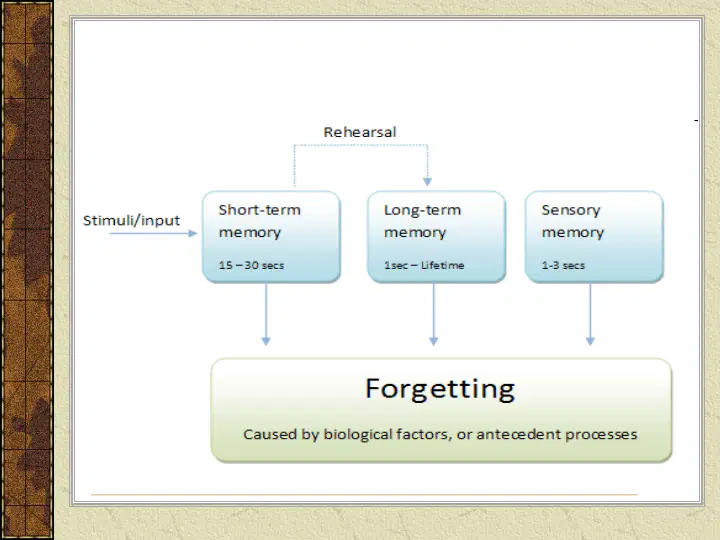
The Atkinson-Shiffrin Model – 1968
(Multiple-Store Model of Memory)
Multi-Store Model Song: http://www.youtube.com/watch?v=-vmpRKsk_nk
41
1.
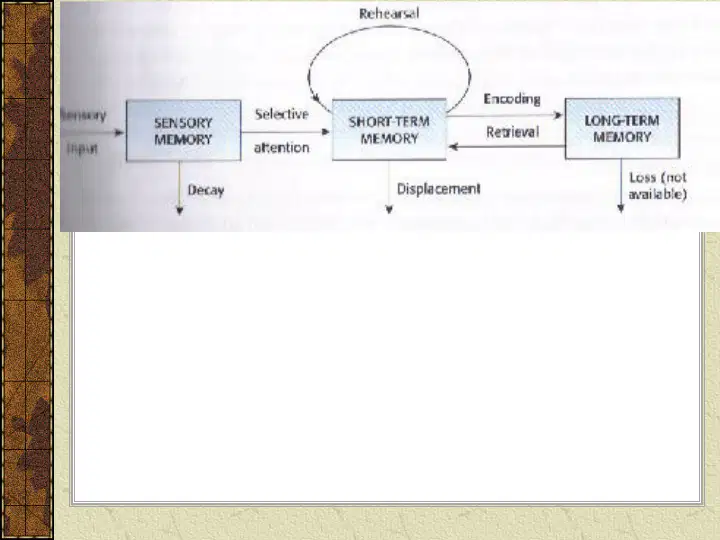
Only a small amount of information makes past the
sensory
memory
to Short Term Memory (
STM)
. The capacity of STM is
limited to around 7 items for 6
-
12 seconds.
2. Rehearsal is an important factor if info is to get to
Long Term
Memory (LTM)
.
3. LTM
is described as a vast storehouse of information. Memories
may often be distorted when they are retrieved but we fill in the
gaps as predicted by schema theory.
42
Criticism to Atkinson-Shiffrin
The model is too simplistic. Does not
accommodate for the subdivisions of STM and
LTM memory stores.
43
Evidence of the Multi
-
Store
Model of Memory
S
erial Position
E
ffect
refers to the finding that
recall accuracy varies as a function of an item's
position within a list.
–
When asked to recall a list of items in any order (free
recall), people tend to begin recall with the
end
of the
list, recalling those items best (the
recency
effect
).
–
Among earlier list items, the
first
few items are recalled
more frequently than the middle items (the
primacy
effect
).
44
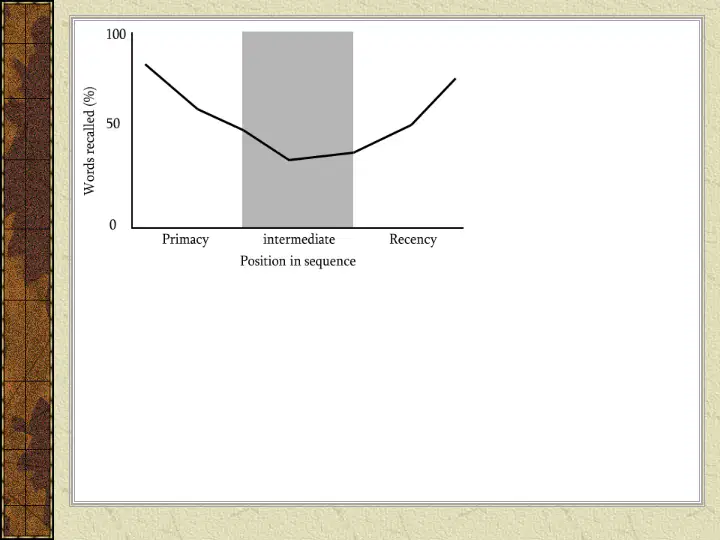
Graph showing the
serial position effect,
the vertical axis
shows the percentage
of words recalled, the
horizontal axis shows
their position in the
sequence
One suggested reason for the primacy effect is that the initial
items presented are most effectively stored in
long
-
term memory
because of the greater amount of processing devoted to them.
One suggested reason for the
recency
effect is that these items
are still present in
working memory
when recall is solicited.
Items that benefit from neither (the middle items) are recalled
most poorly.
45

B.
The “
Working Memory Model
”
Created by
Baddeley
and Hitch
(1974) in which they
proposed their
‘working memory model’ as an alternative to the short
-
term store in
Atkinson &
Shiffrin's
'multi
-
store' memory model (1968). This model
builds off of the multi
-
store model. However, they believe that STM is a
single store and is broken down into many components.
Attempts to
describe a more accurate model of Short Term Memory (STM).
1.
The Central Executive
:
controlling
system that monitors
and coordinates the operations of other components, which
are called “
slave systems
”
-
most important job is “
attentional control
” which is
accomplished in two ways:
a.
Automatic level
is based on habit and controlled more
or less automatically by stimuli from the
env’t
.
b.
Supervisory Attentional Level
: deals w/ emergencies
or creates new strategies when the old ones are no
longer sufficient.
46
2. The Episodic Buffer: the role of the buffer is to act as
a temporary and passive display store until the information
is needed – much like a television screen.
3. The Phonological Loop: divided into two components
a. Articulatory control system, orinner voice, which can
hold information in a verbal form. (ex. When you try to
remember a telephone # and repeat it to yourself.)
b. Phonological Store, or inner ear. It holds speech-based
material in a phonological form.
4. The Visuospatial Sketchpad: also called the inner eye;
and deals w/ visual and spatial info from either sensory
memory or LTM.
47
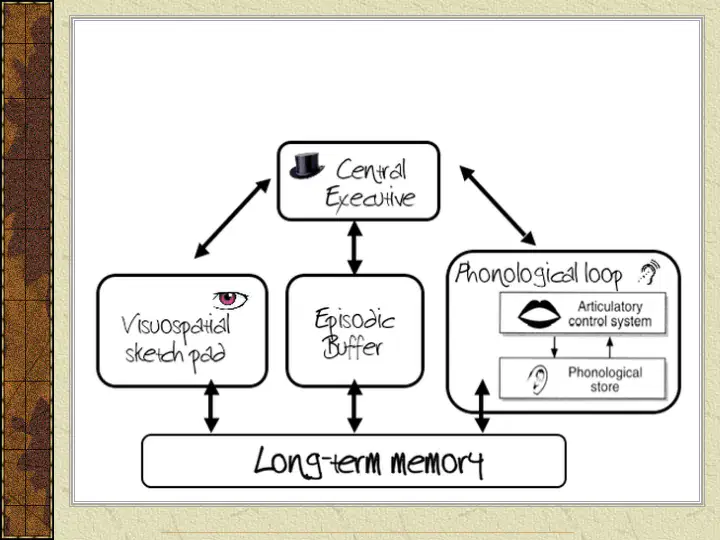
The Working Memory Model
(Baddeley and Hitch, 1974)
SONG: http://www.youtube.com/watch?v=4gg6Xd1teZ0
48

Evidence of Working Memory
Today we use “dual-task techniques” to illustrate the
presence of working memory.
This is when you ask the participant to carry out a
cognitive task while carrying out another and hope
that the 1st task is “interfering the 2nd”.
If the two tasks interfere with each other so that one
or both are impaired, it is believed that both tasks
use the same component of STM.
49

Evaluation
of the Model
It includes active storage and processing, which makes it
useful for explaining a variety of cognitive tasks, more so
than the multi
-
store model.
This model is able to explain why people are able to
perform different cognitive tasks simultaneously without
disruption
-
“multi
-
tasking”
Work done by
Gathercole
(2001) has given us insight of
how disruption of working memory is associated with
deficits in academic performance.
–
Ex. He says that deficits in the phonological loop lead to deficits
in mathematics and reading.
Eysenck
(1988) found that
ind
v
diff. in intelligences may
depend on diff in working memory.
50

Application & Criticism
The working memory model explains many
practical observations, such as why it is
easier to do two different tasks (one verbal
and one visual) than two similar tasks (e.g.,
two visual.) However, the concept of a
central executive has been criticized as
inadequate and vague – Further research is
being conducted.
51

The Cognitive Level of Analysis
Explain how
biological factors
affect one cognitive
process: brain
damage → memory
In what ways do you think
your brain impacts your
memory?
Aim:
Do Now:
Homework:
See Agenda
52

III. Explain how biological factors affect one
cognitive process: brain damage → memory
A.
Hippocampus
:
•
Research by Kandel found that the hippocampus is
important in the formation of explicit memories
(fact based info)
•
Case studies have shown that damage here results
in the inability to form new explicit memories but
still can form newimplicit memories (procedural
and/or emotional memories)
53

B.
Amygdala
•
Found to play a role in the storage of
emotional
memories
•
According to LeDoux, certain memories have
emotional significance and this might explain why
memories based on emotional events are
remembered better.
•
Could give us insight into PTSD (post-traumatic
stress disorder) and why some have problems
forgetting, because emotional memories are
difficult to get rid of.
54
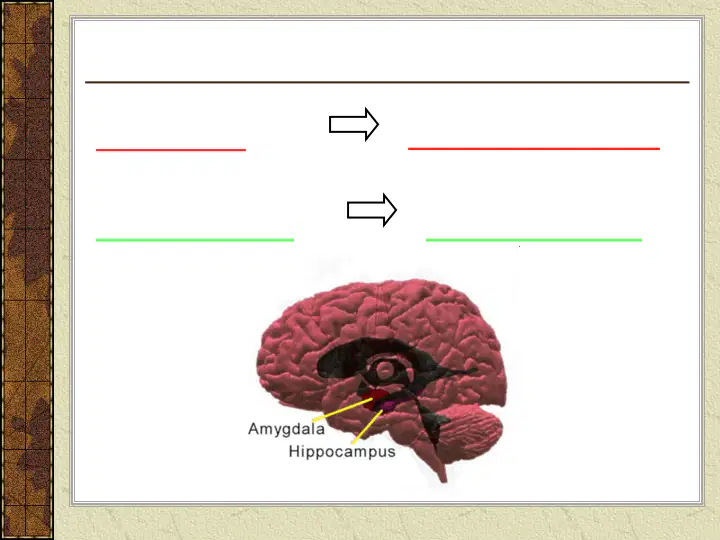
Biological Connection to Memory
The Amygdala
emotional memory
The Hippocampus
explicit memory
55

C.
Brain Damage and Memory
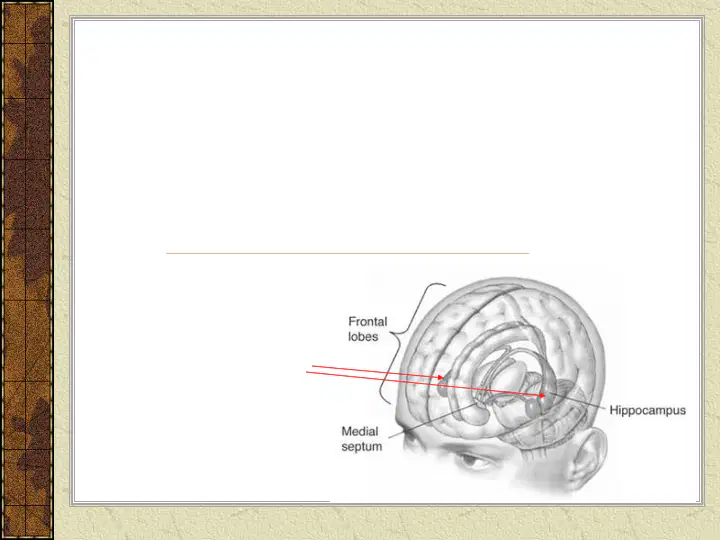
1. Clive Wearing: he suffers from both
anterograde and retrograde amnesia.
- Anterograde amnesia: the inability to make new
memories
- Retrograde amnesia: the inability to remember
old memories
- MRI scans show damage to Clive’s
hippocampus and some frontal regions.
56
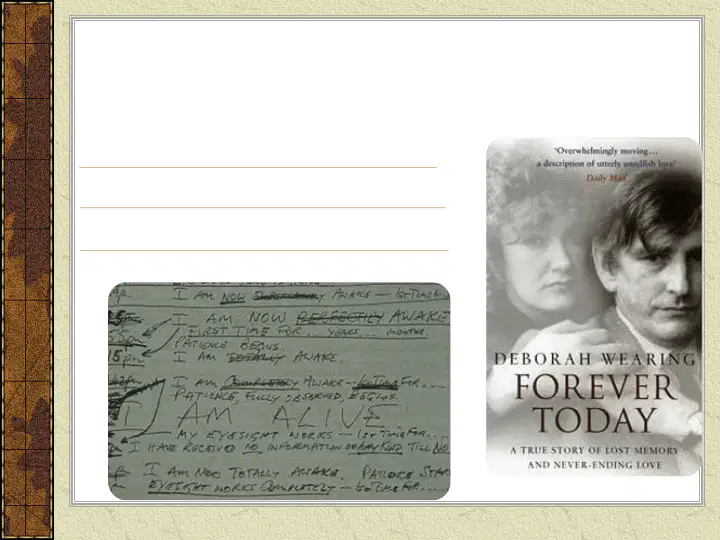
Clive Wearing
“The Man with no Long Term Memory”
http://www.youtube.com/watch?v=Vwigmktix2Y
(General - 3 minutes)
http://www.youtube.com/watch?v=c62C_yTUyVg
(Overview of Case - 13 minutes)
http://www.youtube.com/watch?v=9BrCBq2FY_U
(Overview of Brian - 9 minutes)
57
2. “H.M.” (1926-2008)was one of the most famous and
important case studies to modern cognitive neuroscience and
our understandings of memory.
Described by Brenda Milner and William Scoville (1957)
(1953) HM had a partial resection of his medial temporal lobe
(MTL) as an attempt to stop his epileptic seizures.
Medial Temporal Lobe
http://www.youtube.com/watch?v=IKP6tBhM2T4 (2 minutes)
58
After the surgery he suffered from severe
anterograde amnesia (inability to make new
memories after the trauma): although his working
memory and procedural memory were intact, he
could not commit new events to long-term
memory.
He also suffered moderate retrograde amnesia, and
could not remember most events in the 3–4 -day
period before surgery, and some events up to 11
years before, meaning that his amnesia was
temporally graded.
However, his ability to form long-term procedural
memories was still intact; thus he could, as an
example, learn new motor skills, despite not being
able to remember learning them.
59

1. Craik and Lockhart (1972)
The levels of processing framework was presented as an
alternative to theories of memory.
States that stimulus information is processed at multiple levels
simultaneously depending upon its characteristics. Furthermore,
the "deeper" the processing, the more that will be remembered.
Ex: information that involves strong visual images or many associations with
existing knowledge will be processed at a deeper level.
- Similarly, information that is being attended to receives more processing
than other stimuli/events.
The theory also supports the finding that we remember things
that are meaningful to us because this requires more processing
than meaningless stimuli.
Other Theories of Memory…..
60
The Cognitive Level of Analysis
Discuss how Social and
Cultural Influence
affect
one Cognitive
Process.
Evaluate the extent to
which the cognitive
process is reliable.
cohnitive
process
Do you believe eyewitness
testimony is reliable? Explain
Aim:
Do Now:
Homework:
See Agenda
61

V. Discuss how Social and Cultural
Influence effect one Cognitive Process:
It should be of no surprise that cognition is
influenced by the environment around you.
With globalization and modern technology it
requires all of us to have specialized education
- think about how much we have to learn and need to memorize from
school (math, psychology, language etc.)
According to Jerome Bruner, children of any culture
learn the basics of culture through schooling and
daily interaction with members of the culture in
which they live.
62

A. The role of schooling on remembering
Research has shown that memory tests done on
Western cultures do not always give the same data in
other regions of the world.
1. Cole & Scribner (1974): Memory strategies in
different cultures:
- Compared word recall between US and Kpelle
people of rural Liberia.
- Realized that they could not use the same words for
both cultures so they started to observe daily
activities of Kpelle people, so words were more
relevant.
- compared data from school vs. non-school children
in Liberia.
63

- Asked children to recall as many items as possible from 4
categories: utensils, clothes, tools, and vegetables.
Results:
a.
Children without schooling could not increase recall even
after practicing. Remembered 10 items the first time and
only 2 more after 15 practice trials
b.
Children with schooling learned list just as quickly as US
children and used similar techniques such as “chunking”
c.
In a later trial, the researchers presented the objects in a
story (narrative). The illiterate children recalled the objects
more so.
d.
Other studies confirm these results (Rogoff & Wadell,
1982) found that Mayan children could easily recall objects
if put into a meaningful story format.
64

REVIEW SLIDE:
A Theory of Cognitive Process: Schema Theory
Created by Frederic Bartlett (1886-1969), he carried
out studies on reconstructive memory to show how
humans process information using pre-existing
“schemas”.
Read a Native American story “The War of the Ghosts” to
20 English participants and found that as the story was read
more to them their recall of the story dropped from 330
words to about 180 and often substituted bits of the story to
match previous experiences.
The recalled story gradually became more Western as items
such as the ‘canoe’ was changed to a ‘boat’. The ghosts
were often forgotten because they are not an important
feature of Western culture.
This indicates that memory is influenced by our existing
knowledge, which in turn is created by the culture in which
we live
65
REVIEW SLIDE:
Schema Theory is a cognitive process about information
processing. They are “organizational frameworks of the
mind”.
It can describe how specific knowledge is organized and
stored in memory so that it can be accessed and used when it
is needed.
One cannot see a schema inside someone else’s head, but
psychologists believe it gives us insight into the mind
nonetheless.
Schema theory suggests that humans are active processors
of informationand so when it a certain situations we use our
schemas as templates dictating how to react or behave.
Cognitive Schema: can be defined as networks of knowledge,
beliefs, and expectations about particular aspects of the world.
66

REVIEW SLIDE:
Evaluation of Schema theory
Strengths:
It is clear that schema theory pertains to how we
categorize information and interpret stories and make
inferences.
It has contributed to our understanding of “memory
distortions” (Bartlett)
Social psychologists often refer to “social schemas” in
explaining the origins of prejudice and stereotyping.
It supports the idea that culture can effect our way of
thinking (memory).
67
REVIEW SLIDE:
Limitations:
It is not clear how schemas are acquired in
the first place and how they actually
influence our cognitive processes.
Furthermore, some say that the concept of
schemas are too vague (Cohen, 1993) and
thus are not useful.
68
VI. Reliability of one cognitive process: Memory
How reliable is memory? Recently legal systems
have learned more towards DNA evidence because
of the inconsistencies of memory.
“Reconstructive memory” allows one to explain
how memory may be influenced by other factors
1. Frederic Bartlett:
- his “War of the Ghost” experiment showed how
culture effects the reconstructive process of
memory and how schemas influence memory
recall.
- Stated the more complicated the story, the more
elements will be forgotten or distorted.
69

2. Elizabeth Loftus
The most horrifying idea is that what we believe
with all our hearts is not necessarily the
truth.(Loftus, 1996)
Dr. Elizabeth F. Loftus, a professor of psychology
and expert researcher on the malleability and
reliability of repressed memories, is an
instrumental figure in cognitive psychology.
70

She has done innumerable studies of over 20,000
subjects showing that eyewitness testimonies are
often unreliable and that false memories can be
triggered in up to 25 percent of people merely by
suggestion or giving of incorrect post event
information (Niemark,1996).
The aimof this study was to investigate later
information, particularly famed
questions, influences a witness's memory for that
event. In asking her subjects to recall an event, she
attempts to replicate how eyewitnesses reconstruct
their memories
71

She showed people film of traffic accident and
quizzed them about that they saw. First, she
showed her subjects a video of a car accident.
Then, in her experimental groups she would either
ask the participants to estimate how fast the car was
going when it “smashed” or “hit.” the car.
Depending on how the question was posed, they
answered differently whether they had seen glass or
not.
Misinformation effect: incorporating
misinformation into ones memory of the event. Her
research demonstrates a flaw in the validity of
eyewitness testimony
http://www.holah.karoo.net/loftusstudy.htm
72

They argue that two kinds of information go into a
person's memory of an event (Loftus & Palmer, 1974)
1st: is the information obtained from perceiving
an event (e.g. witnessing a video of a car
accident),
2nd: is the other information supplied to us after
the event (e.g. the question containing hit
or smashed).
Over time, the information from these two sources
may be integrated in such a way that we are unable
to tell from which source some specific detail is
recalled. All we have is one 'memory'. This
explanation is often referred to as the
reconstructive hypothesis
73

The Cognitive Level of Analysis
Discuss the use of
technology in
instigating cognitive
processes.
Take out your cognitive
review packet and turn to
question
3.7
addresses
the
aim
questions.
Aim:
Do Now:
Homework:
See Agenda
74

VII. Technology & Cognitive Processes
PET scan: has allowed neuroscientists to develop
methods to detect the signs of Alzheimer’s
earlier than ever before.
- research as NYU has developed a brain-scan-based
computer program that illustrates early warning
signs of memory degradation in Alzheimer’s by
showing diminishing metabolic activity in the
hippocampus.
75

MRI and fMRI: both provide 3-D pictures of
brain structures.
– Based on oxygen consumption, the more an area
uses oxygen the more active it is.
– Used to see what areas are active when cognitive
processes such as reading, problem solving and
memory are happening.
– Even used in marketing popular products
“neuromarketing”
(ex. Clinton Kilts, Pepsi/Coke taste test @ Emory: showed
that the ventral putamen was involved in selecting sodas)
See 3.7 in Cognitive Review Packet
76
The Cognitive Level of Analysis
Evaluate one theory of
how emotion may affect
one cognitive process.
To what extent do
cognitive and biological
factors interact in
emotion?
Take out your cognitive
review packet and turn to
questions 3.8 & 3.9 which
address the two aim questions.
Aim:
Do Now:
Homework:
See Agenda
77

Cognition and Emotion:
Tries to answer the questions about why we easily
remember some things but not others:
Famous brain researcher, Antonio Damasio, explains
that emotions are purely physical signals of the body
which react to external stimuli. Feelings arise when
the brain interprets these emotions.
Emotions consist of three components:
1. Physiological changes
2. The person’s own subjective feelings
3. Associated behavior
78

VIII. To what extent do cognitive and
biological factors interact in emotion
The amygdala appears to be critical in emotional
perception and memory.
Studies of animals and humans indicate that stress
hormones such as adrenaline are released when
strong emotions are evoked.
A. In the Emotional Brain (1999) Joseph LeDoux
described two biological pathways of emotions in
the brain.
79

1. Short route: from thalamus to amygdala
2. Long route: passes via the neocortex/amygdala and
hippocampus
- the amygdala receives input and projects them to
areas of the brain stem that help control emotional
responses such as the “fight or flight” response.
- According to LeDoux, it is advantageous that the
amygdala is flexible in where it receives and
transmit emotional information. Allows us to
perceive danger quickly and further evaluate
stimuli which are not threatening (think before
you act)
80

B. Lazarus’s Theory of Appraisal
(Complete the reading/handout(s) provided)
81

C. Brown & Kulik (1977): Flashbulb theory
A flashbulb memory is a memory created in great
detail during a personally significant event, often a
shocking event of national or international importance.
They found highly emotional memories (e.g. hearing
bad news) were often vividly recalled, even some time
after the event.
Ex: a great many people can remember where they were
when they heard of the terrorist attacks on September
11, 2001
82

IX: Other Cognitive Theories/Concepts:
A. Cognitive Dissonance
Cognitive Dissonance Theory = the theory that we
act to reduce the discomfort (dissonance) we feel
when two of our thoughts (cognitions) are
inconsistent
Festinger & Carlsmith’s famous study ( )
developed the cognitive dissonance theory
to explain the results of their experiment.
83

The Experiment:
First, they asked people perform
a boring task (separating spools into groups
of 12 and turning a square peg ¼ a turn).
Then, in two experimental groups they
gave participants either $1 or $20 to tell an
evaluator that they enjoyed the experiment.
They found that the subjects in the $1 were
more likely to actually believe that they
enjoyed the experiment.
Explain - why that is?
84
B. Free Will vs. Determinism
Cognitive Psychology developed as a
reaction against behaviorism which
emphasizes determinism.
However, the cognitive approach states that
a person actively thinks about their behavior
therefore they should be able to change
these cognitions on their own free will.
Some refer to cognitive psychologists as
“soft determinists”
85

Soft determinism: Thesis of determinism is true
and is compatible with freedom, because freedom
requires two elements: capability (“I can”) and
desire (“I want to”). A free act is a voluntary act
that nothing prevents me from performing.
The CLOA does address both biological
and environmental influence, yet does not
say that we are simply born pre-
programmed or simply passive responders
to our surroundings!!!
86

X. Cognition and Therapy
1.) Albert Ellis' Rational Emotive Therapy (1973,1993)
- is a clinical application of cognitive principles blended
with behavioral principles.
- This cognitive-behavioral therapy (CBT) rests on the
idea that inappropriate and self-defeating beliefs are
the root of psychological disorders.
2.) Aaron Beck, another cognitive psychotherapist, has a
similar view on therapy based on the belief that anxiety
promoting patterns of thinking are what cause anxiety
and depressive disorders (Beck, 1976; 1993).
87
XII. Controversies and Criticisms
The largest controversy within the perspective is in
assessing the validity of the approach.
– Some say that lack of experimental evidence for the
approach make the perspective overly simplified and
theoretical.
Ecological validity – the validity that a principle observed in
a laboratory setting has outside of that setting, in the field, in
the real world. OR a studies ability to be generalized to the
masses.
Since there is difficulty in saying what conditions are natural
or normal (some field experiments may be conducted under
very unusual circumstances, while laboratories are human
social situations too),
88

Other’s praise the perspective’s ability to explain behaviors that the
learning perspective cannot and for its functional explanation of
psychology. Furthermore the cognitive approach is particularly strong
when it is combined with ideas from other approaches.
http://cranepsych.com/Psych/Cognitive_pers_validity.pdf
89

XIII. Methods Used
Laboratory experimentation
-Clinical interviews
-Verbal protocols
-Ethical considerations
Easiest Method to write about:Lab
experimentation
90

Laboratory Experiments
- used as the primary method of research for
cognitive psychologists
- Strength: is that all variables can be controlled
- Limitation: suffers from ecological validity and
artificiality
• Brain Technology:
- today, fMRI and CT scans offer the possibilities to
look into brain processes within the ‘active’
brain, giving us insight into the workings of the
mind.
91

XIV. Evaluation/Analysis of this
Approach
Strengths:
- It investigates many areas of behavior ignored by
the learning perspective, using rigorous
scientific methods.
-Explanations at a functional, psychological level
rather than a reductionist approach.
-It has combined with other perspectives to
strengthen its explanations - e.g.
neuropsychology.
92

Weaknesses:
- Overly simplistic - computer model disregards the
complexity of human behavior.
-Overly hypothetical
-Objectification of its participants
-Question of mundane vs. psychological reality
-Sampling is YAVIS (Eyseneck) Young, attractive, verbal,
intelligent, successful, the syndrome of personal qualities that
counselors, therapists, and people in general supposedly find most
appealing in their clients or associates
The Cognitive Level of
Analysis
IB Psychology
Show answer
Auto Play
Slide 1 / 92
SLIDE
Similar Resources on Wayground

86 questions
Miscellaneous3
Presentation
•
11th - 12th Grade
89 questions
Struktur dan Fungsi Jaringan Tumbuhan
Presentation
•
11th - 12th Grade
87 questions
Unit 11- Immunity
Presentation
•
12th Grade
86 questions
Music Appreciation - Semester 1 Study Guide
Presentation
•
10th - 12th Grade
88 questions
World War I
Presentation
•
11th Grade
83 questions
AP US Government Chapter 9 Campaigns and Elections
Presentation
•
11th - 12th Grade
84 questions
Principles of Design
Presentation
•
10th - 12th Grade
84 questions
Chapter 8 Advanced Theories of Covalent Bonding
Presentation
•
University
Popular Resources on Wayground
24 questions
PBIS-HGMS Day 10

Quiz
•
6th - 8th Grade
10 questions
HCS SCI 03 Summer School Review 3
Quiz
•
3rd Grade
11 questions
Home Scope
Quiz
•
7th - 8th Grade
15 questions
HCS SCI 05 Summer School Assessment 3 Review
Quiz
•
5th Grade
35 questions
Lufkin Road Middle School Student Handbook & Policies Assessment
Quiz
•
7th Grade
18 questions
Geo 11.3 Area of Circles and Sectors
Quiz
•
9th - 11th Grade