Kinematics and motion in two dimensions
Presentation
•
Science
•
7th Grade
•
Medium
Standards-aligned
Judy Hutton
Used 2+ times
FREE Resource
24 Slides • 72 Questions
1
Vectors- motion in two directions
Motion in two dimensions consists of horizontal and vertical components.
Understand the independence of horizontal and vertical vectors in two-dimensional motion.
Motion in a plane is also referred to as a motion in two dimensions. For example – Circular Motion, Projectile Motion, etc. For the analysis of such type of motion (i.e. Projectile Motion), the reference point will be made of an origin and the two coordinate axes X and Y. One of the most common examples of motion in a plane is Projectile motion.
2
3
4
5
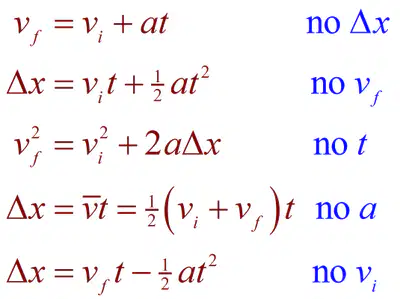
These are the equations used to solve kinematic problems. Copy them to your equation card.
6
7
8
9
10
11
12
13
14
15
16
17
18
19
Multiple Choice
If a ball is thrown up and lands at the same location, what was its acceleration?
-10 m/s2 on the way up and +10 m/s2 on the way down.
-10 m/s2 the entire time.
+10 m/s2 on the way up and -10 m/s2 on the way down.
20
Multiple Choice
Free fall is
moving through the air under the influence of the force of gravity only.
not paying for a fall.
clothing sale with lots of orange & brown clothes.
a feather dropped from an airplane.
21
Multiple Choice
A textbook is dropped from a second floor window and falls to the ground. What happens to the acceleration as the book falls to the ground
the acceleration increases
the acceleration decreases
the acceleration remains constant
22
Multiple Choice
The state that exists when the only force acting on an object is gravity is called
free fall
inertia
acceleration
momentum
23
Multiple Choice
Heavier objects free fall faster than lighter objects.(in the absence of the air resistance)
True
False
24
Multiple Choice
25
Multiple Choice
26
Multiple Choice
27
Multiple Choice
28
Multiple Choice
29
Multiple Choice
30
31
32
Multiple Choice
33
Multiple Choice
At what point is vy= 0 m/s?
A
B
C
D
None of these points
34
Multiple Choice
35
Multiple Choice
36
Multiple Choice
37
Multiple Choice
38
Multiple Choice
39
Multiple Choice
40
Multiple Choice
41
Multiple Choice
42
Multiple Choice
43
Multiple Choice
The path followed by a projectile is also known as its
trajectory
range
height
vertical displacement
44
Multiple Choice
What is the direction of the acceleration for any projectile?
The direction the projectile is traveling.
Down
Up
Sideways
45
Multiple Choice
What is the acceleration of a projectile?
46
Multiple Choice
At what point can we measure the maximum height?
A
B
C
D
None of these points
47
Multiple Choice
At which point can we measure the maximum range of the projectile? (it's landing point)
A
C
D
E
48
Multiple Choice
At which point is the velocity of the object the same as the initial velocity at A?
A
C
D
E
49
Multiple Choice
At which point could you measure half the time the projectile is in the air?
A
C
D
E
50
Multiple Choice
At which point is our object slowing down?
B
D
E
All points
51
Multiple Choice
At which of the following places does a projectile have the greatest acceleration?
At the peak of its trajectory
Half way to the peak
At the instant it is launched
All points have the same acceleration
52
Multiple Choice
53
Multiple Choice
Kinematic equation can only be used when you have a constant ....
Position
Velocity
Acceleration
Time
54
Multiple Choice
The unit we use to measure acceleration is ___.
m/s
m
s
m/s2
55
Multiple Choice
A ball is dropped from a building. How fast is it traveling after falling for 1.77 s? (Hint: It's a free falling object)
14.76 m/s
17.35 m/s
18.91 m/s
20.03 m/s
56
Multiple Choice
A car starts from rest and accelerates uniformly over a time of 5.21 seconds for a distance of 110 m. Determine the acceleration of the car. Choose the appropriate equation.
v=vo+at
d=vot+1/2at2
v2=vo2+2ad
d=1/2(v+vo)t
57
Multiple Choice
Rocket-powered sleds are used to test the human response to acceleration. If a rocket-powered sled is accelerated to a speed of 444 m/s in 1.83 seconds, then what is the distance that the sled travels?
Choose the appropriate equation.
v=vo+at
d=vot+1/2at2
v2=vo2+2ad
d=1/2(v+vo)t
58
Multiple Choice
If Michael Jordan has a vertical leap of 1.29 m, then what is his takeoff speed if his acceleration is -9.8 m/s2 and his velocity at the top of his leap i 0 m/s?
v=vo+at
d=vot+1/2at2
v2=vo2+2ad
d=1/2(v+vo)t
59
Multiple Choice
An engineer is designing the runway for an airport. Of the planes that will use the airport, the lowest acceleration rate is likely to be 3 m/s2. The takeoff speed for this plane will be 65 m/s. All airplanes will start from rest. Assuming this minimum acceleration, what is the minimum allowed length for the runway?
v=vo+at
d=vot+1/2at2
v2=vo2+2ad
d=1/2(v+vo)t
60
Multiple Choice
The unit we use to measure speed is ___.
m/s
m
s
m/s2
61
Multiple Choice
The unit we use to measure distance is ___.
m/s
m
s
m/s2
62
Multiple Choice
The unit we use to measure time is ___.
m/s
m
s
m/s2
63
Multiple Choice
Which of the following symbols represent speed when time is zero?
v
v0
a
x
64
Multiple Choice
Which of the following symbols represent speed at any time?
v
v0
a
x
65
Multiple Choice
What does g represent as in physics
greg
gravity
gas
Grover
66
Multiple Choice
What is the symbol for distance?
m
M
d
D
67
Multiple Choice
What is the symbol for position?
p
Ƥ
x
y
68
Multiple Choice
What is the symbol for height?
hT
Y
Ht
y
69
Multiple Choice
What is the Symbol for force?
F
ḟ
N
Fx
70
Multiple Choice
What is the Formula for Speed?
v = d/t
s = t/d
Speed = Vi - Vf
100mph
71
Multiple Choice
The symbol Δ, stands for a ______________
pyramid
total
change in
position
72
Multiple Choice
a = Δv / Δt
This is the formula to solve what?
amplitude
angular momentum
Acceleration
Delta change
73
Multiple Choice
What is the force of Gravity?
Down
1g
9.8 m/s2
8.9 m/s2
74
Explanation Slide...
Force = mass x acceleration
75
Multiple Choice
What is the formula to find Force
F= d/t
m/a = F
F = mA
F= ma
76
Explanation Slide...
You can run 5 miles and have a displacement of 0. Displacement is how far you displace from where you started.
77
Multiple Choice
A change in position of an object is called ____________.
distance
displacement
magnitude
separation
78
Explanation Slide...
acceleration units are always m/s2 or m/s/s
79
Multiple Choice
If a 73.2kg object is receiving a net force of 933N to the West, then what will be its acceleration?
12.74a2
12.74 m/s
12.74 m/s2
12.74
80
Explanation Slide...
F = mass x acceleration is the same asF = mass x (∆v /∆t)Because acceleration = (∆v /∆t)
81
Multiple Choice
What things are needed to find force (F)?
mass and velocity
mass and final velocity
momentum and acceleration
mass, ∆v and ∆t
82
Multiple Choice
This is the formula for ______________________________.
amplitude
Velocity
Acceleration
V0
83
Multiple Choice
This is the formula for____
going fast
speed
displacement
Velocity
84
Multiple Choice
What does Vf represent?
vector function
velocity forward
final velocity
initial velocity
85
Multiple Choice
How long would it take a car, starting from rest and accelerating uniformly in a straight line at 5 m/s2, to cover a distance of 200 m?
9.0s
10.5s
12.0s
15.5s
86
Multiple Choice
Sam jumped from a plane. His acceleration was 10m/s2. He hit the ground in 8 seconds. What was his velocity just before he hit the ground?
300 m/s
30 m/s
320 m/s
80 m/s
87
Multiple Choice
The speed of an object undergoing constant acceleration increases from 8.0 m/s to 16.0 m/s in 4 s. What is the acceleration of the object?
8 m/s2
4 m/s2
2 m/s2
1 m/s2
88
Multiple Choice
A car accelerates uniformly from rest at 10 m/s2. How long does it take the car to travel a distance of 125 meters?
2 seconds
3 seconds
4 seconds
5 seconds
89
Multiple Choice
A toy car is given an initial velocity of 4 m/s and experiences a constant acceleration of 6 m/s2. What is the final velocity after 5 seconds?
24 m/s
10 m/s
34 m/s
6 m/s
90
Multiple Choice
A car starts from rest and after 7 seconds it is moving at 42 m/s. What is the car’s acceleration?
0.17 m/s2
1.67 m/s2
6 m/s2
7 m/s2
91
Multiple Choice
What's the missing part in the given kinematic equation?
x = xi + vi ×t + 21(a)(−)
t
t2
vf
Δv
92
Multiple Choice
What is the rate of acceleration of a mountain bike if it slows down from 9.4 m/s to 3.0 m/s in a time of 3.75 s?
a = vf – vi / t
-0.61 m/s2
-1.71 m/s2
-1.19 m/s2
-2.07 m/s2
93
Multiple Choice
A policeman traveling 19.5 m/s spots a speeder ahead, so he accelerates his vehicle at a steady rate of 1.81 m/s2 for 3.2 s, at which time he catches up with the speeder. What distance does the police car cover in that time?
d = vit + ½ at2
35.98 m
56.32 m
71.67 m
91.02 m
94
Multiple Choice
A car parked on a hill starts to coast down the hill, accelerating from rest at a constant rate of 0.45 m/s2. How fast will the car be moving after 7.0 s?
vf = vi + at
3.15 m/s
5.07 m/s
6.97.15 m/s
7.81 m/s
95
Multiple Choice
An airplane accelerates down a runway from rest at 3.98 m/s2 for 25.9 s until it lifts off the ground. Determine the distance traveled before takeoff.
d = vit + ½ at2
934.0 m
1004.7 m
1184 m
1334.9 m
96
Multiple Choice
A ball is dropped from a building. How fast is it traveling after falling for 1.77 s?
vf = vi + at
14.76 m/s
17.35 m/s
18.91 m/s
20.03 m/s
Vectors- motion in two directions
Motion in two dimensions consists of horizontal and vertical components.
Understand the independence of horizontal and vertical vectors in two-dimensional motion.
Motion in a plane is also referred to as a motion in two dimensions. For example – Circular Motion, Projectile Motion, etc. For the analysis of such type of motion (i.e. Projectile Motion), the reference point will be made of an origin and the two coordinate axes X and Y. One of the most common examples of motion in a plane is Projectile motion.
Show answer
Auto Play
Slide 1 / 96
SLIDE

Similar Resources on Wayground
92 questions
Sol 7.2
Presentation
•
7th Grade
88 questions
7.5.3-Moving Cellular Material
Presentation
•
7th Grade
90 questions
Units 5 & 6: The Universe, Sun, Earth, & Moon
Presentation
•
8th Grade
90 questions
I viventi e la cellula
Presentation
•
6th - 8th Grade
92 questions
Project Management Foundations
Presentation
•
KG
91 questions
Unit Lessons
Presentation
•
7th Grade
96 questions
Properties of Operations on the set of Integers
Presentation
•
7th Grade
Popular Resources on Wayground
24 questions
PBIS-HGMS Day 10
Quiz
•
6th - 8th Grade
10 questions
HCS SCI 03 Summer School Review 3
Quiz
•
3rd Grade
11 questions
Home Scope
Quiz
•
7th - 8th Grade
15 questions
HCS SCI 05 Summer School Assessment 3 Review
Quiz
•
5th Grade
35 questions
Lufkin Road Middle School Student Handbook & Policies Assessment
Quiz
•
7th Grade
18 questions
Geo 11.3 Area of Circles and Sectors
Quiz
•
9th - 11th Grade