Search Header Logo
1st 9 weeks review

1st 9 weeks review

Assessment

Presentation

•

Science

•

8th Grade

•

Medium

Created by

Angela Drake

Used 4+ times

FREE Resource

8 Slides • 59 Questions

1

​1st 9 weeks Assessment Review

2

First Test 8.5ABC

Look over the first test

Make sure you know what topics we covered the first test and how to answer those questions.

3

4

Multiple Choice

Subscripts tell us the number of _________ of an element and coefficients tell us the number of __________ of a substance.

1

molecules ; atoms

2

reactants ; products

3

atoms ; molecules

4

products ; reactants

5

Multiple Choice

Which particle has a positive charge?
1
electron
2
orbital
3
proton
4
neutron

6

Multiple Choice

Choose the particle that has no charge.
1
nucleus
2
neutron
3
proton
4
electron

7

Multiple Choice

This subatomic particle determines an element's identity.

1
electron
2
proton
3
neutron
4
valence shell

8

Multiple Choice

Both a proton and a neutron have this much mass.

1

1 AMU

2

2 grams

3

13 AMU

4

10 cm

9

Multiple Choice

An electron has a _____ charge.
1
negative
2
positive
3
neutral

10

Multiple Choice

Describe an Electron Cloud?
1
the mist outside of an atom
2
home of the protons
3
where electrons are located
4
nucleus

11

Multiple Choice

What do valence electrons determine about an element?

1

How much mass it has

2

How reactive it is

3

What the charge of the nucleus is

4

How many neutrons the element has in its nucleus

12

Multiple Choice

Which particles make up the nucleus of an atom?
1
protons and neutrons
2
electrons and protons
3
electrons, protons, and neutrons
4
electrons and neutrons

13

Multiple Choice

The particles of the atom you can find by knowing the atomic number.
1
neutrons
2
protons and electrons
3
protons and neutrons
4
atomic mass

14

Multiple Choice

The subatomic particle that determines the identity of an element.
1
neutron
2
proton
3
electron
4
outer shell

15

Multiple Choice

What charge does the nucleus have and why?
1
positive - the neutrons do not have a charge
2
positive - the neutrons and protons are positively charged particles
3
neutral - the neutral charge dominates the positive charge
4
neutral - electrons cancel out the positive charge of the atom

16

Multiple Choice

What is the mass number and name of an element with 8 protons and 8 neutrons?
1
16 - Carbon
2
16 - Oxygen
3
24 - Oxygen
4
8 - Neon

17

Multiple Choice

An element with a mass number of 10 and an atomic number of 6 has how many protons?
1
5
2
8
3
6
4
10

18

Multiple Choice

An element with a mass number of 11 and an atomic number of 5 has how many neutrons?
1
11
2
5
3
6
4
16

19

Multiple Choice

An atom has 10 protons, 15 neutrons and 10 electrons what is its mass number.

1

20

2

10

3

5

4

25

20

Multiple Choice

Question image
What is the number of protons that the element in this image contain?
1
14
2
7
3
15
4
18

21

Multiple Choice

Question image
What is the atomic number of the atom pictured? 
1
9
2
10
3
18
4
19

22

Multiple Choice

Which statement best describes the locations of the subatomic particles?
1
The protons and electrons are found in the nucleus, while neutrons are in the cloud outside the nucleus
2
The neutrons are in the nucleus, while the protons and electrons are in the cloud outside the nucleus
3
The protons and neutrons are in the nucleus, while the electrons are in the cloud outside the nucleus
4
The electrons and neutrons are in the nucleus, while the protons are in the cloud outside the nucleus

23

Multiple Choice

Question image

What do we call columns on the Periodic Table?

1
Periods
2
Groups

24

Multiple Choice

Question image

What do we call rows on the periodic table?

1
Periods
2
Groups

25

Multiple Choice

Question image

What do elements in the same period have in common?

1

the number of energy levels

2

the number of valence electrons

3

the number of protons

4

the number of neutrons

26

Multiple Choice

Question image

What do elements in the same group have in common?

1

the number of energy levels

2

the number of valence electrons

3

the number of protons

4

the number of neutrons

27

Multiple Choice

Which Group contains nonreactive gases?

1

Group 1

2

Group 7

3

Group 2

4

Group 8

28

Multiple Choice

Question image

Which group of metals is the most reactive?

1

Group 1

2

Group 4

3

Group 8

4

Group 2

29

Multiple Choice

Question image

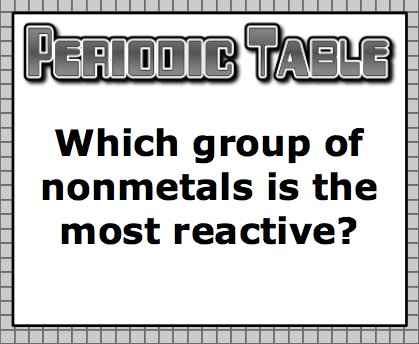
Which group of nonmetals is the most reactive?

1

Group 2

2

Group 7

3

Group 8

4

Group 2

30

Multiple Choice

Question image

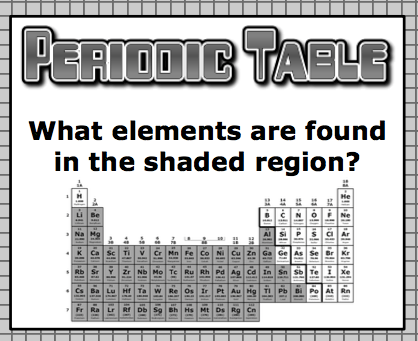
What elements are found in the shaded region?

1
Metals
2
Nonmetals
3
Metalloids

31

Multiple Choice

Question image

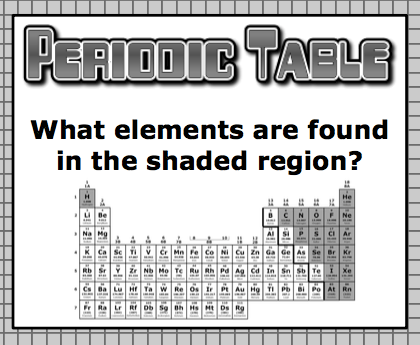
What elements are found in the shaded region?

1
Metals
2
Nonmetals
3
Metalloids

32

Multiple Choice

Question image

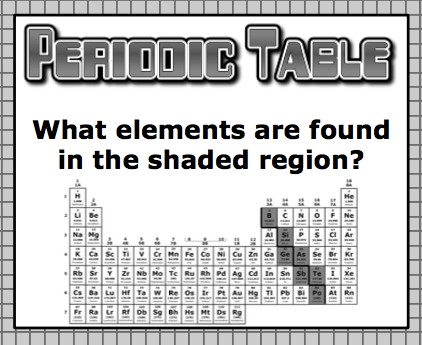
What elements are found in the shaded region?

1
Metals
2
Nonmetals
3
Metalloids

33

Multiple Choice

Question image

Which elements are shiny (lustrous) and malleable?

1
Metals
2
Nonmetals
3
Metalloids

34

Multiple Choice

Question image

Which elements are dull and brittle?

1
Metals
2
Nonmetals
3
Metalloids

35

Multiple Choice

Question image
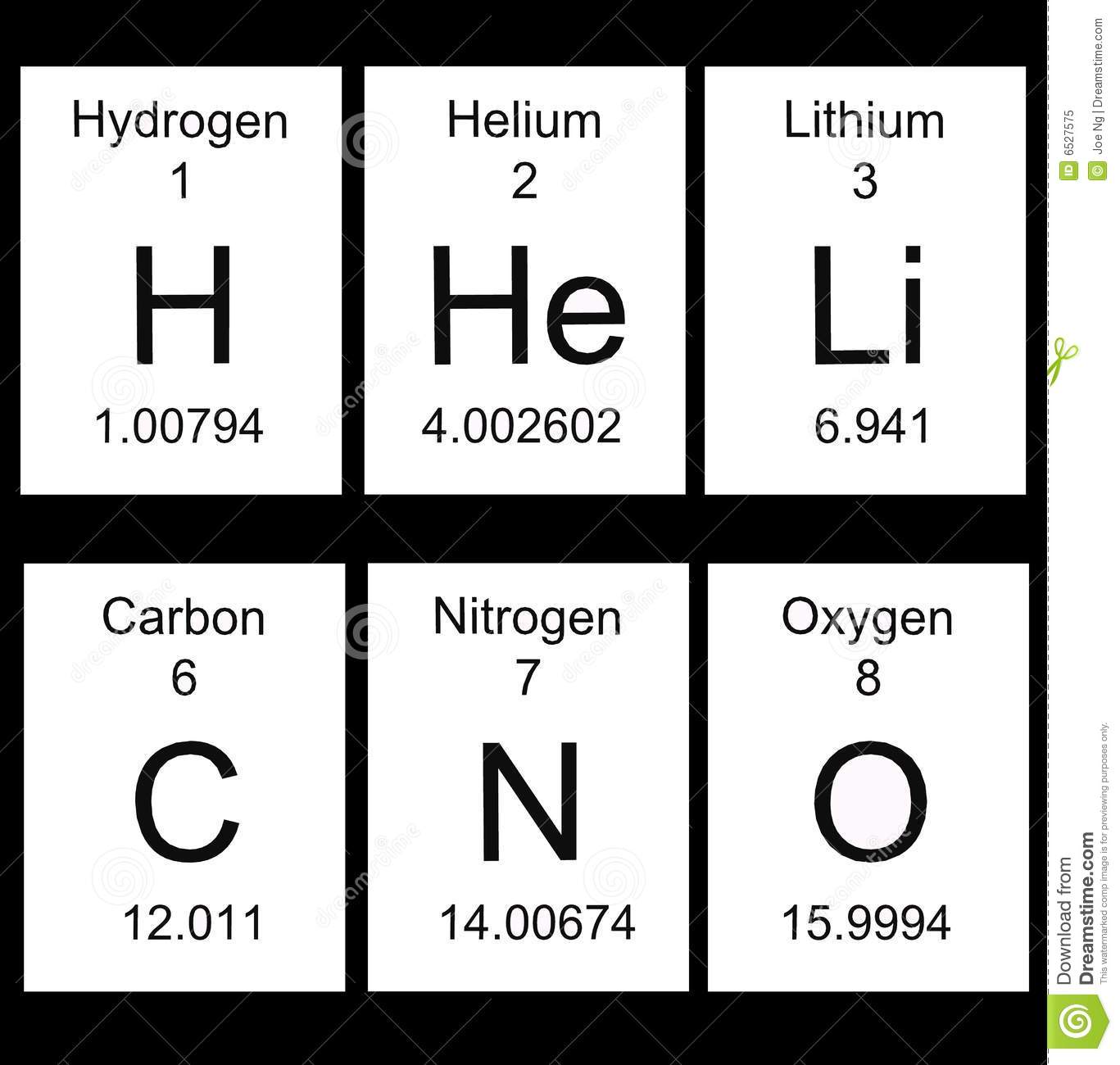
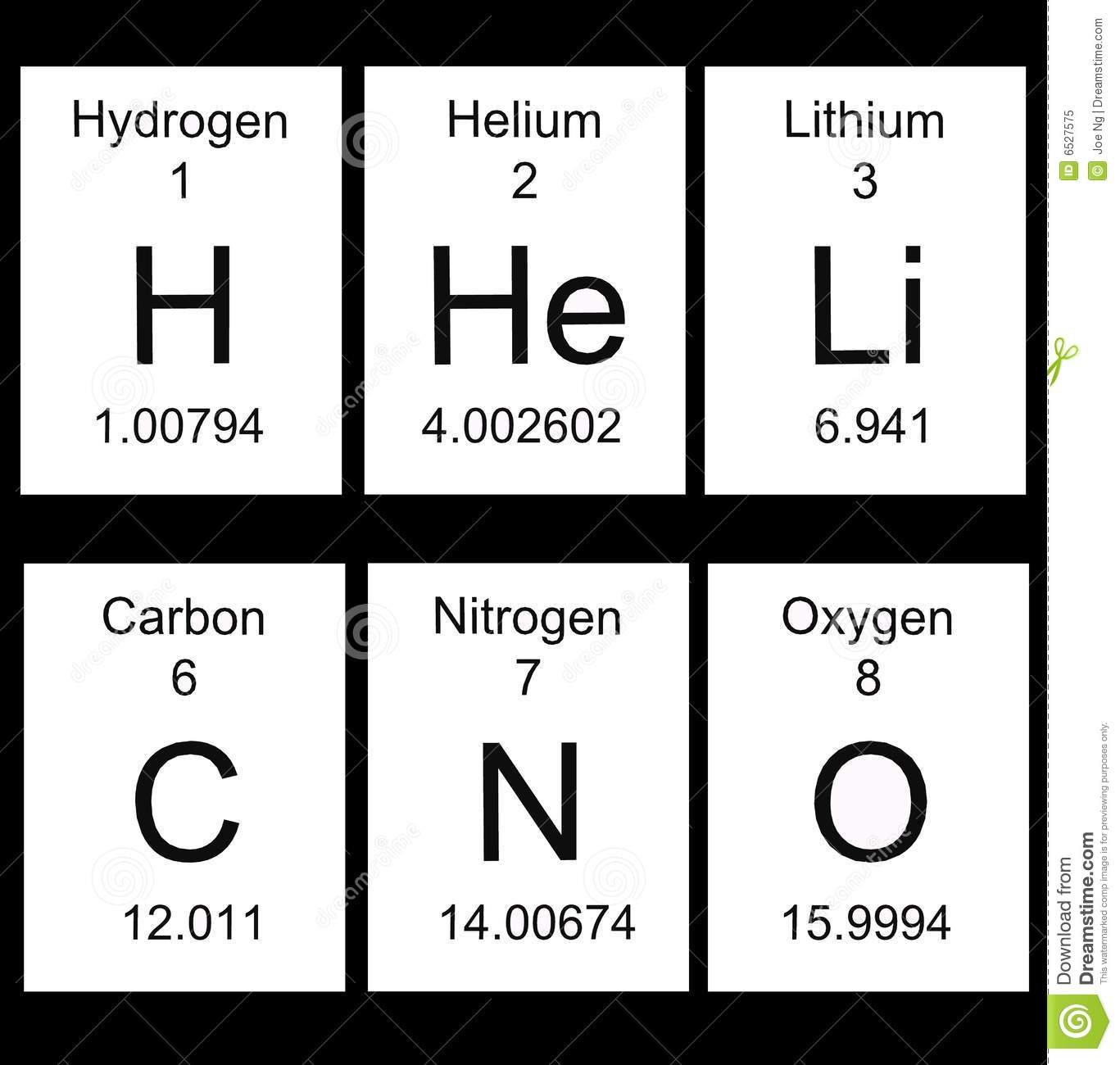
The number at the bottom of each square on the periodic table is the ...
1
atomic number
2
atomic mass
3
chemical symbol
4
element name

36

Multiple Choice

Question image
The number at the top of each square on the periodic table is the ...
1
atomic number
2
atomic mass
3
Chemical Symbol
4
Element Name

37

Multiple Choice

Which group of the periodic table is composed of inert (not reactive)  gases?
1
alkali metals
2
alkaline earth metals
3
halogens
4
noble gases

38

Multiple Choice

Question image

How many valence electrons?

1
2
2
8
3
3
4
13

39

Multiple Choice

Question image

How many valence electrons?

1
2
2
6
3
10
4
16

40

Multiple Choice

Question image

How many valence electrons?

1
1
2
2
3
3
4
4

41

First Test 8.5DE

Look over the 2nd test

Make sure you know what topics we covered the 2nd test and how to answer those questions.

42

43

Multiple Choice

Which of the following describes a precipitate?
1
a liquid forms when a block of metal is heated
2
a solid forms when one liquid is poured into another
3
a gas forms when a solid is placed in a liquid
4
bubbles form when an acid is poured on a rock

44

Multiple Choice

Which is NOT an indication of a chemical change?
1
temperature change
2
formation of a precipitate
3
shape change
4
production of light

45

Multiple Choice

Question image

The Law of Conservation of Mass states that -

1

the number and type of atoms on both sides of a chemical reaction are equal

2

there are more atoms on the reactant side than the product side

3

there are more atoms on the product side than the reactant side

4

the mass of the product will not equal the reactants

46

Multiple Choice

You know you a chemical reaction has occurred if:

1

there is a precipitate.

2

there is a permanent color change.

3

there is a temperature change.

4

All of these answers are evidence.

47

Multiple Choice

In the equation,

2Mg + O2 ---> 2MgO, which are the reactants?

1

2Mg + O2

2

2MgO

3

2Mg and MgO

4

O2 and MgO

48

Multiple Choice

Is bleaching your hair a physical or chemical change?
1
physical
2
chemical

49

Multiple Choice

Marie had a beaker with a small amount of baking soda. She added a few drops of pickle juice to the baking soda and observed fizzing and bubbling. Based on her observation, which of these can Marie determine about the new substance formed by mixing the baking soda and pickle juice?
1
A chemical reaction produced a solid.
2
A chemical reaction produced a gas.
3
No chemical reaction took place.
4
Only a physical change happened.

50

Multiple Choice

How many atoms are in C6H12O6?
1
12
2
26
3
24
4
14

51

Multiple Choice

What will happen to the mass of the product if I double the mass of the reactants?
1
It will decrease by half.
2
It will increase by half.
3
It will double.
4
The mass remains the same.

52

Multiple Choice

How many atoms of carbon (C) are in C6H12O6?
1
3
2
6
3
12
4
24

53

Multiple Choice

What is the right part of a chemical equation called?
H2 + O → H2O
1
Reactants
2
Products 
3
Yields 
4
Chemical Equation 

54

Newton's Laws

Look over your stations lab and your quiz in eduphoria.

55

56

Multiple Choice

Rockets are launched into space using jet propulsion where exhaust accelerates out from the rocket and the rocket accelerates in an opposite direction.
1
Newton's 1st Law
2
Newton's 2nd Law
3
Newton's 3rd Law
4
None of them

57

Multiple Choice

A soccer ball accelerates more than a bowling ball when thrown with the same force.
1
Newton's 1st Law
2
Newton's 2nd Law
3
Newton's 3rd Law
4
None of them

58

Multiple Choice

A rocket is sent into space.  When the power dies out, the rocket will just keep floating and moving in space forever (unless an unbalanced force, such as a meteor, runs into it).
1
Newton's 1st Law
2
Newton's 2nd Law
3
Newton's 3rd Law
4
None of them

59

Multiple Choice

Question image
During a demonstration of Newton’s laws of motion, a student used the setup shown in Figure 1. The student flicked the index card with a fingertip, and the coin fell straight down into a plastic cup as shown in Figure 2. Which of these best explains why the coin fell straight down into the cup instead of remaining on the index card?
1

The coin was at rest until the card was removed, so it tended to remain in the same location. Once the card was gone, the unbalanced force of gravity caused the coin to fall.

2

Moving the card applied an action force on the coin. Since the card was gone, gravity applied a reaction force on the coin.

3

The card had less mass than the coin, so a smaller force of gravity acted on the card. The larger force of gravity on the coin made it fall.

4

The acceleration of the coin falling into the cup was equal and opposite to the acceleration of the card.

60

Multiple Choice

A player hits a ball with a bat. The action force is the impact of the bat against the ball. The reaction force is...
1
The grip of the player's hands on the ball
2
the air resistance of the ball
3
the force of the ball against the bat

61

Explanation Slide...

Check the definition of friction.

62

Multiple Choice

If a flower and a marble are dropped from the same height, what force will cause the flower to fall more slowly?

1

inertia

2

friction

3

motion

4

newton

63

Multiple Choice

Question image
Calculate the Net Force. 
1
60N, Left unbalanced
2
40N, Right unbalanced
3
0N balanced
4
60N, Right, unbalanced

64

Multiple Choice

Question image
Objects that have a net force of zero are...
1
Balanced
2
Unbalanced
3
Accelerating

65

Multiple Choice

Question image
What is the net force?
1
20 N 
2
0 N 
3
400 N 
4
40 N 

66

Multiple Choice

Question image
What is the net force?
1
10 N
2
0 N
3
25 N
4
1 N

67

Multiple Choice

Question image

The mass of a car is 1000 kg. How much force would be required to accelerate the car at a rate of 3 m/s2? The answer to this question is most likely (HINT: Look at the units!!!) -

1

3000 N

2

3000 m/s2

3

3000 kg

pattern-tertiary
​1st 9 weeks Assessment Review

Show answer

Auto Play

Slide 1 / 67

SLIDE