
Stars

Presentation
•
Science
•
3rd Grade
•
Practice Problem
•
Medium
+12
Standards-aligned

Elizabeth White
Used 230+ times
FREE Resource
7 Slides • 10 Questions
1

STARS
Science – Dr. White
2

What are stars?
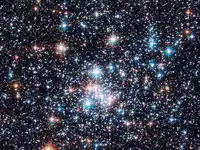
A star is a giant ball of hot, glowing gases (mostly hydrogen) that release energy.
Some of the energy is in the form of light.
Some of the energy is in the form of heat (thermal energy).
All stars, except for our sun, look like tiny dots of light because
they are very far away.
3
Multiple Choice
Stars release what type of energy?
light only
heat only
light and heat
light and sound
4
Multiple Choice
What are stars mostly made of?
helium
hydrogen
oxygen
dust
5
Multiple Choice
Why do all stars (except for our sun) look like tiny dots of light?
they're dying out
they're not as hot as the sun
they're very far away
the atmosphere makes it look that way
6

Light from stars
• Light from stars takes time to
reach Earth.
• Light travels at 300,000 kilometers
per second (about 186,411 miles
per second).
• The distance light travels from
stars is measured in light-years.
• A light-year is the distance light
travels in one year.
7
Multiple Choice
Light from stars reaches Earth immediately.
true
false
8

Star brightness and
distance
• When it is viewed from Earth, our
sun appears to be a very bright
star relative to (compared with)
other stars.
• This is because our sun is the
closest star to Earth.
• A star’s actual brightness and its
apparent brightness can be very
different depending on distance,
how hot the star is, etc.
9
Multiple Choice
Why does the sun appear to be very bright?
because its the closest star to Earth
because its the brightest star in the galaxy
because its the largest star in the universe
it doesn't
10


Types of stars
Our sun and most stars in the
universe are similar in many ways, but
they also differ in some ways.
Stars can be different sizes, have
different colors, and have different
temperatures.
11

Star colors and
temperatures
• A star’s color is a result of its temperature.
• Colors include red, orange, yellow, white,
and blue.
• As you move from the colors on the
left to the colors on the right, the
temperature increases.
• For example, a red star is the coolest
and a blue star is the hottest.
• An orange star would be hotter than
a red star, but cooler than a yellow
star, and so on.
12
Multiple Choice
A star's color is the result of:
its temperature
its size
its age
its distance from Earth
13
Multiple Choice
______ is the hottest color star.
red
orange
yellow
blue
14
Multiple Choice
_____ is the coolest color star.
red
orange
white
blue
15

How can we better detect
stars?
• Telescope 🡪 A telescope is a tool that
makes distant objects appear closer,
large, and easier to see. There are
several different types.
• Refracting 🡪 Use lenses to collect and
magnify visible light.
• Radio 🡪 Detect radio waves to find
objects in space that cannot be seen
by optical telescopes.
• Optical 🡪 Use lenses to gather,
magnify, and focus light.
• Reflecting 🡪 Use mirrors to see
objects in the sky.
• The Hubble Space Telescope &
The Keck Observatory’s twin
telescopes.
16
Multiple Choice
A reflecting telescope uses _____ to see objects in the sky.
mirrors
lenses
radio waves
beams
17
Multiple Choice
The Hubble Space Telescope is a ______ telescope.
optical
refracting
radio
reflecting
STARS
Science – Dr. White
Show answer
Auto Play
Slide 1 / 17
SLIDE
Similar Resources on Wayground

15 questions
Comets Assteroids and Meteors
Presentation
•
3rd Grade
15 questions
Science - LESSON 2 - Models Review Lesson
Presentation
•
3rd Grade
11 questions
Weather and Water
Presentation
•
3rd Grade
12 questions
Advantages of Traits
Presentation
•
3rd Grade
13 questions
Amplify M4Chp 1 Review
Presentation
•
3rd Grade
14 questions
The Scientific Method
Presentation
•
4th Grade
11 questions
Rocks and Minerals
Presentation
•
3rd Grade
11 questions
Parts of a Plant
Presentation
•
3rd Grade
Popular Resources on Wayground
10 questions
Safety Day 2026 – Student Review

Quiz
•
9th Grade
21 questions
Continents and Oceans
Quiz
•
6th Grade
20 questions
Parts of Speech
Quiz
•
5th Grade
16 questions
Subject & Predicate
Quiz
•
5th Grade
25 questions
Multiplication Facts
Quiz
•
5th Grade
12 questions
Map Skills
Quiz
•
3rd Grade
22 questions
Continents and Oceans
Quiz
•
5th Grade
15 questions
Rounding Decimals
Quiz
•
5th Grade
Discover more resources for Science
19 questions
3rd Grade CUA #1 Review GC
Quiz
•
3rd Grade
20 questions
Force and Motion
Quiz
•
3rd Grade
10 questions
Identifying Physical and Chemical Changes

Interactive video
•
1st - 5th Grade
13 questions
Reflect, refract, and absorb
Quiz
•
3rd - 5th Grade
14 questions
Scientific Method
Quiz
•
3rd - 5th Grade
23 questions
Rocks and Soils Unit Assessment
Quiz
•
3rd Grade
11 questions
Lost Energy 3rd grade
Quiz
•
3rd Grade
5 questions
All About Maps
Presentation
•
1st - 5th Grade