
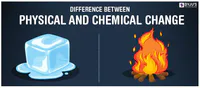
Physical vs Chemical Changes Notes
Presentation
•
Science
•
8th Grade
•
Medium
+8
Standards-aligned
Whitney Price
Used 47+ times
FREE Resource
13 Slides • 14 Questions
1
2
3
4
5
6
7
8
Multiple Choice
Which of the following is NOT an example of a physical change?
Water freezing
Wood breaking apart
Salt dissolving in water
Baking soda and vinegar combine and form bubbles
9
Multiple Choice
What are all the ways a physical change can occur?
Freezing, steam, evaporation, change shape, bending, crushing, chopping, melting, drying clothes
A New Substance forms
Mass decreases, new substance formed, chopping, evaporating
None of these show evidence of a physical change
10
Multiple Choice
What does chopping, melting, crushing, breaking glass, ripping up paper and getting paper or clothing wet mean?
Chemical changes
Chemical and physical changes
Physical changes only
Both the first and the second answer are correct.
11
Multiple Choice
Wadding up Paper
physical change
chemical change
12
Multiple Choice
Melting Cheese
physical change
chemical change
13
Multiple Choice
A student heats a beaker of water with a hot plate and over time, the water begins to bubble, the volume decreases and vapor is visible. This is an example of a ____________ change.
Chemical
Nuclear
Physical
Musical
14
15
16
17
18
19
20
Multiple Choice
Burning Wood
physical change
chemical change
21
Multiple Choice
Milk Souring
physical change
chemical change
22
Multiple Choice
Bicycle Rusting
physical change
chemical change
23
Multiple Choice
Cutting a tree limb into logs is (a)____________ and burning them in the fireplace is (b)____________.
(a) A Physical Change
(b) Also a Physical Change
(a) A Physical Change
(b) A Chemical Change
(a) A Chemical Change
(b) Also a Chemical Change
(a) A Chemical Change
(b) A Physical Change
24
Multiple Choice
When lithium metal is dropped into a container of water, the lithium sparks and fizzes and the water begins to bubble violently. The conclusion that can be drawn from that is:
A new substance is created because this is a chemical change.
No new substances are created because there is a chemical change.
No new substances are created because this is a physical change.
A new substance is created because this is a physical change.
25
Multiple Choice
In this example, there is no gas produced, no temperature change, no odor, and no solids formed. This must be a _________ change.
Physical
Emotional
Hypothetical
Chemical
26
Multiple Choice
A white crystalline powder is mixed with water. No temperature change is observed but the solid disappears. This must be a __________ change.
Chemical
Mechanical
Physical
Electrical
27
Multiple Choice
A car swerves to avoid a collision with an oncoming vehicle and crashes into a tree. The tree falls over. The car is crunched. Liquids pour out of the car onto the street. Based ONLY on those observations, what happened here?
Physical Changes
Chemical Changes
Both Chemical and Physical Changes
Show answer
Auto Play
Slide 1 / 27
SLIDE

Similar Resources on Wayground
21 questions
Big Bang Theory
Presentation
•
8th Grade
21 questions
Natural Selection & Adaptation
Presentation
•
8th Grade
22 questions
Module H-Conduction, Convection, & Radiation
Presentation
•
8th Grade
22 questions
Day/Night and Seasons
Presentation
•
8th Grade
19 questions
law of superposition
Presentation
•
8th Grade
19 questions
1.3 Microscopes
Presentation
•
8th Grade
23 questions
Chemical and Physical Properties
Presentation
•
8th Grade
23 questions
Intro to Environmental Changes 8.11B
Presentation
•
8th Grade
Popular Resources on Wayground
10 questions
Safety Day 2026 – Student Review
Quiz
•
9th Grade
21 questions
Continents and Oceans
Quiz
•
6th Grade
20 questions
Parts of Speech
Quiz
•
5th Grade
16 questions
Subject & Predicate
Quiz
•
5th Grade
25 questions
Multiplication Facts
Quiz
•
5th Grade
12 questions
Map Skills
Quiz
•
3rd Grade
22 questions
Continents and Oceans
Quiz
•
5th Grade
15 questions
Rounding Decimals
Quiz
•
5th Grade
Discover more resources for Science
20 questions
Newton's Laws of Motion
Quiz
•
8th Grade
15 questions
potential and kinetic energy
Quiz
•
8th Grade
21 questions
Newton's Laws of Motion
Quiz
•
8th Grade
20 questions
Elements, Compounds and Mixtures
Quiz
•
8th Grade
10 questions
Exploring Chemical and Physical Changes
Interactive video
•
6th - 10th Grade
20 questions
Physical vs Chemical Changes
Quiz
•
8th Grade
20 questions
Conduction, convection, and Radiation Practice
Quiz
•
8th Grade
21 questions
Waves and Wave Properties
Quiz
•
6th - 8th Grade