

Eco 1D Remediation

Presentation
•
Science
•
9th - 12th Grade
•
Easy
+2
Standards-aligned

Fayris Francis
Used 6+ times
FREE Resource
5 Slides • 5 Questions
1
2
Diffusion
The cytoplasm consists many different substances dissolved in water. These particles move from areas of high concentration to areas of low concentration.
This is called diffusion.
Module 3B: Cell Transport & Processes
Passive Transport

3

4
Multiple Choice
How do molecules move during diffusion?
From high concentration to low concentration
From low concentration to high concentration
5
Diffusion
Molecules will move across the cell membrane until equilibrium is reached. Equilibrium is where concentrations are equal on both sides.
Diffusion is the movement of random molecular movements and does not require the use of energy (ATP).
Molecule movement that does not require energy is called passive transport.
Module 3B: Cell Transport & Processes
Passive Transport
6
Multiple Choice
What is the goal of diffusion called when molecules are equally spread out?
Samenss
Equilibrium
7
Multiple Choice
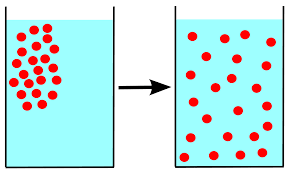
osmosis
isotonic
diffusion
active transport
8
Multiple Choice

a large amount of substance on side of the cell and a small amount on the other side
a small amount of substance on side of the cell and a large amount on the otherside
equal amount of substance on either side of the membrane
no particles on either side of the a cell membrane
9
Facilitated Diffusion
Some molecules (such as charged ions & large molecules like glucose) cannot cross the cell membrane. Instead they use channels (proteins inside of the cell membrane) to let them pass.
The movement of these molecules using special protein channels is known as facilitated diffusion. Although it is fast & specific, facilitated diffusion is still passive transport.
No energy (ATP) is required for this process.
Module 3B: Cell Transport & Processes
Passive Transport
10
Multiple Choice
Which type of diffusion uses a protein to help molecules get across?
Simple diffusion
Facilitated diffusion
Show answer
Auto Play
Slide 1 / 10
SLIDE
Similar Resources on Wayground

12 questions
Testing Expectations
Presentation
•
9th - 12th Grade
10 questions
Intermolecular Forces vs Intramolecular
Presentation
•
9th - 12th Grade
10 questions
Intermolecular Forces
Presentation
•
9th - 12th Grade
8 questions
Physical Science: Types of Energy
Presentation
•
9th - 12th Grade
6 questions
Right Triangle Trig
Presentation
•
9th - 12th Grade
11 questions
Chem Unit 11 - Liquids
Presentation
•
9th - 12th Grade
12 questions
Unit 9 - Simple Circuits
Presentation
•
9th - 12th Grade
12 questions
Meiosis Review
Presentation
•
9th - 12th Grade
Popular Resources on Wayground
10 questions
Safety Day 2026 – Student Review

Quiz
•
9th Grade
21 questions
Continents and Oceans
Quiz
•
6th Grade
20 questions
Parts of Speech
Quiz
•
5th Grade
16 questions
Subject & Predicate
Quiz
•
5th Grade
25 questions
Multiplication Facts
Quiz
•
5th Grade
12 questions
Map Skills
Quiz
•
3rd Grade
22 questions
Continents and Oceans
Quiz
•
5th Grade
15 questions
Rounding Decimals
Quiz
•
5th Grade
Discover more resources for Science
10 questions
Exploring Chemical and Physical Changes

Interactive video
•
6th - 10th Grade
20 questions
Atomic Structure
Quiz
•
9th Grade
10 questions
Exploring the Electromagnetic Spectrum for Middle School Science
Interactive video
•
6th - 10th Grade
10 questions
Exploring Force and Motion Concepts
Interactive video
•
6th - 10th Grade
10 questions
Exploring Air Masses and Weather Fronts
Interactive video
•
6th - 10th Grade
14 questions
Periodic Trends
Interactive video
•
11th Grade
10 questions
Exploring the States of Matter
Interactive video
•
6th - 10th Grade
10 questions
Exploring Forces: Net Force, Normal Force, Gravity, and Friction
Interactive video
•
6th - 10th Grade