
Year 9 Revision and recap 1 chemistry

Presentation
•
Science
•
9th Grade
•
Practice Problem
•
Easy

Taylah Smith
Used 6+ times
FREE Resource
17 Slides • 23 Questions
1

2
Definitions
Atomic structure
The periodic table
Electron configuration
Radioactivity
Conservation of mass
Chemical reactions
Balancing equations
3
Key definitions
Chemistry uses words that can be confusing or difficult to understand. Key words such as, atom, compound, element, ion, mixture, molecule are used throughout.
4
Match
Match the following terms with their definitions
Atom
Compound
Element
Cation
Anion
The fundamental building block of all materials. It consists of protons, neutrons, and electrons.
A pure substance that is made up of 2 or more different types of atoms chemically joined.
A substance made up of only 1 type of atom.
A positively charged ion.
A negatively charged ion.
The fundamental building block of all materials. It consists of protons, neutrons, and electrons.
A pure substance that is made up of 2 or more different types of atoms chemically joined.
A substance made up of only 1 type of atom.
A positively charged ion.
A negatively charged ion.
5
Atomic structure
The atomic structure of an atom is made up of 3 subatomic particles:
- Electrons
- Protons
- Neutrons

6
Labeling
Label the following atomic structure
7
Open Ended
What type of charge does a proton have?
8
Multiple Choice
How many protons does an atom have if it has an atomic number of 15?
30
15
16
18
9
The periodic table provides us with information about the elements.
- Atomic number
- Element symbol
- Element name
- Atomic mass

10

11
Match
Match the following element names to their symbols
Iron
Copper
Potassium
Phosphorus
Calcium
Fe
Cu
K
P
Ca
Fe
Cu
K
P
Ca
12
Match
Match the following elements to their atomic number
Boron
Chlorine
Sodium
Argon
Sulphur
5
17
11
18
16
5
17
11
18
16
13
Open Ended
Aluminium has an atomic mass of 27, and has 13 protons. How many neutrons does it have?
14
The electron configuration of an element allows for us to identify how many electrons it has as well as its capabilities of bonding with another element.
The example shows the calcium atom's electron configuration. How many electrons does it have?

15
There are rules to follow when drawing electron shell diagrams:
- Each orbital has a maximum number of electrons it can hold.
1st orbital - 2
2nd orbital - 8
3rd orbital - 8
4th orbital - 18
- Think of the bus seat rule - each electron from the 2nd shell onwards wants an electron buddy next to them.
- The number of electrons should be the same as the atomic number

16
Draw
Draw the electron shell configuration for Neon
17
Multiple Choice
What is the electron configuration for Chlorine?
2, 4, 7
2, 8, 6
2, 8, 7
2, 8
18
Multiple Choice
What is the electron configuration for Calcium?
2, 4, 4, 2
2, 8, 8, 1
2, 8, 8
2, 8, 8, 2
19
Draw
Draw the electron shell configuration for Fluorine
20
positively charged ion
Loses electrons
Cation
A negatively charged ion
Gains electrons
Anion

21
Match
Match the following ions
Chloride
Potassium
Oxide
Magnesium
Bromide
Cl-
K+
O2-
Mg2+
Br-
Cl-
K+
O2-
Mg2+
Br-
22
Radioactivity
Isotopes are members of a family of an element that all have the same number of protons but different numbers of neutrons.
Some elements will have different number of neutrons and therefore, will go via alternative names. For example, Carbon-12, Carbon-13, and Carbon-14

23

24
Multiple Choice
How many neutrons does carbon-14 have
12
6
8
7
25
Multiple Choice
How many neutrons does hydrogen-3 (tritium) have?
1
0
3
2
26
Synthesis
When 2 or more single elements react to form 1 product.
A + B -> AB
Example: 2Mg + O2 -> 2MgO

27
Decomposition
When a compound breakdown into 2 or more simpler products.
AB -> A + B
Example: H2CO3 -> CO2 + H2O

28
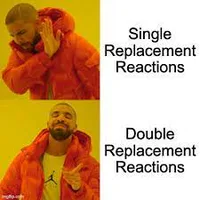
Single replacement
When a single element replaces another element in a compound
A + BC -> AC + B
Example: Zn + CuCl2 -> ZnCl2 + Cu

29
Double replacement
The cations and anions of two compounds switch places
AB + CD -> AC + BD
Example: HCl + NaOH -> NaCl + H2O
30
Multiple Choice
What type of reaction is the following chemical reaction?
KBr + AgNO3 -> KNO3 + AgBr
Synthesis
Decomposition
Single replacement
Double replacement
31
Multiple Choice
What type of reaction is the following chemical reaction?
Cu + 2HCl -> CuCl2 + H2
Synthesis
Decomposition
Single replacement
Double replacement
32
Multiple Choice
What type of reaction is the following chemical reaction?
2H2 + O2 -> 2H2O
Synthesis
Decomposition
Single replacement
Double replacement
33
Multiple Choice
What type of reaction is the following chemical reaction?
2HgO -> 2Hg + O2
Synthesis
Decomposition
Single replacement
Double replacement
34
Conservation of mass
The conservation of mass states that mass is neither created nor lost during chemical reactions.
This is important to remember when balancing equations...

35
Word equations
Word equations are the reactants -> products of a chemical reaction written in word format.
EXAMPLE:
Hydrogen + Oxygen -> Water

36
Open Ended
Write the word equation for the following reaction:
sodium oxide reacts with hydrochloric acid to produce sodium chloride and water
37
Drag and Drop
38
Drag and Drop
39
Drag and Drop
40
Drag and Drop
Show answer
Auto Play
Slide 1 / 40
SLIDE
Similar Resources on Wayground

35 questions
Byzantine Empire
Presentation
•
9th Grade
34 questions
Stellar Evolution - Connection
Presentation
•
9th Grade
33 questions
Minerals
Presentation
•
9th Grade
32 questions
Science 9 - Unit B Review Slides
Presentation
•
9th Grade
37 questions
Modern Atomic Theory
Presentation
•
9th Grade
35 questions
Newton's Laws of Motion
Presentation
•
8th Grade
35 questions
Life Science Review for Benchmark
Presentation
•
8th Grade
34 questions
Linear, Quadratic, or Exponential?
Presentation
•
9th Grade
Popular Resources on Wayground
10 questions
Safety Day 2026 – Student Review

Quiz
•
9th Grade
21 questions
Continents and Oceans
Quiz
•
6th Grade
20 questions
Parts of Speech
Quiz
•
5th Grade
16 questions
Subject & Predicate
Quiz
•
5th Grade
25 questions
Multiplication Facts
Quiz
•
5th Grade
12 questions
Map Skills
Quiz
•
3rd Grade
22 questions
Continents and Oceans
Quiz
•
5th Grade
15 questions
Rounding Decimals
Quiz
•
5th Grade
Discover more resources for Science
10 questions
Exploring Chemical and Physical Changes

Interactive video
•
6th - 10th Grade
20 questions
Atomic Structure
Quiz
•
9th Grade
10 questions
Exploring the Electromagnetic Spectrum for Middle School Science
Interactive video
•
6th - 10th Grade
10 questions
Exploring Force and Motion Concepts
Interactive video
•
6th - 10th Grade
10 questions
Exploring Air Masses and Weather Fronts
Interactive video
•
6th - 10th Grade
10 questions
Exploring the States of Matter
Interactive video
•
6th - 10th Grade
10 questions
Exploring Forces: Net Force, Normal Force, Gravity, and Friction
Interactive video
•
6th - 10th Grade
10 questions
Differentiating Thermal Energy and Temperature
Interactive video
•
6th - 10th Grade