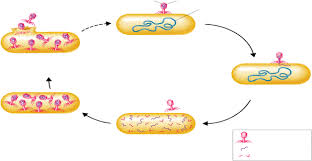
Viruses
Presentation
•
Biology
•
10th Grade
•
Medium
+3
Standards-aligned
Alexandra Osler
Used 11+ times
FREE Resource
21 Slides • 35 Questions
1
2
3
4
5
6
Multiple Choice
non-living because they grow and develop
living because they can use energy
non-living because they cannot reproduce on their own
living because they can maintain homeostasis
7
Multiple Choice
True
False
8
Multiple Choice
they need genetic material
They need a host cell
They need bacteria
They need insulin
9
Multiple Choice
They are not made of cells
They cannot reproduce on their own
They do not exchange gases
all of the above
10
11
12
13
Multiple Choice
ability to form proteins at the ribosomes
existence of lipids in cell membranes
presence of genetic code in nucleic acid
production of energy by a mitochondrion
14
Multiple Choice
nucleic acid strand surrounded by a protein coat
a tail surrounded by a protein coat
a tail surrounded by a carbohydrate coat
nucleic acid strand surrounded by a carbohydrate coat
15
Multiple Choice
nucleic acids
ribosomes
mitochondria
cytoplasm
16
Multiple Choice
A
B
C
D
17
Multiple Choice
endospore
decomposer
plasmid
bacteriophage
18
19
20
Multiple Choice
destroyed
copied
passed on to the lysogenic cycle
not affected
21
Multiple Choice
phagocytosis
lytic cycle
lysogenic cycle
formation of antibodies
22
Multiple Choice
Lysogenic Cycle
Lytic Cycle
Binary Fission
Conjugation
23
Multiple Choice
1
2
4
5
24
Multiple Choice
Entry
Attachment
Replication
Assembly
25
26
Multiple Choice
An outbreak of a virus occurs when ....
someone dies from the virus
the virus spreads to more and more hosts
the virus spreads to more than one organ
symptoms of the virus get worse
27
Multiple Choice
What is the difference between Pandemic and Epidemic?
Epidemic - A rapidly spreading disease that affects the local population.
Pandemic - A rapidly spreading disease that affects the world population.
Epidemic - A rapidly spreading disease that affects the world population.
Pandemic - A rapidly spreading disease that affects the local population.
28
29
30
Multiple Choice
Vaccines can be used to prevent viral infection by
destroying any viruses that enter the host.
creating a blocking protein on the cell.
creating an immune response in the host.
preventing replication of the virus.
31
Multiple Choice
structure of the virus are
capsid and nucleic acid
capsid and uncles
capsid, DNA and RNA
32
Multiple Choice
Why do we need a new flu vaccine every year?
Influenza mutates quickly and new strains result
Our bodies rid themselves of the vaccine yearly
When it gets warm outside, vaccines do not work anymore
Cooler temps often cause vaccines to mutate and not be effective
33
Multiple Choice
When a virus mutates this:
Helps the virus adapt to a new host
Can have no effect, be detrimental, or can be beneficial and help the virus adapt to its new host
Causes an outbreak
gives the virus super powers like shooting lasers out of it's eyes
34
Multiple Choice
Each of the following statements is true except -
viruses infect living cells
viruses can replicate without a host
viruses can cause illness
viruses come in different types
35
Multiple Choice
Viruses are not living, because they
are not cellular.
have no DNA.
do not reproduce.
lack a nucleus.
36
Multiple Choice
Cell theory states:
all living things are composed of one or more cells;
a cell is the smallest unit that still retains the properties of life;
and new cells only come from cells that already exist.
Based on cell theory, which of these answer choices would describe one reason a virus is considered nonliving?
A virus is too small to be considered a cell.
A virus does not contain genetic material.
A virus does not have a nucleus.
A virus cannot reproduce itself without a host
37
Multiple Choice
Which statement describes ALL living things?
They are composed of one or more cells.
They must reproduce sexually.
They have organ systems to carry out the processes of life.
They are capable of making their own food.
38
Multiple Choice
Examine the model of a viral structure shown here. Select the choice that accurately compares and contrasts the structures of viruses and cells.
Both cells and proteins have capsid structures surrounding their genomes.
Both cells and viruses have protein molecules.
39
Multiple Choice
Is this characteristic define as living organisms, viruses, or both:
The ability to grow.
Living Organisms
Viruses
Both
40
Multiple Choice
Is this characteristic define as living organisms, viruses, or both:
Ability to reproduce independently.
Living Organisms
Viruses
Both
41
Multiple Choice
Is this characteristic define as living organisms, viruses, or both:
May mutate and evolve.
Living Organisms
Viruses
Both
42
Multiple Choice
Is this characteristic define as living organisms, viruses, or both:
Protein coat instead of membrane.
Living Organisms
Viruses
Both
43
Multiple Choice
Is this characteristic define as living organisms, viruses, or both:
Can have a DNA genome.
Living Organisms
Viruses
Both
44
Multiple Choice
Is this characteristic define as living organisms, viruses, or both:
Not made of cells.
Living Organisms
Viruses
Both
45
Multiple Choice
Is this characteristic define as living organisms, viruses, or both:
Needs a host.
Living Organisms
Viruses
Both
46
Multiple Choice
Identify the correct characteristic of life:
Fox chasing a rabbit—rabbit running away
Energy
Cells
Responds to a Stimuli
Maintains Homeostasis
47
Multiple Choice
Which characteristic of life describes a person touching a hot stove and jerking their hand back.
Organization
Maintaining Homeostasis
Respond to a Stimuli
Grows and Develops
48
Multiple Choice
Identify the correct characteristic of life:
A lizard can change colors to blend in.
Levels of Organization
Adaptation
Homeostasis
Grows & Develops
49
50
51
52
53
54
55
56
Show answer
Auto Play
Slide 1 / 56
SLIDE

Similar Resources on Wayground
52 questions
Biology STAAR Review Cell Structure
Presentation
•
9th Grade
50 questions
Regiony Polski - wybrzeże zachodniopomorskie i pomorskie
Presentation
•
KG
49 questions
Sesión #1 Biología - grado 9no°
Presentation
•
9th Grade
47 questions
Amendments
Presentation
•
10th Grade
48 questions
POPULAR MEMBER SERVICES DIAGNOSTICS, HOSPITILIZATION AND SURGERY
Presentation
•
KG
55 questions
Plant Tissue
Presentation
•
10th Grade
51 questions
Angles Formed by Transversal
Presentation
•
10th Grade
50 questions
2021英表 Lesson5 不定詞 part1
Presentation
•
10th Grade
Popular Resources on Wayground
24 questions
PBIS-HGMS Day 10
Quiz
•
6th - 8th Grade
10 questions
HCS SCI 03 Summer School Review 3
Quiz
•
3rd Grade
11 questions
Home Scope
Quiz
•
7th - 8th Grade
15 questions
HCS SCI 05 Summer School Assessment 3 Review
Quiz
•
5th Grade
35 questions
Lufkin Road Middle School Student Handbook & Policies Assessment
Quiz
•
7th Grade
18 questions
Geo 11.3 Area of Circles and Sectors
Quiz
•
9th - 11th Grade