Kepler's Quiz Review
Presentation
•
Science
•
6th - 8th Grade
•
Medium
+3
Standards-aligned
Kurt Trout
Used 4+ times
FREE Resource
3 Slides • 41 Questions
1
Kepler’s First Law
Law of Orbits: All planets move in elliptical orbits, with the sun at 1 focus.
An ellipse is an oval shape centered on 2 points instead of 1 point.
The orbital period of a planet is how long it takes for it to travel a complete orbit around the Sun… a year!
Perihelion
Aphelion
2
Kepler’s Second Law
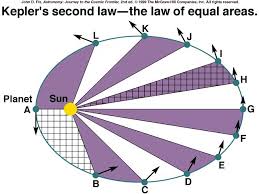
Law of Areas: A line that connects a planet to the Sun sweeps out equal (=) areas in equal (=) times.
Earth sweeps out a longer path when it is closer to the Sun.
Earth moves fastest when it is closest to the Sun
3
Kepler’s Third Law
Law of Periods: The square of the orbital period of any planet is proportional to the cube of the semi major axis of its orbit.
T² = a³ If you know the distance of a planet to the Sun, you would be able to figure out its… orbital period. Basically… The closer a planet is to the Sun, the shorter its orbital period is.
4
Multiple Choice
circle
ellipse
focus
perihelion
5
Multiple Choice
aphelion
perihelion
foci
axis
6
Multiple Choice
the axis
the perihelion
the center
the Sun
7
Multiple Choice
perihelion
aphelion
8
Multiple Choice
aphelion
perihelion
9
Multiple Choice
Position A to B
Position B to C
Position H to I
Position I to J
10
Multiple Choice
The area between A, B and the Sun is the largest.
The area between H, I and the Sun is the largest
Both areas are equal in size
There is not enough information to determine the areas
11
Multiple Choice
a straight line
a large ellipse
a circle
a small ellipse
12
Multiple Choice
faster
slower
13
Multiple Choice
ellipses
perfect circles
14
Multiple Choice
orbit
ellipse
barycenter
precession
15
Multiple Choice
Close to the sun
Far away from the sun
16
Multiple Choice
Planets travel in an ellipse
Planets closest to the sun travel faster
The farther a planet is from the sun, the longer it takes to orbit
Planets revolve around the Earth
17
Multiple Choice
What is at the middle of a Heliocentric system?
Mars
Moon
Sun
Earth
18
Multiple Choice
Who proposed the Heliocentric system?
Copernicus
Ptolemy
Aristotle
Galileo
19
Multiple Choice
greater
same
zero
less
20
Multiple Choice
Rotation
Revolution
Kepler's Laws
Precession
21
Multiple Choice
1 day
1 year
24 hours
364 hours
22
Multiple Choice
Rotation
Revolution
Kepler's 1st Law
Barycenter
23
Multiple Choice
Rotation
Revolution
Kepler's Laws
Precession
24
Multiple Choice
ellipses
perfect circles
25
Multiple Choice
faster
slower
26
Multiple Choice
the shape of the planets' orbits
the speed/area the planet travels
the length of time it takes the planet to orbit the sun
27
Multiple Choice
aphelion
perihelion
28
Multiple Choice
perihelion
aphelion
29
Multiple Choice
circle
ellipse
focus
perihelion
30
Multiple Choice
circle
ellipse
focus
perihelion
31
Multiple Choice
32
Multiple Choice
33
Multiple Choice
34
Multiple Choice
35
Multiple Choice
the shape of the planets' orbits
the speed/area the planet travels
the length of time it takes the planet to orbit the sun
36
Multiple Choice
faster
slower
37
Multiple Choice
38
Multiple Choice
39
Multiple Choice
Close to the sun
Far away from the sun
40
Multiple Choice
Planets closest to the Sun will orbit with the fastest orbital speed.
Planets with the greatest mass will orbit the Sun with the fastest orbital speed.
Planets furthest from the Sun will orbit with the fastest orbital speed.
Planets with the least mass will orbit the Sun with the fastest orbital speed.
41
Multiple Choice
A way of measuring distances in space. Equivalent to the distance from Earth to the Sun.
Elipse
Eccentricity
Astronomical Unit
Period
42
Multiple Choice
Planets orbit the sun in a shape called an ellipse.
Kepler's 1st Law
Kepler's 2nd Law
Kepler's 3rd Law
43
Multiple Choice
Planets travel faster when they are closer to the sun.
Kepler's 1st Law
Kepler's 2nd Law
Kepler's 3rd Law
44
Multiple Choice
Kepler's 3rd law tell us that __ would be dependent on __.
orbital period ; distance
distance ; orbital period
Kepler’s First Law
Law of Orbits: All planets move in elliptical orbits, with the sun at 1 focus.
An ellipse is an oval shape centered on 2 points instead of 1 point.
The orbital period of a planet is how long it takes for it to travel a complete orbit around the Sun… a year!
Perihelion
Aphelion
Show answer
Auto Play
Slide 1 / 44
SLIDE

Similar Resources on Wayground
36 questions
Layers of the Earth
Presentation
•
6th - 8th Grade
38 questions
Atoms and the Periodic Table
Presentation
•
6th - 9th Grade
37 questions
Genetic Engineering
Presentation
•
6th - 7th Grade
35 questions
Plate Tectonics
Presentation
•
6th - 8th Grade
39 questions
What Is Weather
Presentation
•
6th - 8th Grade
39 questions
PURE SUBSTANCES AND MIXTURES
Presentation
•
7th Grade
40 questions
03 - SSA 6th Grade - The Water Cycle
Presentation
•
6th - 8th Grade
40 questions
Plate Tectonics Theory Lesson
Presentation
•
6th - 8th Grade
Popular Resources on Wayground
24 questions
PBIS-HGMS Day 10
Quiz
•
6th - 8th Grade
10 questions
HCS SCI 03 Summer School Review 3
Quiz
•
3rd Grade
11 questions
Home Scope
Quiz
•
7th - 8th Grade
15 questions
HCS SCI 05 Summer School Assessment 3 Review
Quiz
•
5th Grade
35 questions
Lufkin Road Middle School Student Handbook & Policies Assessment
Quiz
•
7th Grade
18 questions
Geo 11.3 Area of Circles and Sectors
Quiz
•
9th - 11th Grade