

The Habitual Aspect : 3 forms of used to !

Presentation
•
English
•
Professional Development
•
Practice Problem
•
Hard

Bernadette Behr
Used 2+ times
FREE Resource
7 Slides • 0 Questions
1

The Habitual Aspect : 3 forms of used to !
2

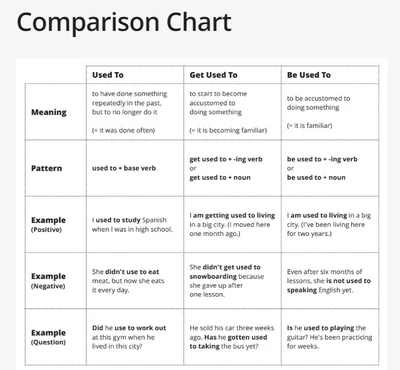
Let's take a look at the 3 forms in more detail :
Used to, get used to, and be used to are three verb forms with similar structures but different meanings. We use this form when talking about habits/routines in the present, past and future !
3
Form :
Used To + Base Verb = I used to run. I would run everyday !
Usage :
Used to is a unique expression in English. Its form and function are similar to a modal (i.e., it gives extra information about the verb and is followed by a base verb). Used to shows that an action was performed repeatedly in the past, but is no longer performed in the present. It is commonly used when talking about long periods in the past (e.g., childhood, school years, past job, etc.).
Examples :
I used to eat meat, but I don’t anymore.
They used to study English every day in high school.
NOTE : Use a Modal Verb ( Would or could. ) in the follow - up sentence to add information.
4
2. Get Used To :
Form :
Get Used To + Noun/‑ing Verb = I need to get used to the winter in London.
Get used to is followed by a gerund (‑ing verb) or a noun. In this expression, the used to part will never change to use to. Only get changes to reflect the verb tense.
Usage :
Get used to indicates that something is becoming familiar. Use this expression for a new habit or routine. Though it is possible to use get used to for both positive and negative experiences, it is more commonly used with negative situations (e.g., when something is difficult).
Examples :
I am getting used to living with my new roommate.
Our new teacher quickly got used to our large, multicultural class.
They couldn’t get used to the noisy neighborhood, so they moved.
Has your brother gotten used to his new boss yet?
5
3. Be Used To :
Form :
Be Used To + Noun/‑ing Verb = I am used to going to bed rather late !
Be used to is followed by a gerund (‑ing verb) or a noun. Note that the used to part will never change to use to. Only be will change to reflect the verb tense.
Usage :
Be used to indicates that something has become familiar. Use this expression when something is now a habit or routine (and has been going on for a while). Like get used to, it is possible to use be used to for both positive and negative experiences, but it is used for negative situations slightly more often.
Examples :
She is used to getting up at 6:00 am because she does it every day.
Is your friend used to the noise from the construction site next to her office?
The teacher wasn’t used to answering so many questions during class.
6
7
What is something that you used to do as a child but no longer do now?
Name five things that you are used to doing every day.
Think of a time when you started a new hobby. Was it hard to get used to it? How long was it until you were used to it?
Imagine you have to move to a new city. Do you think you’ll have a hard time getting used to living there? How about another country?
What types of TV shows did you watch when you were younger? What do you enjoy watching nowadays?
What is something we need to get used to as a child, a teenager and then as an adult. Can you offer any advice to people still going through each stage of life ?
The Habitual Aspect : 3 forms of used to !
Show answer
Auto Play
Slide 1 / 7
SLIDE
Similar Resources on Wayground

6 questions
New Zealand
Presentation
•
Professional Development
6 questions
Can and Can't Business English.
Presentation
•
Professional Development
6 questions
PLC Time
Presentation
•
Professional Development
6 questions
LESSON. 1ST GRADE
Presentation
•
KG
6 questions
Weather Impacts and Consequences
Presentation
•
Professional Development
6 questions
Hotel Expressions
Presentation
•
Professional Development
6 questions
Summarizing
Presentation
•
Professional Development
4 questions
Divertida Mente (in process)
Presentation
•
Professional Development
Popular Resources on Wayground
10 questions
Safety Day 2026 – Student Review

Quiz
•
9th Grade
21 questions
Continents and Oceans
Quiz
•
6th Grade
20 questions
Parts of Speech
Quiz
•
5th Grade
16 questions
Subject & Predicate
Quiz
•
5th Grade
25 questions
Multiplication Facts
Quiz
•
5th Grade
12 questions
Map Skills
Quiz
•
3rd Grade
22 questions
Continents and Oceans
Quiz
•
5th Grade
15 questions
Rounding Decimals
Quiz
•
5th Grade