

Cardiac Cycle

Presentation
•
Biology
•
11th Grade
•
Practice Problem
•
Hard

Seran Bradley
Used 8+ times
FREE Resource
17 Slides • 1 Question
1

Maths Skills:
Heart rate / beats minute−1
Stroke volume / cm3
Cardiac output / cm3minute−1
62
80
4960
R E A R R A N G I N G E Q U A T I O N S
15
A scientist measured the heart rate and the volume of blood pumped in a single heart beat (stroke
volume) of an athlete before exercise and calculated the cardiac output.
Cardiac output is calculated using this equation.
cardiac output = heart rate × stroke volume
Her results are shown in the table below.
After exercise, the athlete’s stroke volume increased by 30% and the cardiac output was
13 832 cm3minute–1
Calculate the athlete’s heart rate after exercise.
Give the answer to 2 significant figures. Show your working.
2
Fill in the Blanks

Calculate the athlete's heart rate after exercise. GIve the answer to 2 significant figures
Type answer...
3

Cardiac cycle
How the blood moves through the heart
4

From the specification
• 3.3.4.1 Mass Transport in Animals
• Students should understand:
1. Pressure and volume changes during the cardiac cycle
2. Valve movements during the cardiac cycle
• How these maintain a unidirectional flow of blood.
• Students should be able to:
• analyse and interpret data relating to pressure and volume changes during the cardiac cycle
5

The cardiac cycle
• A sequence of events that repeats about 70 times a minute in humans
• There are two phases:
❥ Diastole (relaxation)
❥ Systole (contraction or SQUEEZE!)
Remember the basic principles:
Blood flows from higher to lower pressure (down a pressure gradient)
Contraction of heart chambers increases the pressure
Valves open/close according to pressure gradients
Take your pulse! What is your heart rate?
6

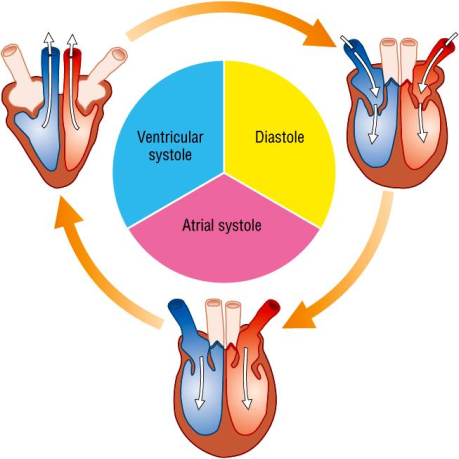
The cardiac cycle
7


Diastole
• Relaxation of the muscle of the heart
• Blood returns to atria from vena cava/pulmonary vein
• Atria fill (as are at lower pressure than veins) and pressure in
atria rises
• Atrial pressure becomes higher than ventricular pressure
• AV valves open
• Blood flows into ventricles (gravity)
• PASSIVE FILLING
• As ventricles are relaxed, SL valves are closed
8


Atrial Systole
• Contraction of both atria, decreasing volume of
chamber and increasing pressure inside
chamber
• Finishes filling of ventricles
• blood flows → ventricles
• No backflow into vena cava or pulmonary vein
as veins have valves
• Ventricles still relaxed
9


Ventricular systole
• Atria relax
• Ventricles contract (0.1s after atria)
• Delay allows ventricular filling to finish
• Contraction causes decrease in volume = Increase in pressure in
ventricle
– Forces AV valves to close to prevent backflow (lub)
– Semi-lunar valves open
– blood flows from ventricles → arteries
• Lasts ~0.3 s
10


Ventricular Diastole
• High pressure in pulmonary artery & aorta closes SL valves to prevent
backflow into ventricles. (dup)
• Whole process restarts
• Blood returns to heart & atria fills again due to high pressure in vena
cava and pulmonary vein.
• Increase in pressure of atria, as ventricles continue to relax, their
pressure falls below that of the atria and so AV valves open
• Blood flows passively into ventricles from atria.
• Atria contract
11

Atrial Systole
The walls of the atria
contract. This reduces the
volume of the atria,
increasing the pressure.
More blood is forced through
the atrio-ventricular valves
into the ventricles.
Ventricular Systole
The walls of the ventricles
now contract, reducing the
volume in the ventricles. The
pressure increases and blood
is forced into the arteries.
Ventricular Diastole
The ventricle walls relax and
the pressure in the ventricles
falls. Blood starts to flow
from the atria into the
ventricles again.
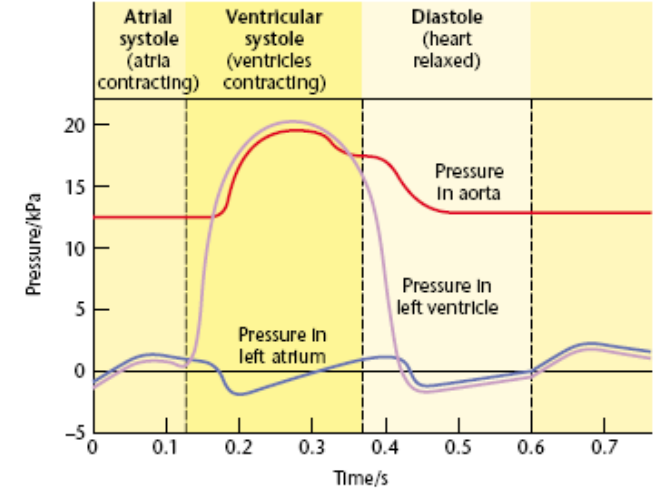
Pressure changes
12

Video review
• https://www.youtube.com/watch?v=SwxA3L55yqs
• https://www.getbodysmart.com/circulatory-system/cardiac-cycle
13


The cardiac cycle
14

15

Cardiac Cycle: Summary
16

A
C
B
17

Questions
• 1. When does the blood start flowing in the aorta?
• 2. Are the semi-lunar valves open or closed at point B?
• 3.Why is ventricular volume decreasing at point C?
• 4. Calculate the heart rate
•Describe the cardiac cycle with reference
to the action of the valves in the heart and
pressure changes
18

ANSWERS
• 1. Point A - ventricles are contracting (AV valves are shut) forcing blood
into the aorta
• 2. Closed, ventricles are relaxed and refilling, so pressure is higher in the
pulmonary artery and aorta forcing SL valves to close
• 3. The ventricles are contracting, reducing the volume of the chamber
• 4. 60/0.8 = 75 beats per minute
Maths Skills:
Heart rate / beats minute−1
Stroke volume / cm3
Cardiac output / cm3minute−1
62
80
4960
R E A R R A N G I N G E Q U A T I O N S
15
A scientist measured the heart rate and the volume of blood pumped in a single heart beat (stroke
volume) of an athlete before exercise and calculated the cardiac output.
Cardiac output is calculated using this equation.
cardiac output = heart rate × stroke volume
Her results are shown in the table below.
After exercise, the athlete’s stroke volume increased by 30% and the cardiac output was
13 832 cm3minute–1
Calculate the athlete’s heart rate after exercise.
Give the answer to 2 significant figures. Show your working.
Show answer
Auto Play
Slide 1 / 18
SLIDE
Similar Resources on Wayground

14 questions
Annelid review part II
Presentation
•
11th Grade
13 questions
Eye recap
Presentation
•
11th Grade
14 questions
Incomplete Dominance & Codominance
Presentation
•
10th Grade
13 questions
Holocaust
Presentation
•
11th Grade
14 questions
Classifying Triangles
Presentation
•
10th Grade
10 questions
Evolution
Presentation
•
10th Grade
12 questions
Oxygen Reduction
Presentation
•
11th Grade
13 questions
Endomembrane
Presentation
•
11th Grade
Popular Resources on Wayground
10 questions
Safety Day 2026 – Student Review

Quiz
•
9th Grade
21 questions
Continents and Oceans
Quiz
•
6th Grade
20 questions
Parts of Speech
Quiz
•
5th Grade
16 questions
Subject & Predicate
Quiz
•
5th Grade
25 questions
Multiplication Facts
Quiz
•
5th Grade
12 questions
Map Skills
Quiz
•
3rd Grade
22 questions
Continents and Oceans
Quiz
•
5th Grade
15 questions
Rounding Decimals
Quiz
•
5th Grade
Discover more resources for Biology
20 questions
Cell Transport
Quiz
•
9th - 12th Grade
8 questions
DNA vs. RNA
Presentation
•
9th - 12th Grade
16 questions
Epithelial tissues
Quiz
•
11th - 12th Grade
15 questions
DNA Structure and Replication
Quiz
•
9th - 12th Grade
20 questions
Ecological Succession Review
Quiz
•
9th - 12th Grade
22 questions
Photosynthesis and Cellular Respiration Review
Quiz
•
9th - 11th Grade
3 questions
Enzymes & Energy
Quiz
•
9th - 12th Grade
38 questions
Mitosis & Meiosis
Quiz
•
9th - 12th Grade