Mutations CFU Prep
Presentation
•
Science
•
7th Grade
•
Medium
+2
Standards-aligned
Heather Ziemba
Used 5+ times
FREE Resource
9 Slides • 26 Questions
1
2
Each nucleotide has 3 parts.
Phosphate group
Sugar (deoxyribose)
Nitrogenous Base
Adenine
Cytosine
Thymine
Guanine
DNA is a Nucleic Acid!
It is made of nucleotides.
3
THE SIDES OF THE LADDER are made up of the deoxyribose sugar and the phosphate group.
THE "RUNGS" (MIDDLE) OF THE LADDER is made up of the nitrogeneous bases.
4
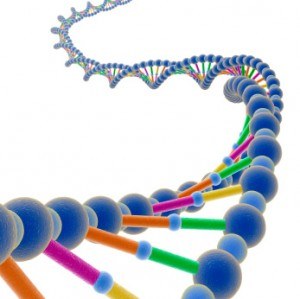
The twisted ladder shape is called a double helix!
This shape was discovered by ROSALIND FRANKLIN, who took an X ray photo of DNA.
5
Multiple Choice
double helix
contains ribose
made of amino acids
contains Uracil
6
Multiple Choice
deoxyribose sugar and adenine
deoxyribose sugar and a hydrogen bond
deoxyribose sugar and the nucleus
deoxyribose sugar and phosphate
7
Multiple Choice
sugar, hydrogen, nitrogen base
sugar, oxygen, nitrogen base
sugar, phosphate, nitrogen base
sugar, phosphate, protein
8
This enzyme unzips and separates the two strands of DNA.
HELICASE
This enzyme adds new nucleotides to each of the separated strands of DNA.
DNA POLYMERASE
Because of how the nitrogenous bases pair, you end up with two identical copies of DNA.
THE RESULT
9
Multiple Choice
What is it called when DNA makes a copy of itself?
Translation
Replication
Mitosis
Gene therapy
10
Multiple Choice
When replication is complete, there are two _____________ DNA modules.
identical
different
similar
11
A change in a DNA sequence affects the amino acid sequence of a protein.
Change in protein structure also changes its function.
Depending on how the function changes, mutations can be good, bad, or neutral.
Mutations = any change in a DNA sequence
12
Multiple Choice
DNA and RNA
DNA
RNA
mRNA and tRNA
13
Multiple Choice
Mutations are SOMETIMES helpful to the organism.
true
false
14
Multiple Choice
What describes a change in the DNA sequence?
Transcription
Translation
DNA replication
Mutation
Apoptosis
15
Multiple Choice
What are considered "negative" mutations?
mutations in the DNA sequence that changes the resulting protein and harms the organism
mutations in the DNA sequence that changes the resulting protein and benefits the organism
mutations in the DNA sequence that produces the same protein
all mutations are considered bad and harm the organisms
16
Multiple Choice
Mutations can be...
Harmful
Beneficial
Neutral
All of the Above
17
Multiple Choice
What are considered "positive" mutations?
mutations in the DNA sequence that changes the resulting protein and harms the organism
mutations in the DNA sequence that changes the resulting protein and benefits the organism
mutations in the DNA sequence that produces the same protein
all mutations are considered bad and harm the organisms
18
19
20
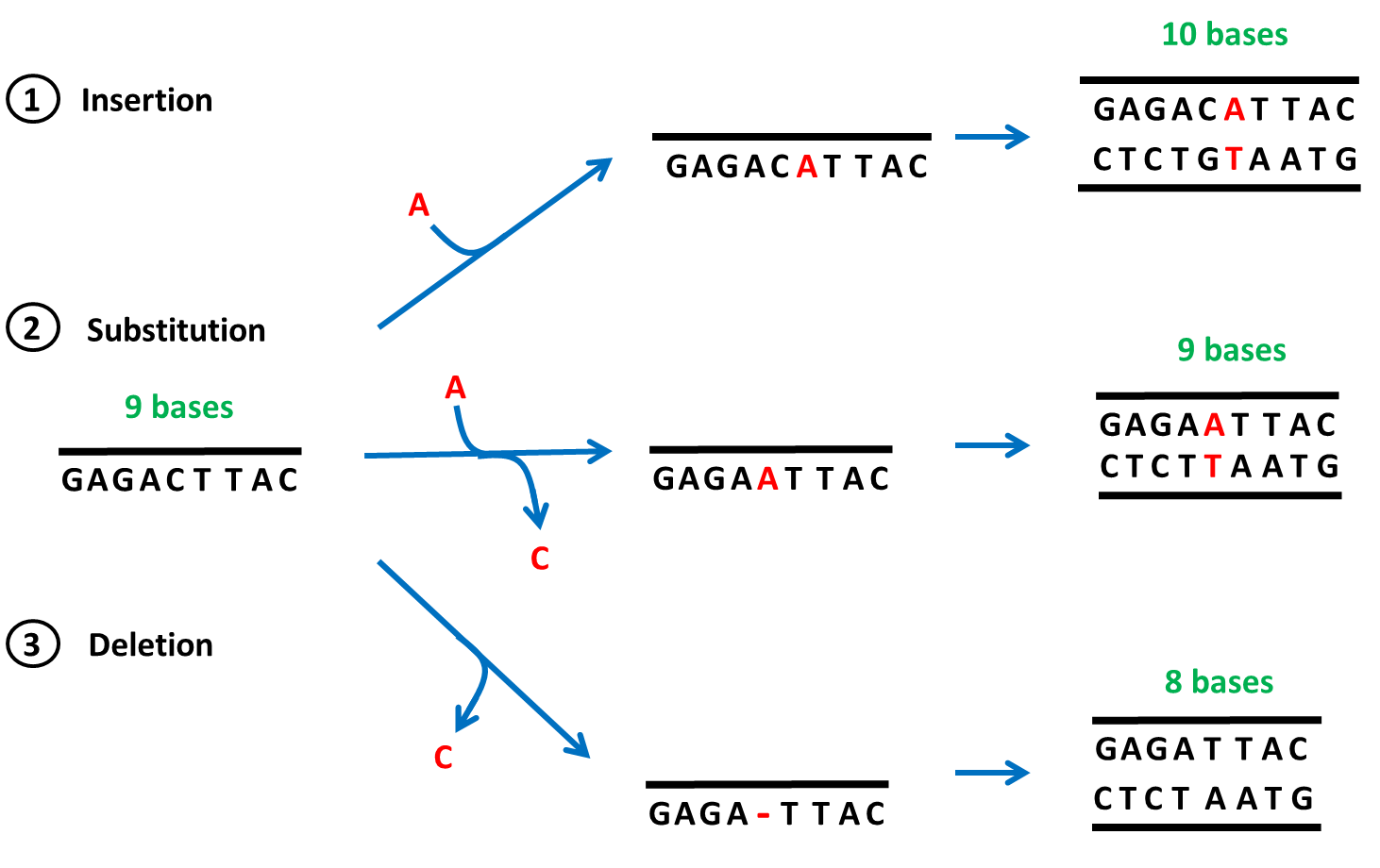
Sections can be deleted or duplicated.
Sections of DNA can be flipped around, or inverted.
Sometimes, sections can be swapped incorrectly, also called translocation.
21
Match
Mutation
Substitution mutation
Frameshift mutation
Silent mutation
Chromosomal mutation
a change in the DNA sequence
a type of mutation where one to few bases are substituted with different bases
a type of mutation caused by adding or deleting bases, affecting all the codons after the change
a type of mutation that doesn't result in a change in the amino acid sequence (same protein)
a type of mutation where large sections of the chromosome are affected
a change in the DNA sequence
a type of mutation where one to few bases are substituted with different bases
a type of mutation caused by adding or deleting bases, affecting all the codons after the change
a type of mutation that doesn't result in a change in the amino acid sequence (same protein)
a type of mutation where large sections of the chromosome are affected
22
Multiple Choice
What mutation has occurred here?
T-G-A-C-C-A
T-G-A-G-C-A
Substitution
Deletion
Insertion
Frameshift
23
Multiple Choice
Which of the following best describes a mutagen?
Direct manipulation of an organism's genes using biotechnology.
Any organism whose genetic material has been altered using genetic engineering techniques.
An agent which can change the structure of DNA, causing a mutation.
24
Multiple Choice
Original: ATC CAT
Mutation: ATC GCAT
What mutation occurred?
deletion
insertion
silent
transverse
25
Multiple Choice
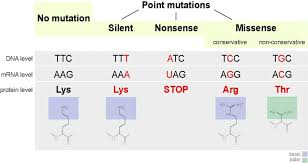
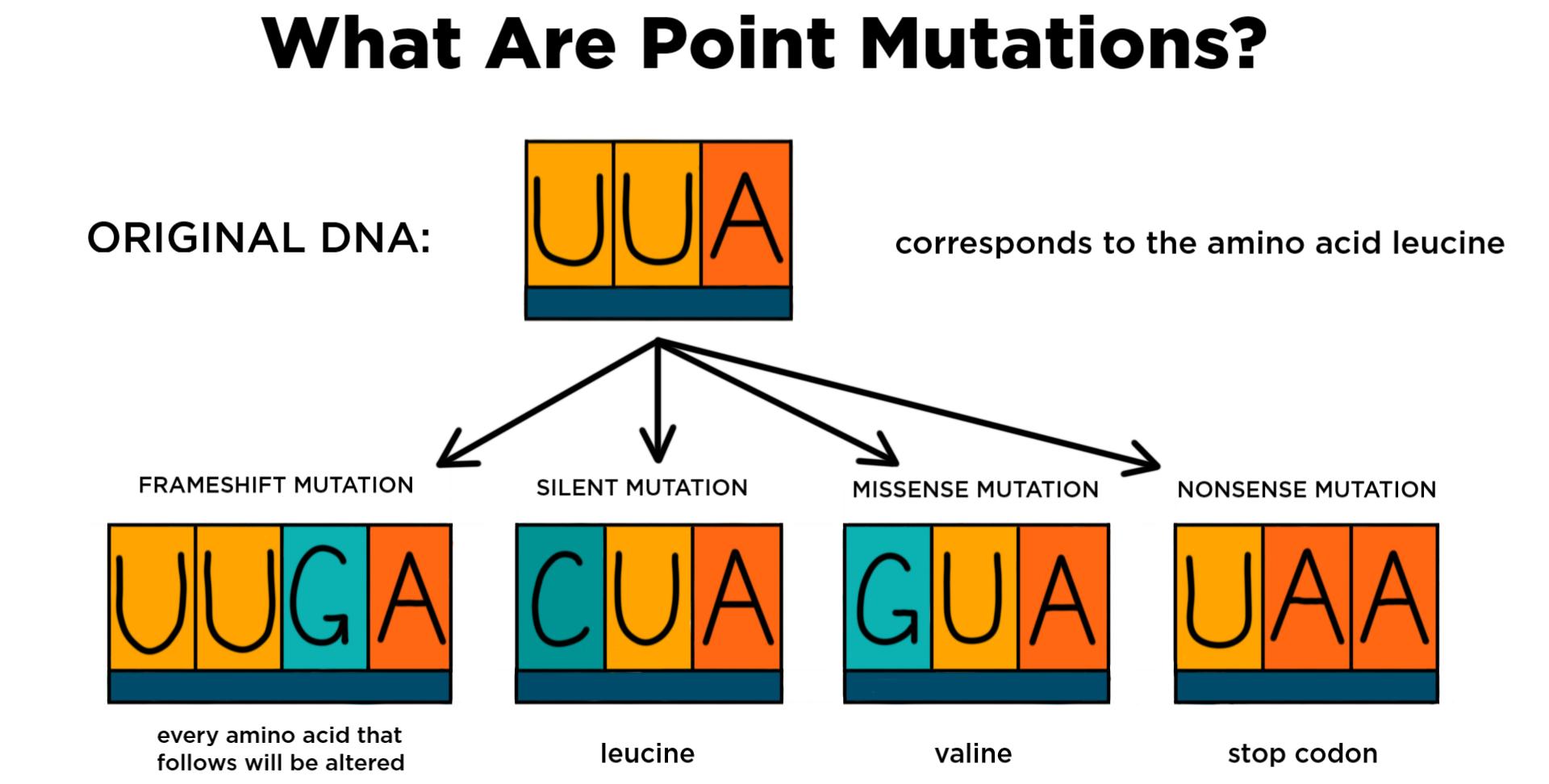
If a point mutation does not change the order of the amino acid sequence, this is called a:
nonsense mutation
silent mutation
missense mutation
frameshift mutation
26
Multiple Choice
Insertions and deletions are also known as:
frameshift mutations
chromosomal mutations
silent mutations
polyploidy
27
Multiple Choice
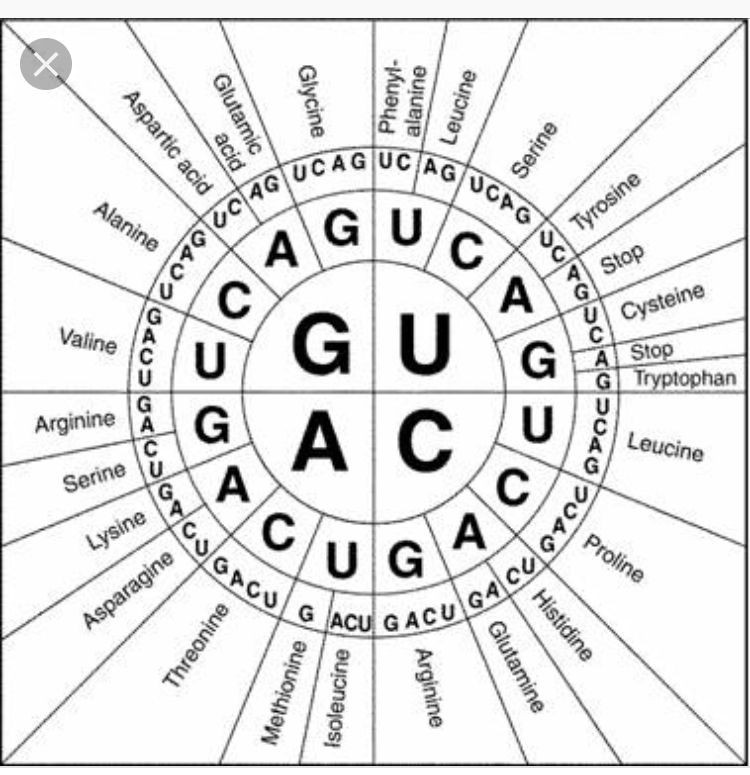
If a mutation codes for "stop" in the amino acid chain, this is called a:
nonsense mutation
missense mutation
silent mutation
frameshift mutation
28
Multiple Choice
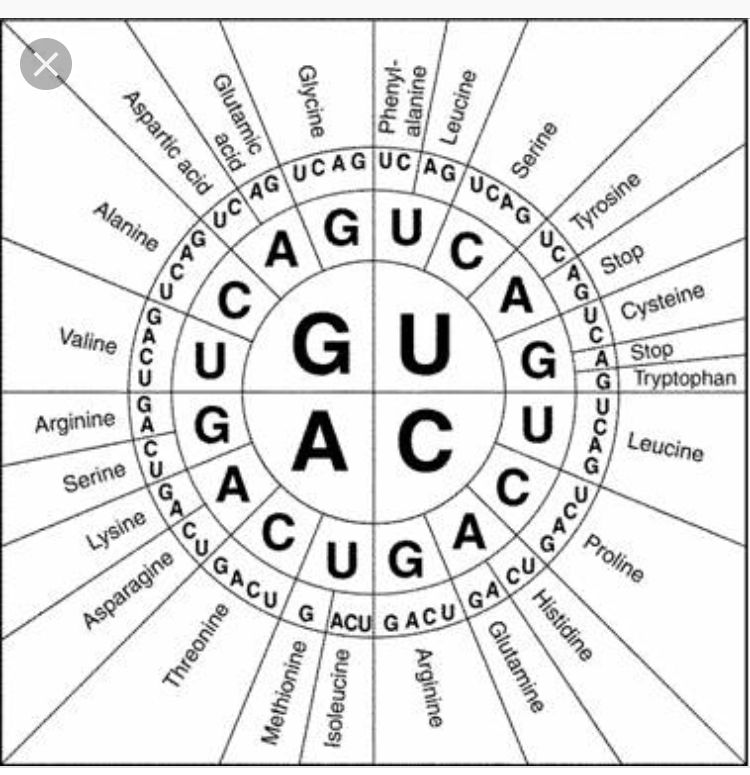
If UCU is changed to UCC, this is a _______________________________.
silent mutation
missense mutation
nonsense mutation
frameshift mutation
29
Multiple Choice
Mutations that change the amino acid specified by the codon, affecting the amino acid sequence, are called:
nonsense mutations
missense mutations
silent mutations
all of the above
30
Multiple Choice
DNA molecule segment is : TTA-CGC-AAG
The mutated DNA segment is TTC-GCA-AG. This is an example of ___ mutation.
Substitution
Deletion
Insertion
Inversion
31
Multiple Choice
Mutations are...
Changes in the sequence of DNA
Broken chromosomes
Bad genes
32
Multiple Choice
What type of gene mutation has occurred here?
T-G-A-C-C-A
T-G-A-C-C-A-A
Substitution
Deletion
Insertion
33
Multiple Choice
Deletion
A
B
C
34
Multiple Choice
Substitution
A
B
C
35
Multiple Choice
Insertion
A
B
C
Show answer
Auto Play
Slide 1 / 35
SLIDE

Similar Resources on Wayground
29 questions
Limiting Factors and Carrying Capacity
Presentation
•
7th Grade
27 questions
Describing Phase Change at Two Scales
Presentation
•
7th Grade
27 questions
Chemical and Physical Change
Presentation
•
7th Grade
30 questions
Organisms and their Environment Review
Presentation
•
7th Grade
32 questions
Digestive System
Presentation
•
7th Grade
29 questions
Air Pollution
Presentation
•
7th Grade
25 questions
7th Science- Energy Transfer in Ecosystems
Presentation
•
7th Grade
27 questions
Atoms, Elements, Molecules, & Compounds
Presentation
•
7th - 8th Grade
Popular Resources on Wayground
10 questions
Safety Day 2026 – Student Review
Quiz
•
9th Grade
21 questions
Continents and Oceans
Quiz
•
6th Grade
20 questions
Parts of Speech
Quiz
•
5th Grade
16 questions
Subject & Predicate
Quiz
•
5th Grade
25 questions
Multiplication Facts
Quiz
•
5th Grade
12 questions
Map Skills
Quiz
•
3rd Grade
22 questions
Continents and Oceans
Quiz
•
5th Grade
15 questions
Rounding Decimals
Quiz
•
5th Grade
Discover more resources for Science
10 questions
Exploring Chemical and Physical Changes
Interactive video
•
6th - 10th Grade
14 questions
Week 1 Falcon Flex Fast and Curious
Quiz
•
7th Grade
42 questions
Explore Plate Tectonics and Boundaries
Quiz
•
7th Grade
21 questions
Waves and Wave Properties
Quiz
•
6th - 8th Grade
16 questions
Photosynthesis and Cellular Respiration Review
Quiz
•
7th Grade
20 questions
Food Webs + Energy Pyramids
Quiz
•
7th Grade
9 questions
Biology: Cell Structure
Interactive video
•
7th Grade
8 questions
Diffusion and Osmosis Review
Presentation
•
6th - 8th Grade