

Intelligence (AP Psychology)

Presentation
•
Social Studies
•
9th - 12th Grade
•
Practice Problem
•
Hard

Zachary Stephenson
Used 13+ times
FREE Resource
25 Slides • 0 Questions
1

SLIDESMANIA.COM
What makes us
intelligent?
Or
Not so
intelligent…
2

SLIDESMANIA.COM
01
Intelligence ● The ability to learn from experience,
solve problems, and use knowledge to
adapt to new situations.
○ Is socially constructed thus…
○ Can be culturally specific.
3

SLIDESMANIA.COM
Is intelligence one thing or
several different abilities?
To find out scientists use
FACTOR ANALYSIS:
A statistical procedure that
identifies clusters of related
items on a test.
Charles Spearman used FA to
discovery his g or (general
intelligence).
4

SLIDESMANIA.COM
Multiple Intelligences
Howard Gardner disagreed
with Spearman’s g and
instead came up with the
concept of multiple
intelligences.
He came up with the idea
by studying savants (a
condition where a person
has limited mental ability
but is exceptional in one
area).
5
SLIDESMANIA.COM
"The measure of intelligence is the ability to
change."
― Albert Einstein
6

SLIDESMANIA.COM
Gardner’s Multiple Intelligences
• Visual/Spatial
• Verbal/Linguistic
• Logical/Mathematical
• Bodily/Kinesthetic
• Musical/Rhythmic
• Interpersonal
• Intrapersonal
• Natural
Learn More about
Gardner
7

SLIDESMANIA.COM
Sternberg’s Three Aspects of Intelligence
Gardner Simplified (C.A.P)
Creative (generating novel ideas)
Analytical (academic problem solving).
Practical (required for everyday tasks where multiple solutions exist).
8

SLIDESMANIA.COM
Emotional Intelligence (EQ)
First called social intelligence.
The ability to perceive, express,
understand, and regulate
emotions.
Some studies show EQ to be a
greater predictor for future
success than IQ
9
SLIDESMANIA.COM
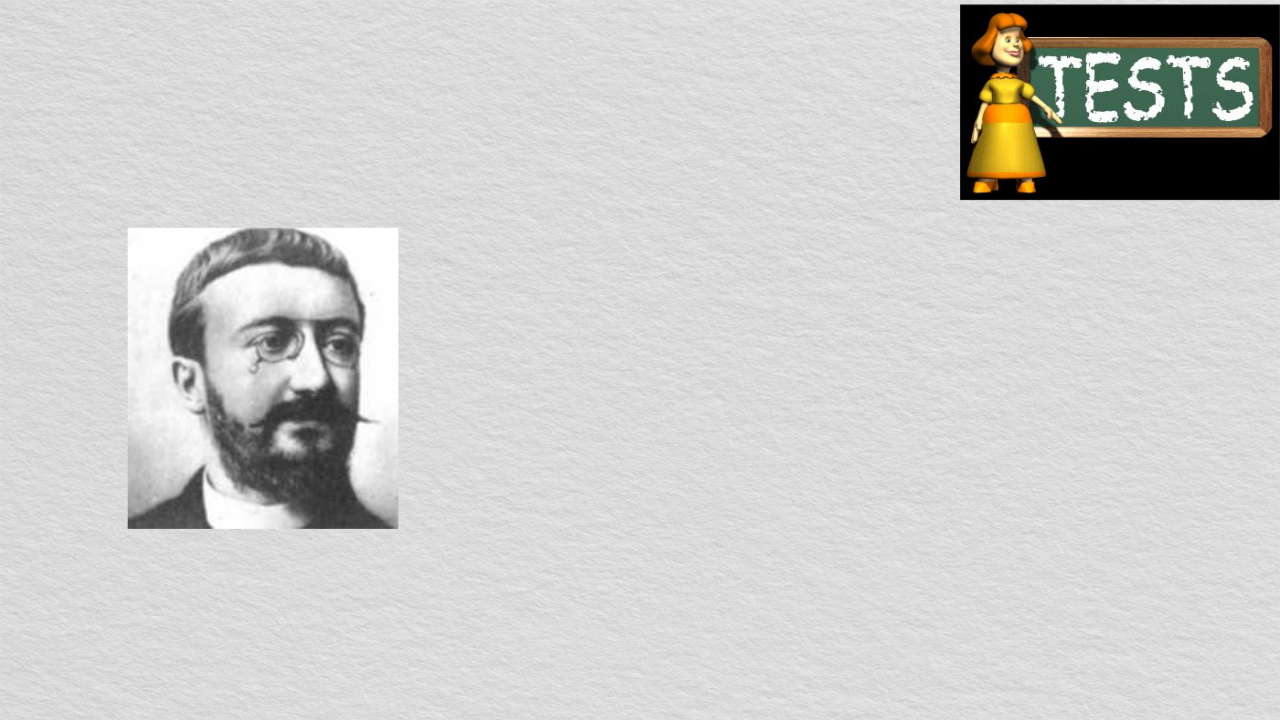
How do we Assess Intelligence?
Alfred Binet and Theodore Simon set
out to figure out a concept called a
mental age (what a person of a
particular age should know).
They discovered that by discovering
someone’s mental age they can predict
future performance.
Hoped they could use test to help
children, not label them.
10

SLIDESMANIA.COM
Terman and his IQ Test
• Used Binet’s research to
construct the modern day IQ
test called the Stanford-Binet
Test.
• IQ=Mental age/Chronological
age X 100.
A 8 year old has a mental age of 10, what is her
IQ?
A 12 year old has the mental age of 9, what is
his IQ?
A boy has the mental age of 10 and an IQ of
200, how old is he?
11

SLIDESMANIA.COM
12

SLIDESMANIA.COM
Problems with the IQ Formula
13

SLIDESMANIA.COM
Modern Tests of Mental Abilities
Wechsler Adult Intelligence Scale (WAIS) consists of 15
subtests and cues us in to strengths by using…
Similarities (in which way are these alike?)
Vocabulary (naming objects or defining words)
Block Design (visual abstract processing)
Letter-Number Sequencing (on hearing a sequence
of letters and numbers, repeating the numbers in
order, and then the letters in alphabetical order).
14

SLIDESMANIA.COM
Aptitude test
Achievement Test
Aptitude v. Achievement Tests
A test designed to predict a person’s
future performance.
A test designed to assess what
a person has learned.
15

SLIDESMANIA.COM
How do we construct Intelligence tests?
Tests must be:
•Standardized
•Reliable
•Valid
16

SLIDESMANIA.COM
Standardization
The test must be pre-tested to a
representative sample of people and
form a normal distribution or bell
curve
17

SLIDESMANIA.COM
18

SLIDESMANIA.COM
Reliability
The term reliability in
psychological research
refers to the
consistency of a
research study or
measuring test.
19

SLIDESMANIA.COM
Validity
The extent to which a test measures
what it is supposed to measure.
Content Validity: does the test
sample a behavior of interest
Predictive Validity: does the test
predict future behavior.
20

SLIDESMANIA.COM
21

SLIDESMANIA.COM
Does Intelligence Change Over Time?
By age 3, a child’s IQ can predict
adolescent IQ scores. BUT…
Depends on the type of
intelligence, crystallized or fluid.
22

SLIDESMANIA.COM
Crystalized vs Fluid Intelligence
Crystalized= ability to relate
information to past experiences
(old people intelligence)
Fluid= Our ability to learn new
things...i.e.Technology
23

SLIDESMANIA.COM
24

SLIDESMANIA.COM
Extremes of Intelligence
Most individuals with Down
syndrome have mild (IQ: 50–69) or
moderate (IQ: 35–50) intellectual
disability with some cases having
severe (IQ: 20–35) difficulties.
Sho Yano earned his bachelor's degree at
Loyola University at age 12 — and it only
took him three years. Then, at 21, he earned
his MD from the University of Chicago.
25

SLIDESMANIA.COM
Test Bias?
Tests do discriminate.
But some argue that there sole
purpose is to discriminate.
We have to look at the type of
discrimination.
Should we eliminate standardized
testing?
SLIDESMANIA.COM
What makes us
intelligent?
Or
Not so
intelligent…
Show answer
Auto Play
Slide 1 / 25
SLIDE
Similar Resources on Wayground

20 questions
Multiplying Polynomials (Special Cases)
Presentation
•
9th - 12th Grade
18 questions
Scatterplots
Presentation
•
9th - 12th Grade
17 questions
Study Skills 1
Presentation
•
9th - 11th Grade
17 questions
Box and Whisker Plots
Presentation
•
9th - 12th Grade
18 questions
7.5 Parts of Similar Triangles
Presentation
•
9th - 12th Grade
19 questions
Target Heart Rate
Presentation
•
8th - 12th Grade
21 questions
Business in the Gilded Age - Unit 3
Presentation
•
9th - 12th Grade
Popular Resources on Wayground
24 questions
PBIS-HGMS Day 10

Quiz
•
6th - 8th Grade
10 questions
HCS SCI 03 Summer School Review 3
Quiz
•
3rd Grade
11 questions
Home Scope
Quiz
•
7th - 8th Grade
15 questions
HCS SCI 05 Summer School Assessment 3 Review
Quiz
•
5th Grade
35 questions
Lufkin Road Middle School Student Handbook & Policies Assessment
Quiz
•
7th Grade
18 questions
Geo 11.3 Area of Circles and Sectors
Quiz
•
9th - 11th Grade