unit 8 -- specific heat
Presentation
•
Chemistry
•
9th - 12th Grade
•
Practice Problem
•
Medium
Standards-aligned
TRACEY RANKIN
Used 29+ times
FREE Resource
18 Slides • 11 Questions
1
2
3
4
5
6
7
Multiple Choice
Because heat is energy, the SI units for heat are ---
Watts
Celsius
joules
Newtons
8
Multiple Select
Select all of the following examples of friction.
air resistance
viscosity
static
nuclear
chemical
9
Multiple Choice
Thermal energy that transfers from one object to another.
Thermal transfer
Friction
Temperature
Heat
10
11
12
Multiple Choice
What are the 3 factors that determine an object's thermal energy?
temperature, volume, and heat
temperature, mass, and specific heat
temperature, energy, and thermal friction
13
14
15
Multiple Choice
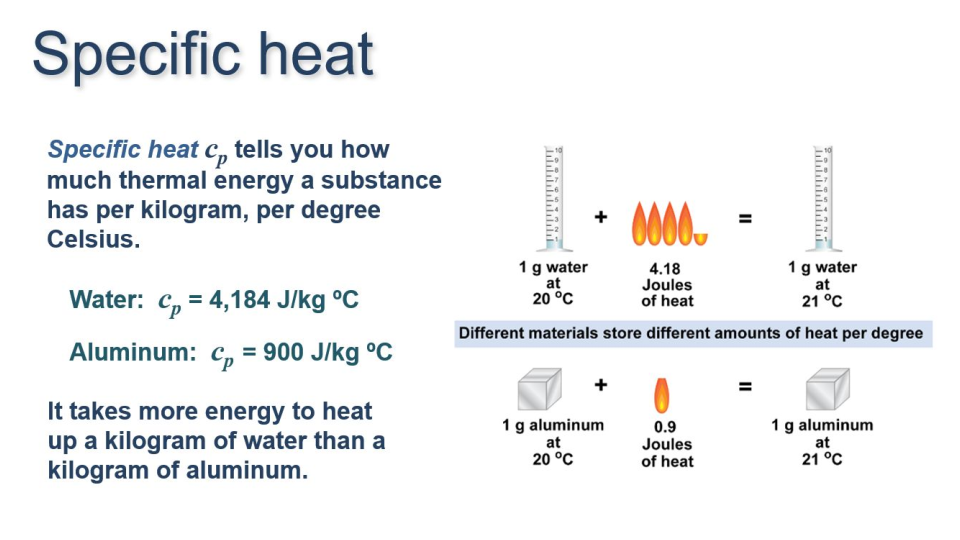
What does specific heat tell you?
how much thermal energy a substance has per kilogram
how much thermal energy is released when it cools
how much mass a substance has at the same temperature
16
Multiple Choice
Water and Aluminum have very different specific heats. What do these numbers tell you?
Aluminum heats water much faster than other substances
It takes more water to heat a pot made of aluminum
It takes much more energy to heat water than aluminum
17
18
19
Multiple Choice
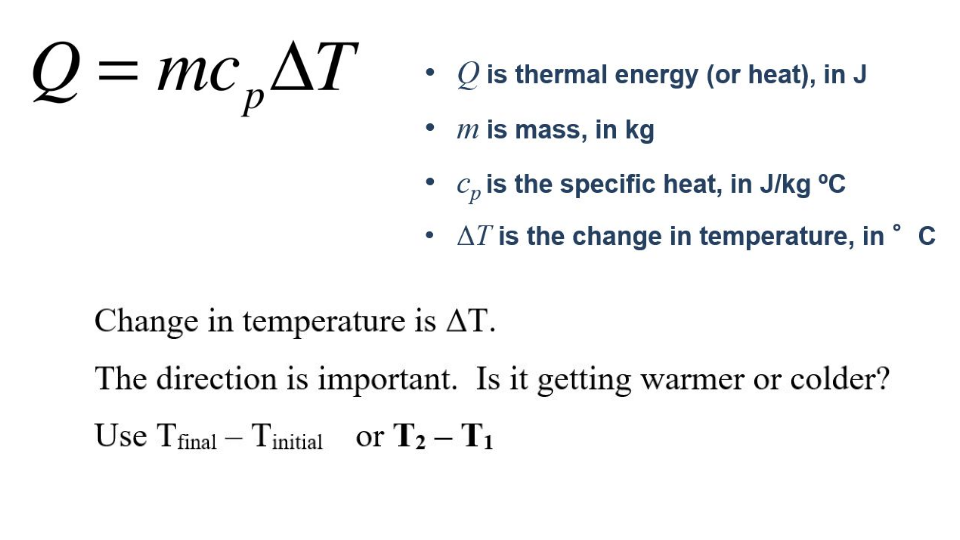
What does the cp represent in the equation?
the mass
the total thermal energy of the substance
the change in temperature
the specific heat
20
Multiple Choice
What does the Q represent in the equation?
the specific heat capacity
the amount of thermal energy
the change in temperature
the amount of the substance
21
22
23
24
25
26
Multiple Choice
Which type of substances have higher specific heat capacities?
light, polar molecules
less dense molecules
heavy atoms
most metals
27
Multiple Choice
Strong intermolecular forces correspond to _____ specific heats.
higher
lower
28
Multiple Choice
Why does water have high specific heat?
it is clear
it has a large mass
it is liquid and polar
it is heavy and dense
29
Show answer
Auto Play
Slide 1 / 29
SLIDE

Similar Resources on Wayground
22 questions
Accuracy v. Precision, Sig Figs, and Scientific Notation
Presentation
•
9th - 12th Grade
20 questions
Types of Reactions
Presentation
•
9th - 12th Grade
25 questions
Electron Configuration, Orbital Notation, & Dot diagrams
Presentation
•
9th - 12th Grade
20 questions
Periodic Trends
Presentation
•
10th - 12th Grade
26 questions
Stoichiometry Lesson
Presentation
•
9th - 12th Grade
22 questions
How big is a mole?
Presentation
•
9th - 12th Grade
21 questions
Chemistry Unit 9: Lesson 1 Solutions and Molarity
Presentation
•
10th - 12th Grade
21 questions
Density (PS)
Presentation
•
8th - 11th Grade
Popular Resources on Wayground
10 questions
Safety Day 2026 – Student Review
Quiz
•
9th Grade
21 questions
Continents and Oceans
Quiz
•
6th Grade
20 questions
Parts of Speech
Quiz
•
5th Grade
16 questions
Subject & Predicate
Quiz
•
5th Grade
25 questions
Multiplication Facts
Quiz
•
5th Grade
12 questions
Map Skills
Quiz
•
3rd Grade
22 questions
Continents and Oceans
Quiz
•
5th Grade
15 questions
Rounding Decimals
Quiz
•
5th Grade
Discover more resources for Chemistry
20 questions
electron configurations and orbital notation
Quiz
•
9th - 12th Grade
20 questions
Periodic Table Trends
Quiz
•
11th Grade
25 questions
Writing and Naming Binary Ionic compounds
Quiz
•
10th Grade
20 questions
COUNTING ATOMS
Quiz
•
10th Grade
50 questions
Unit 3: Atomic Assault Summative Review
Quiz
•
11th Grade
20 questions
Physical or Chemical Change/Phases
Quiz
•
8th Grade - University
15 questions
Periodicity Module Exam Practice Quiz
Quiz
•
9th - 12th Grade
20 questions
Naming Ionic Compounds
Quiz
•
10th Grade