

Energy Test Review 2023

Presentation
•
Science
•
9th Grade
•
Medium

David Thibodeau
Used 1+ times
FREE Resource
32 Slides • 26 Questions
1
Some text here about the topic of discussion
2
More than meets the eye

3
When you microwave popcorn, turn on Spotify, or flip on a light, you are relying on energy transformations to make those different appliances work. Energy can transform from one form to another. In the case of the microwave, electric energy is transformed into radiant energy.

4
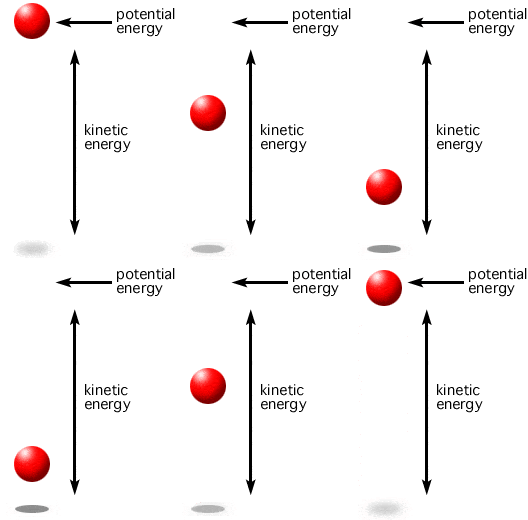
Potential energy and kinetic energy are strongly related. As an object begins moving, it is increasing in kinetic energy and decreasing in potential energy. As it slows, its potential energy moves up and its kinetic energy decreases. In the GIF to the right, the ball reaches maximum potential energy at the height of its bounce because it has slowed to a stop in the air before approaching the ground again.
5
The Law of Conservation of Energy states that energy can be transformed from one form to another or transferred from one region to another, but it cannot be destroyed. This means that for any closed system, the amount of energy remains constant and the amount of energy in the universe is constant.

6
If energy is conserved and never destroyed, then how does a car stop moving? If it stops moving, isn't its mechanical energy destroyed and that's why it stops? Actually, when you apply the brakes on a car, the tires and actions of the brake pads convert the mechanical energy of the car into thermal energy via friction. In fact, in many cases, when we are transforming energy into various forms, energy is lost as thermal energy. This is the case for light bulbs, computers, and batteries.

7
Thermal Energy - We use thermal energy in our heaters, in warming lamps, in stoves, in ovens, and in combustion engines. In the case of an electric heater, that is a conversion of electrical energy from the power plant into thermal energy from the heater. In the case of a combustion engine, that is the conversion of thermal energy into mechanical energy. You could also argue that a combustion engine converts chemical energy into thermal energy by burning fuel which is used to produce mechanical energy.

8
Chemical Energy - Photosynthesis, the creation of glucose molecules inside a plant for food, is an example of radiant energy from the sun being converted into chemical energy which is stored in the plant. We also produce mechanical energy through chemical energy in our metabolism: digesting food and breaking down sugar, fats, and proteins to move our muscles and continue living. This chemical energy is also used to keep our body temperature up, which is a conversion of chemical energy into thermal energy.

9
Radiant Energy - Radiant energy is used in microwaves, cell phones, radio waves, and light bulbs. All of these devices convert electrical energy to radiant energy for different purposes. Cell phones also convert the radiant energy of waves into sound energy. They also convert sound energy into radiant energy when you speak into the microphone. The conversion process includes multiple steps. When you're listening to someone speak on the phone, the radiant energy from their phone and the towers is converted into electrical energy by your phone which then converts that electrical energy into sound energy.

10
Electric Energy - Most of the devices we use on a daily basis use electric energy in some form. We can use electric fans which convert electric energy into mechanical energy. We can use electric heaters which convert electric energy into thermal energy. We even use cell phones which convert electric energy into both radiant energy and sound energy. Electric energy is often converted for us to use it in some other way, but electric energy is also created via other forms of energy: thermal (in the case of geothermal), mechanical (in the case of wind and hydroelectric energy), and chemical (in the case of coal plants and natural gas plants).
11
Whenever energy changes form, there is some energy lost in the form of heat. You feel this heat on your phone when it's charging and you can even feel this heat when next to a high-powered computer. Light bulbs produce heat because of this fact as well. Thermal energy that is lost and cannot be used is called waste energy.

12
Multiple Choice

13
Multiple Choice

14
Multiple Choice

15
Multiple Choice

16
Multiple Choice

17
Multiple Choice

18
Multiple Choice

Thermal
Chemical
Sound
Nuclear
19
20
21

22
Multiple Choice
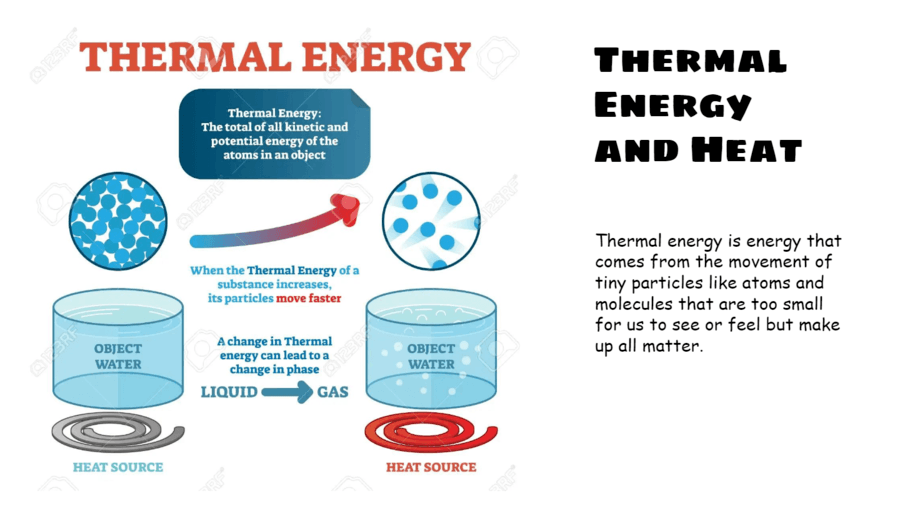
All matter is made of tiny particles that are constantly moving
True
False
23

24

25

26
27

28
Multiple Choice
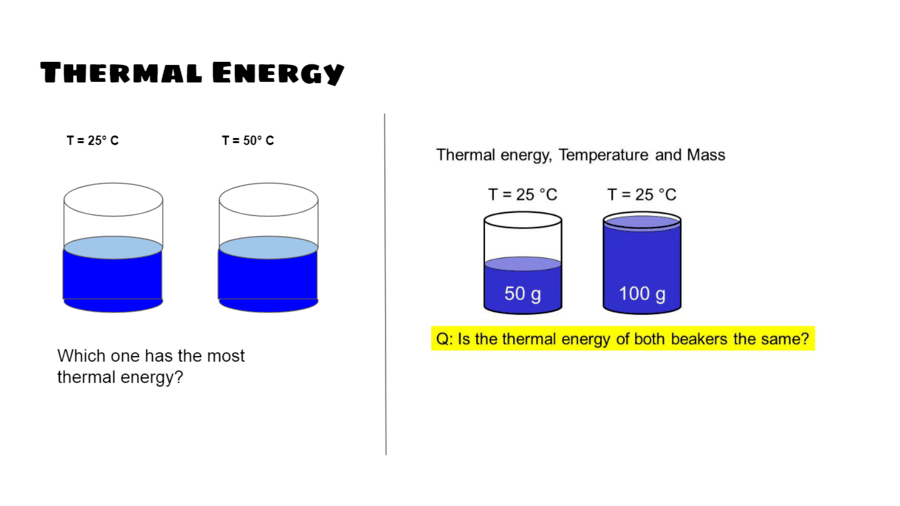
What is the thermal energy of a system?
the total kinetic energy of moving particle
the average kinetic energy of moving particles
the amount of heat in a substance
29
Multiple Select
If the particles of an object begin moving faster...(May be more than one answer)
the temperature will go up
the thermal energy will go up
the mass will go up
the object will move across the floor
30
Fill in the Blanks
The average amount of kinetic energy in an object is its
Type answer...
31
Multiple Select
Which of the following will increase the thermal energy of an object. (May be more than one answer)
increasing the temperature
increasing the mass
reducing the mass
reducing the temperature
32
Multiple Choice
Increasing the mass of an object will increase its temperature
True
False
33

34

35

36

37

38
Match
Specific Heat Capacity
Temperature
Thermal Energy
Convection
Conduction
the amount of energy it takes to raise the temperature of a substance
the average amount of kinetic energy in particles
the total amount of kinetic energy in particles
the movement of fluids (gases and liquids) due to temperature differences
the transfer of thermal energy through collisions of particles when objects touch
the amount of energy it takes to raise the temperature of a substance
the average amount of kinetic energy in particles
the total amount of kinetic energy in particles
the movement of fluids (gases and liquids) due to temperature differences
the transfer of thermal energy through collisions of particles when objects touch
39

40

41
Fill in the Blanks
A substance with a high specific heat requires (more/less) energy to raise the temperature.
Type answer...
42

43
Fill in the Blanks
If you want the temperature to go up quickly, you should choose a substance with a (high/low) specific heat.
Type answer...
44
Fill in the Blanks
Thermal energy is represented by the letter
Type answer...
45
How much heat is needed to raise a 0.30 kg piece of aluminum from 30℃ to 150℃?
Formula: Q = mcΔT
Some text here about the topic of discussion
46

Look for a chart like this which lists the specific heat of different substances.
47
How much heat is needed to raise a 0.30 kg piece of aluminum from 30℃ to 150℃?
specific heat (c) of aluminum = 900 j/kgC
Formula: Q = mcΔT
m = mass = 0.30 kg,
Some text here about the topic of discussion
48
How much heat is needed to raise a 0.30 kg piece of aluminum from 30℃ to 150℃?
Formula: Q = mcΔT
What is ΔT? Change in temperature.
150℃ - 30℃ = 120℃
Some text here about the topic of discussion
49
How much energy is needed to raise a 0.30 kg piece of aluminum from 30℃ to 150℃?
Formula: Q = mcΔT
m = 0.30, c = 900, ΔT = 120
Q = 32400 j (amount of energy needed)
Some text here about the topic of discussion
50
Multiple Choice
51
Multiple Choice
52
Multiple Choice

53
Multiple Choice

54
Multiple Choice
55
Multiple Choice
56
Multiple Choice
57
Multiple Choice
58
Multiple Choice
Some text here about the topic of discussion
Show answer
Auto Play
Slide 1 / 58
SLIDE
Similar Resources on Wayground

53 questions
Untitled Lesson
Presentation
•
KG
54 questions
Metamorphic Rocks Lesson
Presentation
•
9th - 10th Grade
58 questions
Ecology
Presentation
•
9th Grade
52 questions
Food Tests
Presentation
•
9th Grade
53 questions
change of state of matter
Presentation
•
8th - 9th Grade
51 questions
Unit 6 Review
Presentation
•
9th Grade
53 questions
Marine Science Ch 2
Presentation
•
9th Grade
51 questions
Biology 34.2
Presentation
•
9th Grade
Popular Resources on Wayground
10 questions
Safety Day 2026 – Student Review

Quiz
•
9th Grade
21 questions
Continents and Oceans
Quiz
•
6th Grade
20 questions
Parts of Speech
Quiz
•
5th Grade
16 questions
Subject & Predicate
Quiz
•
5th Grade
25 questions
Multiplication Facts
Quiz
•
5th Grade
12 questions
Map Skills
Quiz
•
3rd Grade
22 questions
Continents and Oceans
Quiz
•
5th Grade
15 questions
Rounding Decimals
Quiz
•
5th Grade
Discover more resources for Science
10 questions
Exploring Chemical and Physical Changes

Interactive video
•
6th - 10th Grade
20 questions
Atomic Structure
Quiz
•
9th Grade
10 questions
Exploring the Electromagnetic Spectrum for Middle School Science
Interactive video
•
6th - 10th Grade
10 questions
Exploring Force and Motion Concepts
Interactive video
•
6th - 10th Grade
10 questions
Exploring Air Masses and Weather Fronts
Interactive video
•
6th - 10th Grade
10 questions
Exploring the States of Matter
Interactive video
•
6th - 10th Grade
10 questions
Exploring Forces: Net Force, Normal Force, Gravity, and Friction
Interactive video
•
6th - 10th Grade
10 questions
Differentiating Thermal Energy and Temperature
Interactive video
•
6th - 10th Grade