Factors affecting solubility
Presentation
•
Chemistry
•
9th Grade
•
Practice Problem
•
Easy
+2
Standards-aligned
Karina Marquez
Used 23+ times
FREE Resource
9 Slides • 9 Questions
1
2
By crushing the solute to smaller pieces the amount of surface area for the solute to contact the solvent INCREASES.
The more solute/solvent interactions that occur the faster will be the rate of dissolution!
This is why Kool-aid is such a fine powder!
***Important to note that molecular bonds are NOT being broken, the molecules are just in smaller pieces.
3
Draw
Circle the seltzer that will dissolve the most quickly. Then, write an explanation of WHY it will dissolve the most quickly using the terms "surface area", "solvent" and "solute"
4
Open Ended
Write an explanation of WHY it will dissolve the most quickly using the terms "surface area", "solvent" and "solute"
5
6
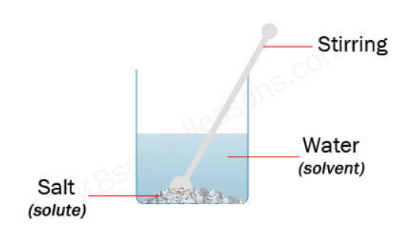
Stirring or agitating a solution increases the amount of solute/solvent interactions mechanically.
Increasing solute/solvent interactions increases rate of dissolution.
This is why you stir the Kool-aid when you add it to the water.
7
Draw
Label the solute and the solvent. Then, write a description about how agitation is effecting the rate of dissolution.
8
Open Ended
Write a description about how agitation is effecting the rate of dissolution.
9
This video is about How TEMPERATURE affects the rate of dissolution.
10
Increasing kinetic energy (energy of motion) increases the number of solute/solvent interactions.
Increasing the number of solute/solvent interactions increases the rate of dissolution.
AGAIN NOTE that for gases, they are actually more soluble in liquids at lower temperatures, because they boil out when the temperature is too high.
11
Draw
Circle the container with the most kinetic energy. Then, write a description about the effect of increasing kinetic energy on the rate of dissolution.
12
Open Ended
Write a description about the effect of increasing kinetic energy on the rate of dissolution.
13
Exemplar
Heating a solution increases the kinetic energy of the solution. This will increase the rate of dissolution, because the solute and solvent will be interacting or "bumping" in to each other more, causing the solute to dissolve more quickly.
14
Match
Match the following terms:
Increasing agitation
Crushing solute
Temperature increase
Mechanically increases number of solute/solvent interactions to increase rate of dissolution
Increases surface area of solute to interact with solvent to increase the rate of dissolution
Increases kinetic energy of solute and solvent particles to increase rate of dissolution
Mechanically increases number of solute/solvent interactions to increase rate of dissolution
Increases surface area of solute to interact with solvent to increase the rate of dissolution
Increases kinetic energy of solute and solvent particles to increase rate of dissolution
15
Open Ended
List 3 ways to increase the rate of dissolution of a solute AND DESCRIBE each.
16
To increase the rate of dissolution, you can:
-stir
-crush the solute
-heat the solution
Why do these all work? It is all about increasing solute-solvent interactions. The more the solute and solvent interact, the more quickly the solute will dissolve.
Stirring manually makes the solute and solvent bump into each other more.
Crushing the solute creates more surface area of solute to bump into the solvent more.
Heating the solution increases the kinetic energy of the solution, which means the solute and solvent will be moving around more and will bump into each other more.
17
Open Ended
Exit ticket time!!!
Ramen flavoring is designed the way it is to ensure easy dissolution for you, the Ramen eater.
Describe in complete sentences how each of the ways we just learned to increase rate of dissolution are exemplified in Ramen flavoring packets.
18
The flavor packets have very small, fine pieces of solute (flavoring). That creates a lot of surface area for dissolution. You place the flavoring in hot water and stir, which also contributes to the quick dissolution of the flavor packet.
Show answer
Auto Play
Slide 1 / 18
SLIDE

Similar Resources on Wayground
13 questions
VSEPR theory
Presentation
•
10th Grade
14 questions
Physical and Chemical Properties
Presentation
•
8th Grade
13 questions
Multiplying binomials
Presentation
•
9th Grade
13 questions
Second Conditional
Presentation
•
9th Grade
13 questions
Preposition
Presentation
•
9th Grade
14 questions
Quadratic Key Features 7A
Presentation
•
9th Grade
12 questions
Best Fit Line
Presentation
•
9th Grade
12 questions
Imperialism
Presentation
•
9th Grade
Popular Resources on Wayground
10 questions
Safety Day 2026 – Student Review
Quiz
•
9th Grade
21 questions
Continents and Oceans
Quiz
•
6th Grade
20 questions
Parts of Speech
Quiz
•
5th Grade
16 questions
Subject & Predicate
Quiz
•
5th Grade
25 questions
Multiplication Facts
Quiz
•
5th Grade
12 questions
Map Skills
Quiz
•
3rd Grade
22 questions
Continents and Oceans
Quiz
•
5th Grade
15 questions
Rounding Decimals
Quiz
•
5th Grade
Discover more resources for Chemistry
20 questions
electron configurations and orbital notation
Quiz
•
9th - 12th Grade
20 questions
Physical or Chemical Change/Phases
Quiz
•
8th Grade - University
15 questions
Periodicity Module Exam Practice Quiz
Quiz
•
9th - 12th Grade
44 questions
C1 Atomic Structure Review
Quiz
•
9th Grade
19 questions
Isotopes & Ions
Quiz
•
9th Grade
8 questions
Label Energy Diagram
Quiz
•
9th - 12th Grade
10 questions
Endothermic/Exothermic
Quiz
•
9th - 12th Grade
6 questions
Energy Change
Quiz
•
9th - 12th Grade