
ch 5 the integumentary system

Presentation
•
Biology
•
Professional Development
•
Easy
Standards-aligned

Laisha Jimenez
Used 3+ times
FREE Resource
7 Slides • 4 Questions
1
Some text here about the topic of discussion
2
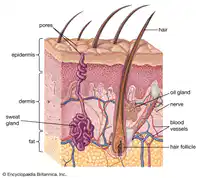
Epidermis- superficial region Consists of epithelial tissue and is avascular epi= above
Dermis-underlies epidermis
Mostly fibrous connective tissue, vascular
Hypodermis- (superficial fascia) hypo= below
Not technically part of the skin
Subcutaneous
Mostly adipose tissue
skin layers
3
Come Lets Get Sun- Burned (superficial to deep)
Stratum Corneum
Stratum Lucidum
Stratum Granulosum
Stratum Spinosum
Stratum Basale
Some text here about the topic of discussion
4
Open Ended
what is the first epidermal layer superficial to deep?
5
Some text here about the topic of discussion
Keratinocytes Produce keratin Fibrous protein that gives skin its protective properties Tightly connected by desmosomes Millions slough off every day
Melanocytes Spider-shaped cells located in deepest epidermis Produce melanin packaged into melanosomes (What is this?) melanosomes are transferred to keratinocytes protect nucleus from UV damage
Dendritic (Langerhans) cells star-shaped macrophages that patrol deep epidermis activate the immune system Derived from bine marrow and migrated to epidermis
Tactile (Merkel) cells sensory receptors that sense touch
6
Open Ended
what is the name of the skin cells that produce keratin?
7
Merocrine-
Most numerous type
Abundant on palms, soles, and forehead
Ducts connect to pores
Function in thermoregulation
Regulated by sympathetic nervous system
Secrete sweat
99% water, salts, vitamin C, antibodies, dermcidin (microbe-killing peptide), metabolic wastes
Eccrine- AKA knows as merocrine
sebaceous gland- Widely distributed, except for thick skin of palms and soles
Most develop from hair follicles and secrete into hair follicles
Relatively inactive until puberty
Stimulated by hormones, especially androgens
Secrete sebum
Some text here about the topic of discussion
8
Apocrine- Confined to axillary and anogenital areas
Secrete viscous milky or yellowish sweat that contains fatty substances and proteins
Bacteria break down sweat, leading to body odor
Larger than eccrine sweat glands with ducts emptying into hair follicles
Begin functioning at puberty
Function unknown but may act as sexual scent gland
Modified apocrine glands
Ceruminous glands: lining of external ear canal; secrete cerumen (earwax)
Mammary glands: secrete milk
9
1st degree burn- Epidermal damage only
Localized redness, edema (swelling), and pain
2nd degrees burn Epidermal and upper dermal damage
Blisters appear
First- and second-degree burns are referred to as partial-thickness burns because only the epidermis and upper dermis are involved
3rd degree burn
Entire thickness of skin involved (referred to as full-thickness burns)
Skin color turns gray-white, cherry red, or blackened
No edema is seen and area is not painful because nerve endings are destroyed
Skin grafting usually necessary
10
Open Ended
what burn degree is it when blisters start appearing?
11
Poll
On what topics do you need further assistance?
glands
epidermal layers
skin layers
no questions
Some text here about the topic of discussion
Show answer
Auto Play
Slide 1 / 11
SLIDE
Similar Resources on Wayground

14 questions
Colour 101
Presentation
•
Professional Development
7 questions
B2 SCI - on prefix "nano" - Text 10
Presentation
•
Professional Development
14 questions
Convection Conduction Radiation
Presentation
•
KG - University
14 questions
Conduction Convection
Presentation
•
KG - University
6 questions
environment
Presentation
•
Professional Development
11 questions
PASS Wk2
Presentation
•
University
6 questions
mụn điều trị
Presentation
•
KG - University
11 questions
Reading about the human body
Presentation
•
University
Popular Resources on Wayground
10 questions
Safety Day 2026 – Student Review

Quiz
•
9th Grade
21 questions
Continents and Oceans
Quiz
•
6th Grade
20 questions
Parts of Speech
Quiz
•
5th Grade
16 questions
Subject & Predicate
Quiz
•
5th Grade
25 questions
Multiplication Facts
Quiz
•
5th Grade
12 questions
Map Skills
Quiz
•
3rd Grade
22 questions
Continents and Oceans
Quiz
•
5th Grade
15 questions
Rounding Decimals
Quiz
•
5th Grade