

Enzymes Part 2

Presentation
•
Biology
•
9th - 12th Grade
•
Medium
Standards-aligned

Jane Claussen
Used 15+ times
FREE Resource
22 Slides • 11 Questions
1
Understanding the means of Enzyme vocabulary, enzyme structures and their functions
I Will...
Review enzymes, their structure, their functions, and enzyme vocabulary.
We Will...
2
proteins that function as biological catalysts
A catalyst is a substance that increases the rate of a chemical reaction.


3
Lets Review...
Enzymes are named according to the reaction that they catalyse and often end in "ase"
The substance present at the beginning of the reaction is called the substrate.
The substrate binds to the enzyme at the Active Site
The substance made by the reaction is called the product.
For Example: In saliva there is an enzyme called amylase.
It catalyses the breakdown of starch to the complex sugar maltose.
starch ------------- ► maltose
In this reaction, starch is the substrate, and maltose is the product.
4

5
An enzyme works only when the perfect fitting substrate binds at the active site.
The enzyme is like a lock that the substrate fits like a key.
We say that the shape of the enzyme and the shape of the substrate are complementary to one another

6

7
Activation Energy

Enzymes - biological catalysts, speeding up reactions in the body
Done by lowering activation energy...
Activation Energy - how much energy is required for the reaction to start.
8
Multiple Choice

A model of an enzyme and its corresponding substrate is shown. Which model best represents the molecules at the end of the reaction?
9
Multiple Choice

The diagram below models an enzyme breaking down a complex carbohydrate called starch. Enzymes are structures used to help chemical reactions take place, but they do not actually take part in the chemical reaction. If X represents what a starch molecule will break down into, then X could represent what biomolecule and its monomer?
Amino Acid
Simple Sugar
Protein
Fatty Acid
10
Multiple Choice
For an enzyme to be able to catalyze a reaction, the active site must —
be occupied by an inhibitor
increase the activation energy level
have a complementary shape to the substrate
cause the enzyme to be destroyed in the reaction
11
Understanding the means of Enzyme vocabulary, enzyme structures and their functions
I Will...
Review enzymes, their structure, their functions, and enzyme vocabulary.
We Will...
12
Temperature
pH
Inhibitors
Non-Competitive Inhibitor
Competitive Inhibitor
Enzyme Concentration
Substrate Concentration
Coenzymes and Cofactors
13
Enzymes are made inactive by low temperature.
Because they are protein molecules Enzymes are damaged by heat, high temperature.
This is called DENATURED


14
Multiple Choice
15

16
Enzymes work best at a particular temperature. Enzymes in the human body usually work best at about 37 °C
17
Multiple Choice

What is the optimal temperature of this enzyme?
60
40
70
30
18
Enzymes work best at a particular pH Some enzymes work best in acid conditions (low pH). Others work best in neutral (7 pH) or alkaline conditions (high pH)

19
Multiple Choice
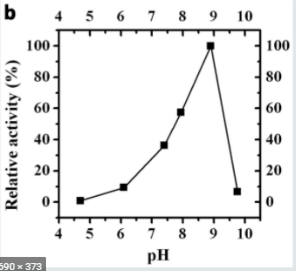
What is the optimal pH for this enzyme?
6
10
9
7
20

- Shape of active site can change, so substrate can no longer bind and enzyme cannot catalyze. This is denaturation.
21
Multiple Choice
Changes in pH and temperature can ___________________ an enzyme which causes it to lose its shape and affects its function.
puncture
denature
double
delete
22

23

24

Molecule that binds to Allosteric site - site where regulator binds
Causes change of shape to active site, cannot catalyze reactions
Non-Competitive Inhibitors
25
Multiple Choice
Non Competitive Inhibitors bind to _________ to prevent enzyme from catalyzing.
Allosteric Site
Active Site
Site of Photosynthesis
Binding site
26

Molecule that can bind to active site of enzyme
Prevents enzyme from forming enzyme-substrate complexes. Stops enzyme from catalyzing
Competitive Inhibitor
27
Multiple Choice
Competitive Inhibitors are molecules that bind to ________ to prevent enzyme from catalyzing.
Site of Photosynthesis
Allosteric Site
Active Site
Binding Site
28

Enzyme concentration increases, rate of reaction increases
Enzyme Concentration
29

Substrate concentration increases, rate of reaction increases
Substrate Concentration
30
Multiple Choice
Increasing substrate concentration and enzyme concentration will _________ the rate of reactions.
Stop
Decrease
delay
Increase
31

Cofactors - help enzymes work at optimum reactions. Inorganic ions such as calcium or magnesium
Coenzyme- cofactors that are organic/carbon based. Obtains from vitamins we eat
Cofactors and Coenzymes
32
Multiple Choice
Cofactors and Coenzymes both help the ________ bind to the ________.
Substrate; Enzyme
Substrate; Allosteric Site
Enzyme; Product
Product; Substrate
33
Understanding the means of Enzyme vocabulary, enzyme structures and their functions
I Will...
Review enzymes, their structure, their functions, and enzyme vocabulary.
We Will...
Understanding the means of Enzyme vocabulary, enzyme structures and their functions
I Will...
Review enzymes, their structure, their functions, and enzyme vocabulary.
We Will...
Show answer
Auto Play
Slide 1 / 33
SLIDE
Similar Resources on Wayground

27 questions
Reaction Rates
Presentation
•
9th - 12th Grade
27 questions
Inverse Variation
Presentation
•
9th - 12th Grade
25 questions
Crime Scene Investigation and Evidence Collection Part 2
Presentation
•
9th - 12th Grade
25 questions
Mandatos informales (+)(-)
Presentation
•
9th - 12th Grade
25 questions
newton's laws
Presentation
•
9th - 12th Grade
27 questions
5.1_Intro to Evolution Lesson_3/27
Presentation
•
9th - 12th Grade
24 questions
Lesson 11 Cell Differentiation
Presentation
•
9th - 12th Grade
22 questions
DNA Replication!
Presentation
•
9th - 12th Grade
Popular Resources on Wayground
10 questions
Safety Day 2026 – Student Review

Quiz
•
9th Grade
21 questions
Continents and Oceans
Quiz
•
6th Grade
20 questions
Parts of Speech
Quiz
•
5th Grade
16 questions
Subject & Predicate
Quiz
•
5th Grade
25 questions
Multiplication Facts
Quiz
•
5th Grade
12 questions
Map Skills
Quiz
•
3rd Grade
22 questions
Continents and Oceans
Quiz
•
5th Grade
15 questions
Rounding Decimals
Quiz
•
5th Grade
Discover more resources for Biology
20 questions
Cell organelles and functions
Quiz
•
10th Grade
20 questions
Cell Transport
Quiz
•
9th - 12th Grade
25 questions
photosynthesis and cellular respiration
Quiz
•
9th Grade
20 questions
Cell Cycle
Quiz
•
9th Grade
8 questions
DNA vs. RNA
Presentation
•
9th - 12th Grade
14 questions
Ecological Succession: Primary and Secondary
Quiz
•
9th Grade
20 questions
Macromolecules
Quiz
•
10th Grade
20 questions
Characteristics of Life
Quiz
•
9th - 10th Grade