Thermal Energy & the Kinetic Molecular Theory
Presentation
•
Science
•
10th Grade
•
Medium
+5
Standards-aligned
John Oglesby
Used 8+ times
FREE Resource
19 Slides • 23 Questions
1
Kinetic Molecular Theory :
Thermal Energy
2
Thermal Energy Transfer
Conduction → Transfer of thermal energy by collisions between particles in matter. Occurs in solids, liquids, & gases. Metals are the best conductors.
Convection → Transfer of thermal energy in a fluid by the movement of warmer and cooler fluid from place to place. Occurs in liquids & gases.
Radiation → Transfer of energy by electromagnetic waves. Occurs in gases only.
3
Conduction
Transfer of thermal energy that occurs in solids, liquids, and gases when two substances of different temperatures touch.
4
Convection
Heat transfer caused by the rising of hotter, less dense fluids and the falling of cooler, more dense fluids.
5
Radiation
The transfer of energy by the movement of electromagnetic waves or subatomic particles.
6
Conductor
A substance that allows the flow of electrical charge or transfers thermal energy through matter.
7
Insulator
A material that does not conduct heat or electric current
8
Multiple Choice
Heat is the transfer of _____ from one object to another due to a difference in temperature.
Time
Force
Energy
Velocity
9
Multiple Choice
The man's hand will immediately receive heat from the metal as the candle gradually warms it. That is called____?
Conduction
Convection
Radiation
10
Multiple Choice
"Metals" are the best____?
Insulators of heat
Conductors of heat
Conductors of light
Insulators of electricity
11
Multiple Choice
How does heat move?
from a warmer to a cooler object
from a cooler to a warmer object
toward a hot object
away from a cold object
12
Multiple Choice
Energy transmitted by electromagnetic waves
conduction
convection
radiation
13
Multiple Choice
When you touch hot sand, heat is transferred by _________ to your skin.
conduction
convection
radiation
14
Multiple Choice
15
Multiple Choice
16
17
18
Kinetic Theory
Think like a molecule
19
KMT
Kinetic Molecular Theory | with Teacher Dan
Kinetic Molecular Theory
Gases are composed of tiny particles.
There are no attractive forces between molecules.
Gas molecules are always in constant random motion.
The molecules collide classically with container walls and one another.
The movement of gas molecules is affected by temperature. The average kinetic energy of the molecules is directly related to the temperature of a gas.
20
Phet - States of Motion
Some text here about the topic of discussion
21
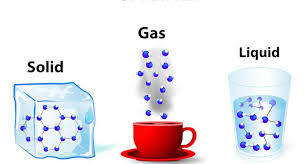
Solid
22
Liquid
23
Gas
24
Heat of fusion
25
Melting point
26
Heat of vaporiztion
27
Boiling point
28
Multiple Choice
What state of matter has a definite volume and a definite shape?
Solid
Liquid
Gas
Plasma
29
Multiple Choice
What state of matter has a definite volume but no definite shape?
solid
liquid
gas
plasma
30
Multiple Choice
What state of matter has not definite shape or volume?
Solid
Liquid
Gas
Plasma
31
Multiple Choice
32
Multiple Choice
33
Multiple Choice
34
Multiple Choice
35
Multiple Choice
36
Multiple Choice
These properties describe a ___.
solid
liquid
gas
37
Multiple Choice
These properties describe a ___.
solid
liquid
gas
38
Multiple Choice
The more energy that particles have, the ___ they move.
slower
faster
39
Multiple Choice
The force of attraction between molecules is ___.
intermolecular forces
bridge forces
chemical bonds
40
Multiple Choice
As matter changes state from liquid to solid, the atoms have ____ kinetic energy.
more
less
the same
41
Multiple Choice
Which state of matter is found in our Sun and other stars?
solid
liquid
gas
plasma
42
Multiple Choice
Kinetic Molecular Theory :
Thermal Energy
Show answer
Auto Play
Slide 1 / 42
SLIDE

Similar Resources on Wayground
37 questions
Arctic Sea Ice Review
Presentation
•
10th Grade
36 questions
Target Stoichiometry Lab with Baking Soda
Presentation
•
10th Grade
34 questions
Populations: Crater Lions
Presentation
•
10th Grade
37 questions
Types of Boundaries
Presentation
•
10th Grade
36 questions
Physiological measurements
Presentation
•
10th Grade
36 questions
UNIT 1: ENERGY FLOW/CYCLE OF MATTER REMEDIATION LESSON
Presentation
•
10th Grade
38 questions
Structure and Properties of Matter
Presentation
•
9th Grade
37 questions
6.1 Intro to polygons
Presentation
•
10th Grade
Popular Resources on Wayground
24 questions
PBIS-HGMS Day 10
Quiz
•
6th - 8th Grade
10 questions
HCS SCI 03 Summer School Review 3
Quiz
•
3rd Grade
11 questions
Home Scope
Quiz
•
7th - 8th Grade
15 questions
HCS SCI 05 Summer School Assessment 3 Review
Quiz
•
5th Grade
35 questions
Lufkin Road Middle School Student Handbook & Policies Assessment
Quiz
•
7th Grade
18 questions
Geo 11.3 Area of Circles and Sectors
Quiz
•
9th - 11th Grade