

Unit 2 Part 3 ( Succession)

Presentation
•
Science
•
9th Grade
•
Medium
+10
Standards-aligned

HEATHER TILTON
Used 8+ times
FREE Resource
20 Slides • 17 Questions
1

2

3

4

5
Multiple Choice
What is an example of an area that is likely to undergo primary succession?
Glaciers melt and leave exposed rock
Plants die from drought and decompose
Land is bulldozed and soil remains
6
Multiple Choice
What is an increase of biodiversity over time, after a natural or man made disturbance?
ecological recession
climax recession
ecological succession
climax succession
7
Multiple Choice
Why does biodiversity increase during the course of succession?
Biodiversity refers to the difference in ages of organisms, so some organisms arrive earlier than others.
Over time, the same trees begin to reproduce and take over an area.
Many populations of organisms gradually begin to occupy the same area to create a climax community.
Many organisms move in to the area for a short amount of time, then leave to find a better habitat.
8

9

10

11

12

13

14

15
Multiple Choice

Primary or secondary ecological succession?
16
Multiple Choice
Pioneer species are the first
trees to grow in an area that has been disturbed
trees that replace the original trees after a forest fire
organisms to live in previously uninhabited areas
organisms to live in a forest canopy
17
Multiple Choice

18

19

20

21

22
Multiple Choice
What is the term that describes a steady and stable community?
peak community
turf community
climax community
disturbed community
23
Multiple Choice
Which is faster: Primary or Secondary Succession?
Primary Succession
Secondary Succession
Both Take The Same Amount of Time
24
Multiple Choice
The Final stage of ecological succession is...
Mature Tree Growth
Climax Community
Pioneer Community
25

26
Multiple Choice
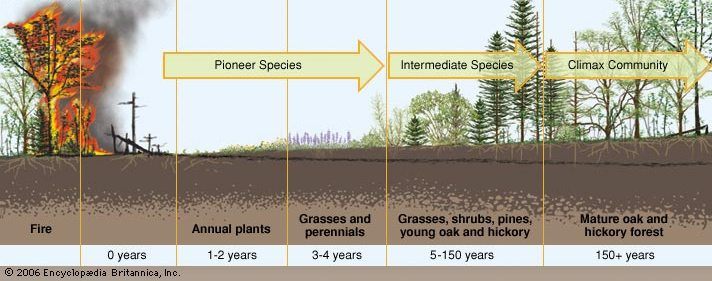
27
Multiple Choice
Over long time periods, global climate change may change the ________ of a species.
I. realized niche
II. fundamental niche
III. extinction rate
I only
II only
I and II
I and III
I, II and III
28

29
Multiple Choice
Which is NOT true regarding keystone species?
Keystone species can be mutualists with other species.
Keystone species are often rare individuals in a community.
Keystone species are most likely to be commensalists.
Keystone species can be highly lethal to several species in a community.
Keystone species may interact with only a single other species
30
Multiple Choice
Which of the following is NOT an outcome of a prescribed fire burn?
Dead biomass is retained in the forest.
Nutrients in dead material are liberated for primary producers.
The risk of larger forest fires is minimized.
Habitat is provided for early-succession species.
The burning of the forest can stimulate the growth of other plant species.
31

32

33

34
Multiple Choice
The environment has an amazing natural capacity to absorb, break down and recycle the wastes and pollution produced. The name given to this function is
Source
Sink
Service
Spiritual
35
Multiple Choice
36
Multiple Choice
Using animals and plants to make clothes would be classified as which ecological service?
Regulating
Provisioning
Cultural
Supporting
37
Multiple Choice
Photographing the Earth's natural beauty would classify as which ecological service?
Supporting
Regulating
Cultural
Provisioning
Show answer
Auto Play
Slide 1 / 37
SLIDE
Similar Resources on Wayground

33 questions
Propaganda Techniques
Presentation
•
9th Grade
28 questions
Introduction to Evolution
Presentation
•
9th Grade
29 questions
Sound Waves
Presentation
•
9th Grade
28 questions
Igneous Rocks Virtual Lab
Presentation
•
8th - 9th Grade
31 questions
Common Ancestry
Presentation
•
8th Grade
31 questions
Grade 9 General Unit 2 Lesson 8
Presentation
•
9th Grade
33 questions
Grade 9 General Unit 2 Lesson 7
Presentation
•
9th Grade
29 questions
Waves/Sound/Light Review
Presentation
•
10th Grade
Popular Resources on Wayground
10 questions
Safety Day 2026 – Student Review

Quiz
•
9th Grade
21 questions
Continents and Oceans
Quiz
•
6th Grade
20 questions
Parts of Speech
Quiz
•
5th Grade
16 questions
Subject & Predicate
Quiz
•
5th Grade
25 questions
Multiplication Facts
Quiz
•
5th Grade
12 questions
Map Skills
Quiz
•
3rd Grade
22 questions
Continents and Oceans
Quiz
•
5th Grade
15 questions
Rounding Decimals
Quiz
•
5th Grade
Discover more resources for Science
10 questions
Exploring Chemical and Physical Changes

Interactive video
•
6th - 10th Grade
20 questions
Atomic Structure
Quiz
•
9th Grade
10 questions
Exploring the Electromagnetic Spectrum for Middle School Science
Interactive video
•
6th - 10th Grade
10 questions
Exploring Force and Motion Concepts
Interactive video
•
6th - 10th Grade
10 questions
Exploring Air Masses and Weather Fronts
Interactive video
•
6th - 10th Grade
10 questions
Exploring the States of Matter
Interactive video
•
6th - 10th Grade
10 questions
Exploring Forces: Net Force, Normal Force, Gravity, and Friction
Interactive video
•
6th - 10th Grade
10 questions
Differentiating Thermal Energy and Temperature
Interactive video
•
6th - 10th Grade