Interpreting Heating Curves
Presentation
•
Chemistry
•
9th - 12th Grade
•
Medium
+2
Standards-aligned
Amy Dahl
Used 79+ times
FREE Resource
11 Slides • 18 Questions
1
By Amy Dahl
2
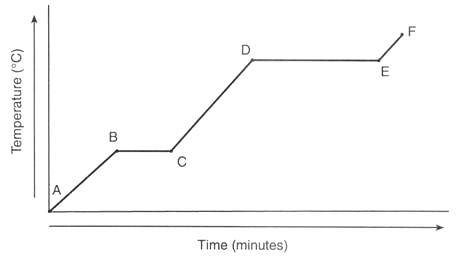
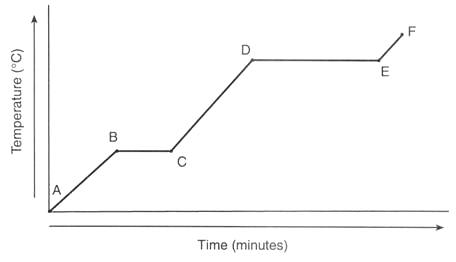
It shows a plot of temperature at various times as a substance is heated.
It is notable for having two "flat spots" where the temperature remains constant even though heat continues to be added.
3
Use what you know to figure out the answer!
The "flat spots" are the key. We can use them to reason out the answer to any question having to do with heating curves.
Some text here about the topic of discussion
4
The vertical axis is temperature. So the higherr the curve gets, the higher the temperature.
Temperature is a measure of particle speed. The higher the temp, the faster they move.
Some text here about the topic of discussion.
First, notice the axes
5
The horizontal axis is heat added (sometimes it is labeled time, but you know it is being heated the entire time).
The farther you go to the right, the more energy has been added.
Some text here about the topic of discussion.
First, notice the axes
6
We expect temperature to go up when the substance is being heated.
But from B-C and D-E it doesn't!
This is because temperature does not change when the phase is changing.
So during flat spots, the phase is changing. Always.
Some text here about the topic of discussion.
Next, the flat spots!
7
Use logic to determine which flat spot is which.
Phase changes that occure when something gets heated are melting and vaporization.
You know melting occurs at a lower temp than vaporization.
Thus B-C is melting, D-E is vaporization.
Some text here about the topic of discussion.
Which is which?
8
This heating curve, for water, shows water's melting point of 0 oC and its boiling point of 100 oC.
Other substances have different melting and boiling points. Just read them off the temp scale.
Some text here about the topic of discussion.
Melting and boiling points
9
Since melting is a change from solid to liquid, before melting you have a solid, and after melting you have a liquid.
So A-B is solid and C-D is liquid.
(during B-C both solid and liquid are present).
Since A-B and C-D slope upwards, T increases and we say they are warming up!
Some text here about the topic of discussion.
More logic
10
Since vaporization is a change from liquid to gas, before vaporization you have a liquid, and after vaporization you have a gas (vapor).
So C-D is liqulid and E-F is gas.
(during D-E both liquid and vapor are present).
Like A-B and C-D, E-F slopes upwards, so the gas gets hotter with time and we say it is warming up.
Some text here about the topic of discussion.
Similarly
11
Some text here about the topic of discussion.
12
Multiple Choice
Vaporizing
13
Multiple Choice
14
Multiple Choice
15
Multiple Choice
Vaporizing
16
Multiple Choice
Vaporizing
17
Multiple Choice
Vaporizing
18
Multiple Choice
19
Multiple Choice
20
Multiple Choice
21
Multiple Choice
22
Multiple Choice
In which segment is the particle speed remaining constant?
23
Multiple Choice
24
Multiple Choice
25
Multiple Choice
26
Multiple Choice
27
Multiple Choice
From point A to point E, the sample is going through an
exothermic process by releasing heat to the surroundings
exothermic process by absorbing heat from the surroundings
endothermic process by releasing heat to the surroundings
endothermic process by absorbing heat from the surroundings
28
Multiple Choice
The melting point of the sample is
-60 ºC
-100 ºC
60 ºC
100 ºC
29
Multiple Choice
By Amy Dahl
Show answer
Auto Play
Slide 1 / 29
SLIDE

Similar Resources on Wayground
24 questions
Metric System
Presentation
•
9th - 12th Grade
22 questions
Solutions Lesson Part 1
Presentation
•
9th - 12th Grade
23 questions
Stock System - Naming Ionic Compounds
Presentation
•
10th - 12th Grade
22 questions
U6L5 - Lecture Notes - Electronegativity and Polarity
Presentation
•
9th - 12th Grade
22 questions
Percent Solutions (mass and volume)
Presentation
•
9th - 12th Grade
22 questions
Experimental vs. Observational Studies
Presentation
•
9th - 12th Grade
22 questions
Tennis
Presentation
•
9th - 12th Grade
21 questions
LESSON - Classifying and Balancing Reactions
Presentation
•
9th - 12th Grade
Popular Resources on Wayground
10 questions
Safety Day 2026 – Student Review
Quiz
•
9th Grade
21 questions
Continents and Oceans
Quiz
•
6th Grade
20 questions
Parts of Speech
Quiz
•
5th Grade
16 questions
Subject & Predicate
Quiz
•
5th Grade
25 questions
Multiplication Facts
Quiz
•
5th Grade
12 questions
Map Skills
Quiz
•
3rd Grade
22 questions
Continents and Oceans
Quiz
•
5th Grade
15 questions
Rounding Decimals
Quiz
•
5th Grade
Discover more resources for Chemistry
20 questions
electron configurations and orbital notation
Quiz
•
9th - 12th Grade
20 questions
Periodic Table Trends
Quiz
•
11th Grade
25 questions
Writing and Naming Binary Ionic compounds
Quiz
•
10th Grade
20 questions
COUNTING ATOMS
Quiz
•
10th Grade
50 questions
Unit 3: Atomic Assault Summative Review
Quiz
•
11th Grade
20 questions
Physical or Chemical Change/Phases
Quiz
•
8th Grade - University
15 questions
Periodicity Module Exam Practice Quiz
Quiz
•
9th - 12th Grade
20 questions
Naming Ionic Compounds
Quiz
•
10th Grade