Benchmark 4 review day 1 (Unit 10 thermo,K&E)
Presentation
•
Chemistry
•
10th Grade - University
•
Medium
+5
Standards-aligned
Katie Smit
Used 6+ times
FREE Resource
27 Slides • 30 Questions
1
Wednesday 5/11- Benchmark review- Unit 10
Announcements/Reminders
Agenda:
12 class DAYS until final!
Thurs 5/9- English EOC, 1st &2nd block
Mon 5/13-Benchmark #4
5/22- no school- Biology EOC
5/23- USH EOC
5/28- final exam (1st&2nd periods)
Unit 10 review
Bellwork:
2
3
4
5
6
7
8
9
10
11
12
13
14
Multiple Choice
Can energy be created?
Yes
No
15
Multiple Choice
Which of the following is not a form of energy?
Thermal (heat)
temperature
light
16
Multiple Choice
Heat flows from _______ to ______ objects
cooler to warmer
warmer to warmer
warmer to cooler
cooler to cooler
17
Multiple Choice
Phase changes: ice to water to steam
endothermic
exothermic
18
Multiple Choice
Phase changes: steam to water to ice
endothermic
exothermic
19
Multiple Select
Select all the processes that are exothermic. The system is underlined in each example.
Your hand gets cold when you touch ice.
The ice gets warmer when you touch it.
Water boils in a kettle being heated on a stove.
Water vapor condenses on a cold pipe.
Ice cream melts.
20
Multiple Select
Select all the processes that are endothermic. The system is underlined in each example.
Your hand gets cold when you touch ice.
The ice gets warmer when you touch it.
Water boils in a kettle being heated on a stove.
Water vapor condenses on a cold pipe.
Ice cream melts.
21
Multiple Choice
22
Multiple Choice
O2(g) + 2 H2 (g) → 2 H2O (g) + Energy
endothermic
exothermic
23
Multiple Choice
24
Multiple Choice
25
Multiple Choice
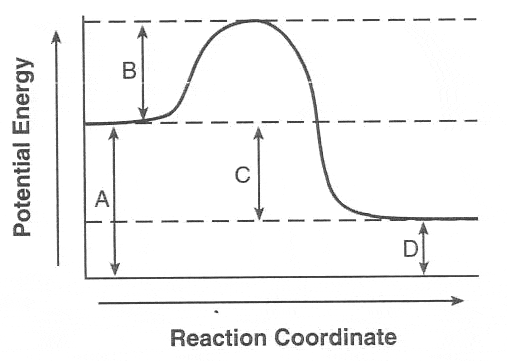
What is the Heat of Reaction ΔH for this reaction?
-200 KJ
200 KJ
400 KJ
-300 KJ
26
Multiple Choice
How much activation energy is needed for this reaction?
300 KJ
500 KJ
400 KJ
100 KJ
27
Multiple Choice
What type of reaction is this?
Exothermic
Endothermic
Energy Producing
No way to tell
28
Multiple Choice
What kind of reaction is this: 2KI + MgCl2 + 200KJ ----> 2KCl + MgI2
Endothermic
Exothermic
29
Multiple Choice
30
Multiple Choice
31
Multiple Choice
32
Multiple Choice
33
Multiple Choice
34
35
36
nIonic solutions have faster reactions than molecule compounds. (bonding)
néTemp. é Rate
né conc. érate
né surface area é rate
né Pressure é rate, ê P ê rate
nCatalysts speed up reactions.
Quick review- Factors affecting rate
37
38
Multiple Choice
This symbol indicates that a reaction is _____
reversible
irreversible
39
→
40
Multiple Choice
41
Multiple Choice
42
43
44
45
46
47
Concentration increase shift away from increase
Concentration decrease shift toward decrease
🡹 pressure shifts in direction of fewer gas molecules.
🡻 pressure shifts in direction of more gas molecules
🡹 temperature favors endothermic reaction
Shift away from heat
🡻 temperature favors exothermic reaction
Shift towards heat
Equilibrium shifts due to stresses:
48
Example- The Haber process (making ammonia NH3)
N2 (g) + 3 H2 (g) ⮀ 2 NH3 (g) + heat
🡹 [N2]
🡻 [H2]
🡹 [NH3]
🡻 [NH3]
🡹 pressure
🡻 pressure
🡹 temperature
🡻 temperature
49
50
51
Multiple Choice
52
Multiple Choice
(🡹 pressure shifts in direction of fewer gas molecules)
(🡻 pressure shifts in direction of more gas molecules )
N2(g) + 3H2(g) ↔ 2 NH3(g) + heat
Increasing the pressure will cause the equilibrium to:
Shift right
Shift left
Have no change
Speed up
53
Multiple Choice
🡹 temperature favors endothermic reaction Shift away from heat 🡻 temperature favors exothermic reaction Shift towards heat
N2(g) + 3H2(g) ↔ 2 NH3(g) + heat
Increasing the temperature will cause the equilibrium to:
Shift right
Shift left
Have no change
Speed up
54
Multiple Choice
(Concentration increase shift away from increase)
(Concentration decrease shift toward decrease)
N2(g) + 3H2(g) ↔ 2 NH3(g) + heat
Decreasing H2 will cause the equilibrium to:
Shift right
Shift left
Have no change
Speed up
55
Multiple Choice
(Concentration increase shift away from increase)
(Concentration decrease shift toward decrease)
N2(g) + 3H2(g) ↔ 2 NH3(g) + heat
Removing N2 will cause the equilibrium to:
Shift right
Shift left
Have no change
Speed up
56
Multiple Choice
(Concentration increase shift away from increase)
(Concentration decrease shift toward decrease)
N2(g) + 3H2(g) ↔ 2 NH3(g) + heat
Increasing H2 will cause the equilibrium to:
Shift right
Shift left
Have no change
Speed up
57
Multiple Choice
SO2(g) + O2(g) <−> SO3(g)
If the concentration of SO2(g) is increased, the equilibrium of the reaction will ___________.
Wednesday 5/11- Benchmark review- Unit 10
Announcements/Reminders
Agenda:
12 class DAYS until final!
Thurs 5/9- English EOC, 1st &2nd block
Mon 5/13-Benchmark #4
5/22- no school- Biology EOC
5/23- USH EOC
5/28- final exam (1st&2nd periods)
Unit 10 review
Bellwork:
Show answer
Auto Play
Slide 1 / 57
SLIDE

Similar Resources on Wayground
48 questions
Periodic table - Structure and element
Presentation
•
10th Grade - University
50 questions
Web Development Review
Presentation
•
9th - 12th Grade
50 questions
Transformations in the Coordinate Plane: Parent Functions
Presentation
•
9th - 12th Grade
53 questions
Pharmacy monday IV final
Presentation
•
KG
52 questions
Multi stage vapour compression
Presentation
•
KG - University
47 questions
The Periodic Table
Presentation
•
10th - 12th Grade
52 questions
SPANISH EXPLORATION LESSON AND ASSIGNMENT
Presentation
•
KG - University
52 questions
Gázokról sok-sok minden...
Presentation
•
10th - 12th Grade
Popular Resources on Wayground
24 questions
PBIS-HGMS Day 10
Quiz
•
6th - 8th Grade
10 questions
HCS SCI 03 Summer School Review 3
Quiz
•
3rd Grade
11 questions
Home Scope
Quiz
•
7th - 8th Grade
15 questions
HCS SCI 05 Summer School Assessment 3 Review
Quiz
•
5th Grade
35 questions
Lufkin Road Middle School Student Handbook & Policies Assessment
Quiz
•
7th Grade
18 questions
Geo 11.3 Area of Circles and Sectors
Quiz
•
9th - 11th Grade