Compare Real Numbers
Presentation
•
Mathematics
•
7th - 8th Grade
•
Medium

Aqil Mohammed
Used 5+ times
FREE Resource
4 Slides • 20 Questions
1
Learning Objectives:
- To be able to identify real numbers
- To be able to compare real numbers
2
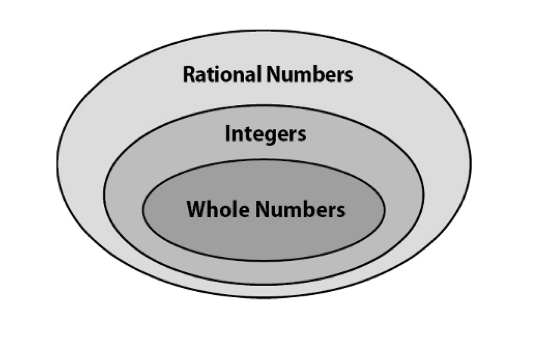
The diagram on the right shows us how to organise real numbers.
3
A rational number is a number that can be expressed as the quotient or fraction p/q of two integers, a numerator p and a non-zero denominator q. For example, −3/7 is a rational number, as is every integer.
An integer includes whole numbers and negative whole numbers. Integers can be positive, negative, or zero. For example: 1, -1, 0, 101 and -101.
A whole number is a number with no fractions. An example of a whole number is the number 5.
Natural numbers are numbers that we use when we are counting or ordering {1, 2, 3, 4, 5, 6, 7, 8, 9, 10, 11 …}
4
Multiple Choice
5
Multiple Choice
6
Multiple Choice
7
Multiple Choice
8
Multiple Choice
9
Multiple Choice
10
Multiple Choice
11
Multiple Choice
12
Multiple Choice
13
Multiple Choice
14
Multiple Choice
Which of the following does not represent a whole number?
9
6.0
12/4
-12/3
15
Multiple Choice
Which of the following could the diagram represent?
I: rational, II: natural
I: integer, II: whole
I: integer, II: rational
I: whole, II: natural
16
Multiple Choice
Which Venn diagram correctly represents the relationship between rational numbers and irrational numbers?
17
Multiple Choice
Rachel states that -5.5 is an integer because it is negative.
Is she correct?
Why or why not?
Yes, because all negatives are integers.
Yes, because all integers have decimals.
No, because integers do not have decimals.
No, because integers cannot be negative.
18
Multiple Choice
Which could be the value of D?
-10
0
43
2.5
19
Multiple Choice
Which could NOT be the value of B?
5
21
-12.5
32
20
Multiple Choice
21
Multiple Choice
22
Multiple Choice
-18/6
23
Multiple Choice
-14 could be classified as all of these EXCEPT?
Integer
Real
Rational
Whole
24
We will focus now on how to arrange real numbers in terms of their size.
Learning Objectives:
- To be able to identify real numbers
- To be able to compare real numbers
Show answer
Auto Play
Slide 1 / 24
SLIDE

Similar Resources on Wayground
18 questions
Graph Types and Uses
Presentation
•
7th - 8th Grade
17 questions
Solving Two-Step Equations and Inequalities Word Problems
Presentation
•
7th - 8th Grade
16 questions
square roots and cube roots
Presentation
•
7th - 8th Grade
16 questions
Exponents, Squares, Square Roots, Cubes, and Cube Roots
Presentation
•
7th - 8th Grade
20 questions
Estimating Square Roots
Presentation
•
6th - 8th Grade
18 questions
7.1 Zero and Negative Exponents
Presentation
•
7th - 9th Grade
19 questions
Graphing Stories
Presentation
•
7th - 8th Grade
19 questions
The Real Number System
Presentation
•
7th - 8th Grade
Popular Resources on Wayground
10 questions
Safety Day 2026 – Student Review
Quiz
•
9th Grade
21 questions
Continents and Oceans
Quiz
•
6th Grade
20 questions
Parts of Speech
Quiz
•
5th Grade
16 questions
Subject & Predicate
Quiz
•
5th Grade
25 questions
Multiplication Facts
Quiz
•
5th Grade
12 questions
Map Skills
Quiz
•
3rd Grade
22 questions
Continents and Oceans
Quiz
•
5th Grade
15 questions
Rounding Decimals
Quiz
•
5th Grade
Discover more resources for Mathematics
20 questions
Rational and Irrational Numbers
Quiz
•
8th Grade
16 questions
Proportional and Non Proportional Relationships in Tables, Graphs, and Equations
Quiz
•
7th Grade
20 questions
Constant of Proportionality
Quiz
•
7th Grade
20 questions
Halloween Trivia
Quiz
•
7th Grade
15 questions
One-Step Equations
Quiz
•
7th Grade
20 questions
Add and Subtract Integers
Quiz
•
6th - 8th Grade
16 questions
Adding and Subtracting Integers
Quiz
•
7th Grade
20 questions
Slope from a Graph
Quiz
•
8th Grade