Atomic Structure Part 1
Presentation
•
Chemistry, Science
•
10th - 12th Grade
•
Easy
+2
Standards-aligned
Andrew Baldwin
Used 14+ times
FREE Resource
5 Slides • 12 Questions
1
Atomic Structure Part 1
by Andrew Baldwin
2
Multiple Choice
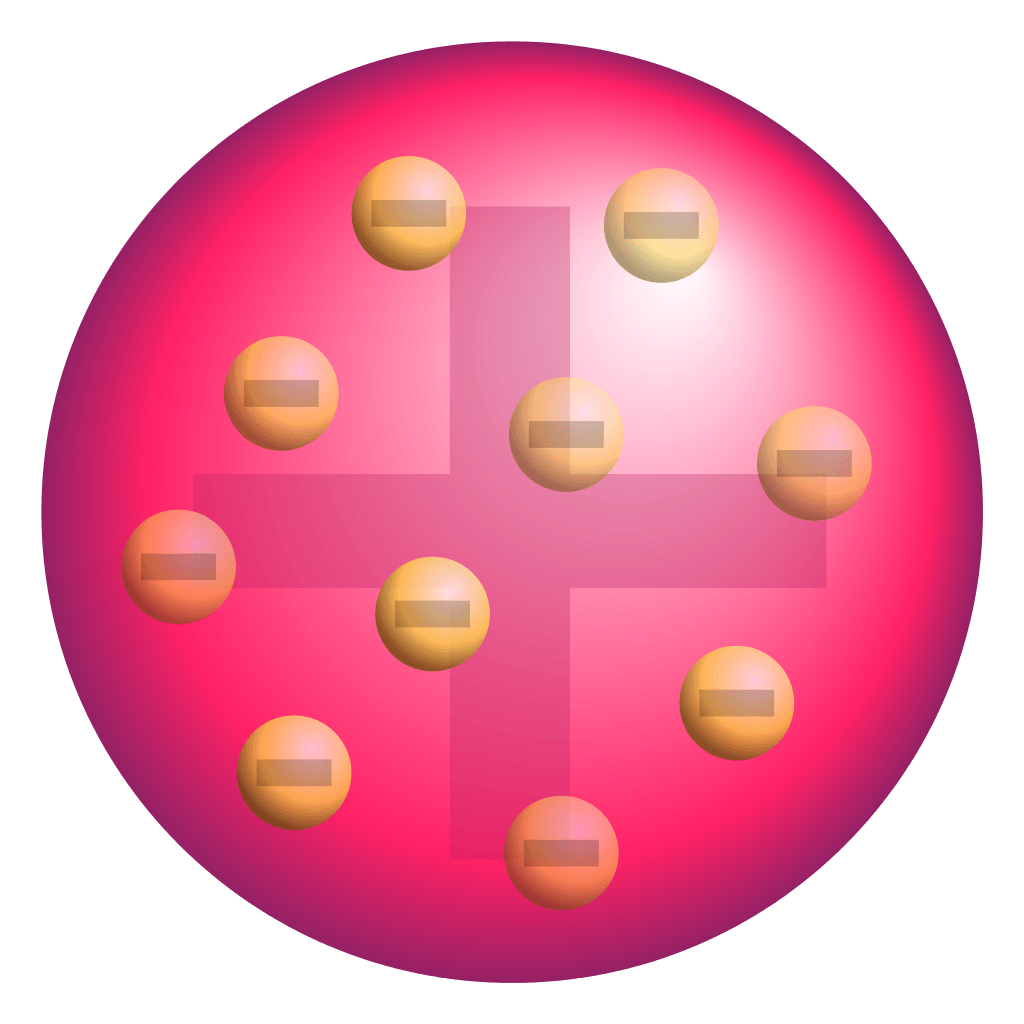
This model was developed after J.J. Thompson discovered electrons, a particle smaller than an atom. It shows electrons floating freely in a positive region.
The "Plum Pudding Model" of the atom
The "Rutherford Model" of the atom
Democritus's model of the atom
The "Quantum Mechanical Model" of the atom
3
Multiple Choice
In the gold foil experiment, most of the positively charged alpha particles passed through the gold foil, but some were deflected or bounced back. What did we conclude because of this?
Atoms are small indivisible spheres
Atoms are mostly empty space with a small, dense, positive center
Atoms have negatively charged particles which orbit the nucleus
Light is a wave, not a particle
4
Multiple Choice
Which scientist is responsible for first stating that all the atoms of a particular element are identical but are different from the atoms of all other elements?
Dalton
Thomson
Aristotle
Democritus
Proust
5
Poll
Confidence with the last lesson.
I can teach anyone about the atomic models
I know them in order but I can't explain fully why.
I can put some of them in order but I am not very sure.
I am not sure that I can put any of them in order.
6
7
8
9
10
Multiple Choice
An atom is electrically neutral because
the numbers of protons and neutrons are equal.
the numbers of protons and electrons are equal.
neutrons balance the protons and electrons.
11
Multiple Choice
What is atomic number?
Number of protons in an atoms
Number of neutrons in an atom
Mass of an atom
Charge on an atom
12
Multiple Choice
What electrical charge does a proton have?
+1
0
-1
+2
13
Multiple Choice
What mass does a neutron have?
1 amu
0 amu
-1 amu
+2 amu
14
Multiple Choice
How many electrons does a sodium atom have?
23
11
12
34
15
Multiple Choice
The __________ of an atom is the sum of the protons and neutrons in the nucleus of that atom.
mass number
atomic number
atomic weuight
isotope weight
16
Multiple Choice
The mass number of an element that has 18 protons, 18 electrons, and 19 neutrons is _____.
12.5
13
25
37
17
Poll
Rate your confidence.
I got this and can teach it better than you.
I got it but explaining isn't there yet.
I think I get but I am not confident.
I don't think I get it yet.
Atomic Structure Part 1
by Andrew Baldwin
Show answer
Auto Play
Slide 1 / 17
SLIDE

Similar Resources on Wayground
13 questions
Calculating Molar Mass Day 1
Presentation
•
9th - 12th Grade
14 questions
Multiple Ionization Energies
Presentation
•
10th - 12th Grade
12 questions
Particle/Mole Conversions
Presentation
•
9th - 12th Grade
12 questions
Quantum Mechanical Model of the Atom- Introduction
Presentation
•
10th - 12th Grade
15 questions
Stoichiometry Review Lesson
Presentation
•
9th - 12th Grade
13 questions
Overview of Muscle Tissues
Presentation
•
11th - 12th Grade
10 questions
Earth Sciences: Plate Boundaries
Presentation
•
9th - 12th Grade
16 questions
Gas Laws Review (participation)
Presentation
•
10th - 12th Grade
Popular Resources on Wayground
24 questions
PBIS-HGMS Day 10
Quiz
•
6th - 8th Grade
10 questions
HCS SCI 03 Summer School Review 3
Quiz
•
3rd Grade
11 questions
Home Scope
Quiz
•
7th - 8th Grade
15 questions
HCS SCI 05 Summer School Assessment 3 Review
Quiz
•
5th Grade
35 questions
Lufkin Road Middle School Student Handbook & Policies Assessment
Quiz
•
7th Grade
18 questions
Geo 11.3 Area of Circles and Sectors
Quiz
•
9th - 11th Grade