
Galaxy Formation
Presentation
•
Physics
•
9th Grade
•
Medium
Standards-aligned

g Custer
Used 33+ times
FREE Resource
12 Slides • 9 Questions
1
Galaxy Formation
2
Pre-Assessment
What can you recall?
3
Multiple Choice
What is at the center of our Solar System?
Earth
The Sun
A Black Hole
Jupiter
4
Multiple Choice
In what Galaxy is Earth located?
Andromeda
Milky Way
Sagittarius
Snickers
5
Multiple Choice
Which of the following correctly lists bodies in space from the smallest to the largest?
Earth, Sun, Solar System, Milky Way Galaxy, Universe
Earth, Sun, Milky Way Galaxy, Solar System, Universe
Sun, Earth, Solar System, Milky Way Galaxy, Universe
Universe, Milky Way Galaxy, Sun, Solar System, Earth
6
What is a Galaxy?
A group of billions of stars and their planets, gas, and dust that extends over many light-years and forms a unit within the universe.
Held together by gravitational forces
7
"Discovery" of Galaxies
Early astronomers observed these “spiral nebulae” and most believed them to be clouds of gas and stars within our own galaxy.
In 1924, Edwin Hubble was able to measure the distance to the “Great Nebula in Andromeda” and found its distance to be much larger than the size of the Milky Way.
8
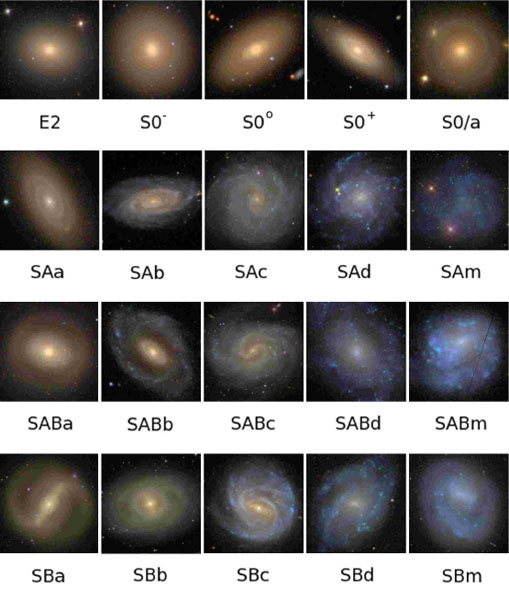
Galaxy Classification
Hubble divided galaxies into different “classes” based on their appearance.
These are part of the "basic language" of Physics.
9
10
11
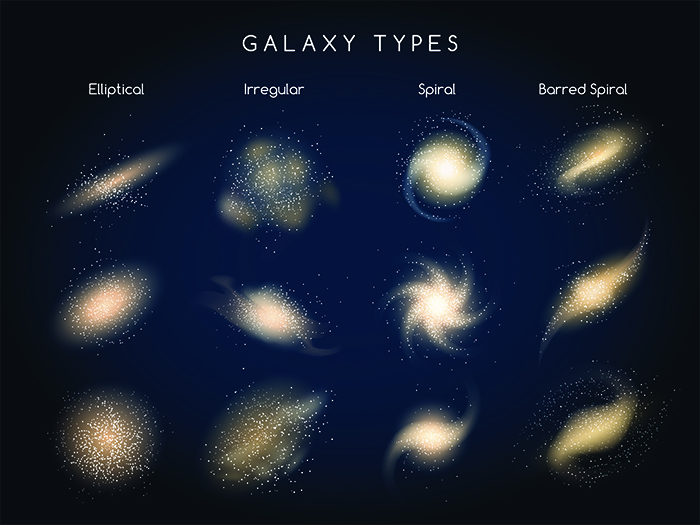
Spiral Galaxies
Have long arms winding toward a bright bulge at the center.
The difference between tightly and loosely wound spirals can be used to classify spiral galaxies.
About 77% of the observed galaxies in the universe are spiral galaxies.
12
Elliptical Galaxies
Shaped like a squished circle.
Elliptical galaxies are classified by how stretched out they are.
The most abundant type of galaxies found in the universe but because of their dim qualities, they're often outshone by other galaxies
13
Irregular Galaxies
The catchall name given to any galaxy that does not neatly fit into one of the other categories.
They have no defined shape nor structure and may have formed from collisions or violent activity.
Some of the smallest galaxies and are full of gas and dust, signifying star formation.
14
15
Learning Check!
What questions do you have?
16
Multiple Select
Which of the following are galaxy types?
Select all that apply.
Spiral
Elliptical
Spherical
Irregular
Obloidal
17
Multiple Choice
Galaxies are classified and named according to their
shape
wavelength
distance from Earth
cosmic background radiation
18
Multiple Choice
Irregular galaxies are defined as having
a rounded shape
no real shape and are comparatively very small.
"arms" branching from the center
19
Multiple Choice
Spiral galaxies are best described as
irregular in shape with random star movement.
regular in shape with mostly orderly star movement.
having a huge round shape with mostly very old stars.
20
Multiple Choice
Elliptical galaxies can be described as having
an uncertain shape with mostly old stars.
a circular or elongated shape.
a spiral structure with lots of gas & dust.
21
Multiple Choice
Andromeda is a galaxy close to the Milky Way. From the side, Andromeda looks like a flat disc with a bulge in the middle. From above, Andromeda has “arms” of stars that curve around the central bulge of stars. What type of galaxy is Andromeda?
a spiral galaxy
a planetary nebula
an irregular galaxy
an elliptical galaxy
Galaxy Formation
Show answer
Auto Play
Slide 1 / 21
SLIDE

Similar Resources on Wayground
16 questions
World of Matter Review
Presentation
•
9th Grade
17 questions
Cause and Effect of the Scientific Revolution
Presentation
•
9th Grade
16 questions
SPACE RACE
Presentation
•
9th Grade
12 questions
Matter and its properties-1
Presentation
•
9th Grade
17 questions
Lesson 17: Energy Transformations
Presentation
•
8th Grade
16 questions
Laws of Motion
Presentation
•
8th Grade
19 questions
Black Holes
Presentation
•
8th Grade
17 questions
DNA notes
Presentation
•
9th Grade
Popular Resources on Wayground
10 questions
Safety Day 2026 – Student Review
Quiz
•
9th Grade
21 questions
Continents and Oceans
Quiz
•
6th Grade
20 questions
Parts of Speech
Quiz
•
5th Grade
16 questions
Subject & Predicate
Quiz
•
5th Grade
25 questions
Multiplication Facts
Quiz
•
5th Grade
12 questions
Map Skills
Quiz
•
3rd Grade
22 questions
Continents and Oceans
Quiz
•
5th Grade
15 questions
Rounding Decimals
Quiz
•
5th Grade
Discover more resources for Physics
20 questions
Position vs. Time Graphs
Quiz
•
9th Grade
10 questions
Exit Check 5.1 - Forms of Energy
Quiz
•
9th Grade
11 questions
Electricity Explained
Interactive video
•
9th - 12th Grade
87 questions
25-26 Unit 1.2 Review - Radioactivity & Earth's Age
Quiz
•
8th - 10th Grade
18 questions
Quiz #8 Practice: Forces on an Incline
Quiz
•
9th Grade
25 questions
Newton's Laws of Motion
Quiz
•
9th Grade