

Imperialism Lesson & Questions

Presentation
•
History
•
9th Grade
•
Medium

Bridget Beard-Imber
Used 1+ times
FREE Resource
16 Slides • 6 Questions
1
Imperialism
Have your notebook ready to take notes as needed.
Go to the next blank page
2
Building Support for Imperialism
Why did the United States assert itself as a world power?
Following the Civil War, most Americans showed little interest in expanding nation’s territory outside United States. I
Focused on reconstructing South, settling the West, & building up industry
1880s, economic & military competition from Europe & growing feeling of cultural superiority convinced Americans the United States should become a world power.
3
“U.S. Imperialism” video
January of 1893, a group of powerful Caucasian planters backed by U.S. Marines orchestrated a plan to annex Hawaii to the United States.
4
U.S. Imperialism
5
Multiple Select
What are the main reasons a nation becomes imperialistic? Choose all that apply.
Money
Power
Isolation
Culture
6
Open Ended
Based on the video:
1.Which argument for imperialism seems most relevant today?
2. Which argument seems most out of date?
7
Reading a Graph answer in notebook
1. What are exports & imports?
2. What is the export trend?
3. How does the graph demonstrate economic imperialism?
4. How do these changes reflect U.S. motivations for expansion?

8
A Desire for New Markets
Many European nations expanding overseas, a development called the New Imperialism
Imperialism is economic & political domination of a strong nation over weaker ones.
European nations expanded their power overseas for many reasons.
needed to import raw materials for manufacturing
9
To protect their investments, European nations began taking control over territories, making some into colonies and others into protectorates
In protectorate, the imperial power protected local rulers against rebellions & invasion.
In return, rulers usually had to accept Europeans’ advice on how to govern their countries.
As United States industrialized, many Americans noticed the expansion of European power overseas & took interest in new imperialism.
Many concluded the nation needed new overseas markets to keep its economy strong
10
A Feeling of Superiority
Certain key ideas encouraged Americans to support nation’s expansion overseas.
Historian John Fiske argued that English-speaking nations had superior character, ideas, and systems of government.
Many Americans linked his ideas, known as Anglo-Saxonism, with idea of Manifest Destiny.
These Americans believed nation was destined to expand overseas to spread civilization to others.
11
Building a Modern Navy
ideas gained support, the United States became more assertive in foreign affairs. The crisis ended peacefully
In 1888, the country risked war to prevent Germany from taking control of Samoa.
it led some Americans to believe the United States would be shut out of foreign markets if it did not build up its navy & acquire bases overseas
By 1890s, several different ideas had come together
Business leaders wanted new markets overseas
Anglo-Saxonism had convinced Americans destined to expand into world, while growing European imperialism threatened U.S. security
ideas convinced Congress to authorize a large modern navy.
12
Open Ended
Reading Check:
Why did Americans’ attitudes toward overseas expansion change?
13
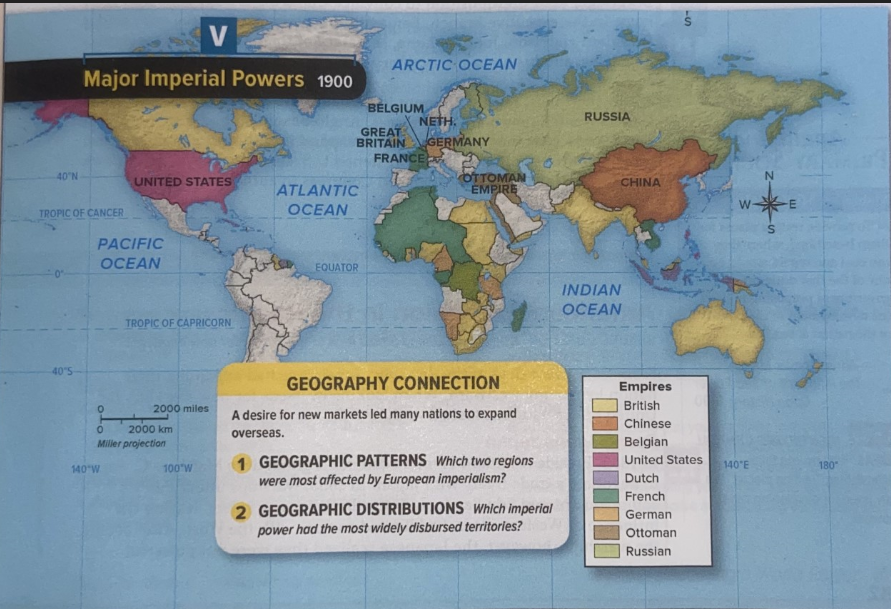
Major Imperial Powers answer in notebook
1. What color is used to represent France?
2. According to this map, which continent was not controlled by imperialist powers?
3. Why do you think The Caribbean fell under American Influence?
14
Perry Opens Japan
1852, President Millard Fillmore ordered Commodore Matthew C. Perry to negotiate a trade treaty with Japan.
1853 warships under Perry’s command entered Edo Bay (now Tokyo Bay). Japan’s rulers, fearing influence of Western ideas, had limited contact with the West
After seeing warships, the Japanese realized they were not powerful enough to resist modern weapons
1854, Japan signed Treaty of Kanagawa, giving United States trading rights at two Japanese ports.
15
Open Ended
Reading Check
1. Why did Japan want to limit contact with the West?
2. What changed Japan's mind about opening up to the West?
16
Annexing Hawaii
Americans found that sugarcane grew well in Hawaii, and planters established sugar plantations
1875 United States signed a treaty exempting Hawaiian sugar from tariffs. This action taken to aid Hawaii during economic recession & prevent Hawaii from turning to Britain or France for help
When treaty up for renewal, United States insisted Hawaii grant it exclusive rights to a naval base at Pearl Harbor.
17
Cont.
1887, wealthy sugar planters led by Sanford Dole forced the Hawaiian king to accept a new constitution that limited the king’s authority.
planters eventually wanted to make Hawaii part of the United States. Tensions grew worse when Congress passed a new tariff in 1890
tariff gave subsidies to American sugar producers, making Hawaiian sugar more expensive. The planters knew that if Hawaii joined the United States, they too would get the subsidies
next year, Queen Liliuokalani ascended the Hawaiian throne and tried to restore the monarchy's authority.
18
annex Hawaii cont
In response, planters overthrew queen. Backed by the American ambassador & U.S. Marines, the planters forced Liliuokalani to give up power, & asked Dole to serve as president of the new Hawaiian Republic. Dole then requested the United States annex Hawaii.
President Cleveland, opposed imperialism, tried to restore the queen to power, but Hawaii’s new leaders refused. Instead, they decided to wait until a new president took office.
1898, under President McKinley, the United States annexed Hawaii & McKinley chose Dole to be Hawaii's first governor.
19
Open Ended
Reading Check
How did the search for new overseas markets push the United States to become a world power?
20
America Supports Cuba
When uprising began in Cuba against the Spanish, President Cleveland declared the United States neutral.
However, stories of Spanish atrocities swayed many Americans in the rebels’ favor.
news reports, which writers exaggerated or made up stories to attract readers, became known as yellow journalism. Although some stories were invented, Cubans indeed suffered horribly.
21
Calls for War
1897, William McKinley became president of the United States asked Spain if United States could help negotiate to end conflict, so United States would not have to intervene in the war.
Spain offered Cubans autonomy, but only if Cuba remained part of the Spanish Empire.
rebels refused to negotiate.
& the loyalists rioted in Havana.
McKinley sent the battleship USS Maine to Havana to protect Americans living there.
February 15, 1898, the Maine exploded in Havana Harbor. To this day, no one is sure why the Maine exploded.
22
Multiple Select
Reading Check
What events led to the war with Spain in 1898? Check all that apply
Opression of Cuban people by the Spanish
Sensationalized reporting events in Cuba
Insults to U.S. President
Sinking of Maine in Havana Harbor
Imperialism
Have your notebook ready to take notes as needed.
Go to the next blank page
Show answer
Auto Play
Slide 1 / 22
SLIDE
Similar Resources on Wayground

21 questions
Industrial Revolution Vocabulary
Presentation
•
9th Grade
17 questions
What time is it?
Presentation
•
9th Grade
17 questions
Renewable & Non-Renewable Resources
Presentation
•
9th Grade
17 questions
Parallel Structure
Presentation
•
9th Grade
17 questions
Spanish American War
Presentation
•
9th Grade
17 questions
European History
Presentation
•
9th Grade
16 questions
Jackson's Presidency
Presentation
•
8th Grade
19 questions
2nd Great Awakening
Presentation
•
8th - 9th Grade
Popular Resources on Wayground
10 questions
Safety Day 2026 – Student Review

Quiz
•
9th Grade
21 questions
Continents and Oceans
Quiz
•
6th Grade
20 questions
Parts of Speech
Quiz
•
5th Grade
16 questions
Subject & Predicate
Quiz
•
5th Grade
25 questions
Multiplication Facts
Quiz
•
5th Grade
12 questions
Map Skills
Quiz
•
3rd Grade
22 questions
Continents and Oceans
Quiz
•
5th Grade
15 questions
Rounding Decimals
Quiz
•
5th Grade
Discover more resources for History
25 questions
The American Revolution
Quiz
•
7th - 10th Grade
15 questions
The Bill of Rights
Quiz
•
8th - 12th Grade
15 questions
Ancient Rome
Quiz
•
7th - 10th Grade
16 questions
Students of Civics Unit 2: The Constitution
Quiz
•
7th - 11th Grade
10 questions
Exploring the 7 Principles of the Constitution

Interactive video
•
6th - 10th Grade
10 questions
Significance of the Declaration of Independence
Interactive video
•
6th - 10th Grade
22 questions
Beginning of WW2 Quiz
Quiz
•
9th Grade
10 questions
Exploring the Age of Exploration
Interactive video
•
6th - 10th Grade