


Electrolyte and Non Electrolyte
Presentation
•
Chemistry
•
12th Grade
•
Easy
Standards-aligned
Marissa sebastian Moe
Used 24+ times
FREE Resource
3 Slides • 10 Questions
1
Electrolyte and Non Electrolyte
Classifying substances into electrolytes and non-electrolytes
2
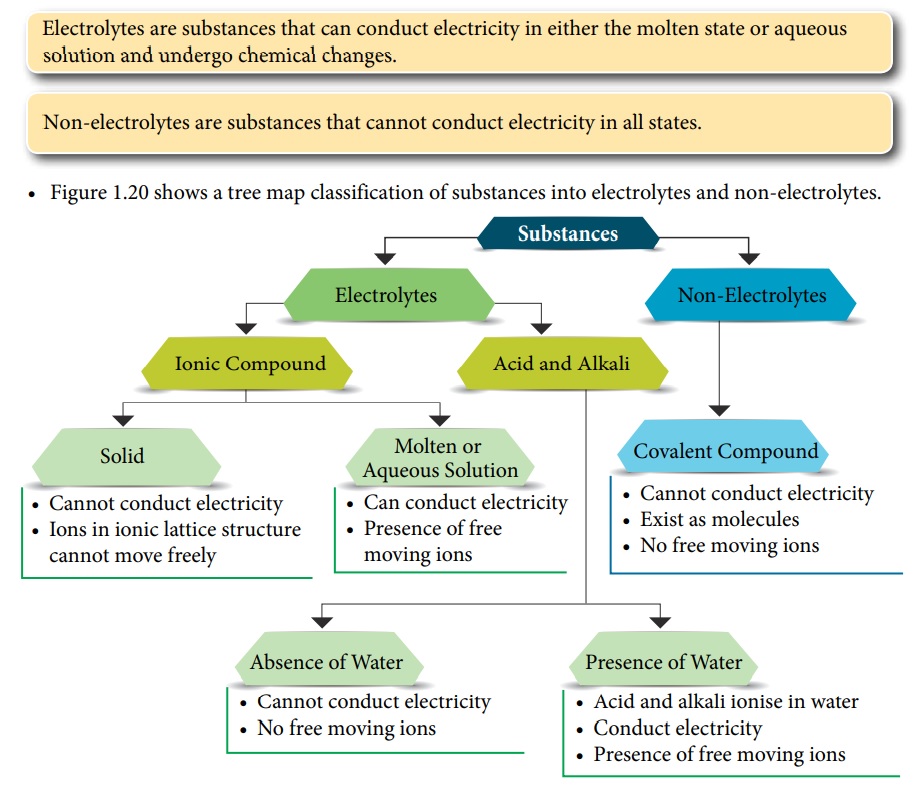
Analyze the following information before we proceed to the quiz section.
3
Multiple Choice
What is the the meaning of electrolyte?
Substances that can conduct electricity in either the molten state or aqueous solution and undergo chemical changes.
Substances that cannot conduct electricity in all states.
4
Multiple Choice
What is the the meaning of non-electrolyte?
Substances that can conduct electricity in either the molten state or aqueous solution and undergo chemical changes.
Substances that cannot conduct electricity in all states.
5
Multiple Choice
Which of the following is not an example of electrolyte?
Molten lead(II) bromide
Copper(II) chloride solution
Hydrochloric acid
Liquid ethanol
6
Multiple Choice
Why does covalent compound such as tetra chloromethane cannot conduct electricity in all state?
Exist as molecules and no free moving ions
Exist as solid
Has free moving ions
7
Multiple Choice
Ionic compounds are able to conduct electricity either molten or aqueous solution because
the presence of free moving ions
has no free moving ions
it is in molten or aqueous state
8
Multiple Choice
Ionic compounds are able to conduct electricity either molten or aqueous solution because
the presence of free moving ions
has no free moving ions
it is in molten or aqueous state
9
Multiple Choice
Acid and alkali can only conduct electricity
without the presence of water
with the presence of water
10
Multiple Choice
In the absence of water, acid and alkali cannot conduct electricity because
there is free moving ions
there is no free moving ions
11
The next questions will be based on this information. Analyze the table before you proceed.
12
Multiple Choice
What is the meaning of conductor?
Substances that conduct electricity in solid or molten state, but do not undergo chemical changes.
Substances that conduct electricity in molten state or aqueous solution, and undergo chemical changes.
13
Multiple Choice
Which of the following is an example of conductor?
Graphite
Acid and alkali
Electrolyte and Non Electrolyte
Classifying substances into electrolytes and non-electrolytes

Show answer
Auto Play
Slide 1 / 13
SLIDE

Similar Resources on Wayground
16 questions
The Transition Metals
Presentation
•
10th - 12th Grade
6 questions
Acids and Bases
Presentation
•
10th Grade
12 questions
Chemical Building Blocks Lesson
Presentation
•
University
16 questions
Fluids & Electrolyte Case study
Presentation
•
University
8 questions
Electrolysis of an Aqueous Solution
Presentation
•
12th Grade
13 questions
Review of Chemical Bonds
Presentation
•
11th Grade
16 questions
Electrolysis Lab
Presentation
•
12th Grade - University
12 questions
Acids and Bases and Salts
Presentation
•
12th Grade
Popular Resources on Wayground
24 questions
PBIS-HGMS Day 10
Quiz
•
6th - 8th Grade
10 questions
HCS SCI 03 Summer School Review 3
Quiz
•
3rd Grade
11 questions
Home Scope
Quiz
•
7th - 8th Grade
15 questions
HCS SCI 05 Summer School Assessment 3 Review
Quiz
•
5th Grade
35 questions
Lufkin Road Middle School Student Handbook & Policies Assessment
Quiz
•
7th Grade
18 questions
Geo 11.3 Area of Circles and Sectors
Quiz
•
9th - 11th Grade