

Chapter 10: Section 3 Indian Removal

Presentation
•
Social Studies
•
7th Grade
•
Hard

Regina Johnson
Used 4+ times
FREE Resource
14 Slides • 0 Questions
1
Chapter 10: Section 3 Indian Removal
2
3
Indian Removal Act
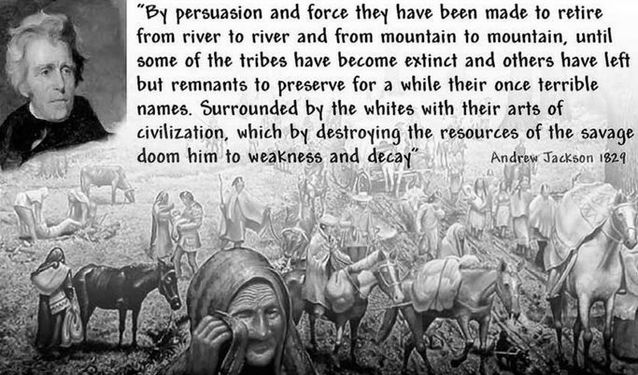
Under pressure from Jackson, Congress passed the Indian Removal Act in 1830, authorizing the removal of Native Americans who lived east of the Mississippi River to lands in the West.
Congress then established Indian Territory—U.S. land in what is now Oklahoma—and planned to move Native Americans there.

4
Indian Removal Act
Supporters argued that removal to Indian Territory would protect Indians from further conflicts with American settlers.
To manage Indian removal to western lands, Congress approved the creation of a new government agency, the Bureau of Indian Affairs.

5
Indian Removal Act
The Choctaw were the first Indians sent to Indian Territory.
Forced the Choctaw leaders to sign the Treaty of Dancing Rabbit Creek.
Treaty gave more than 7.5 million acres of their land to the state.
Federal officials in charge of the move did not provide enough food or supplies to the Choctaw.
About one-fourth of the Choctaw died of cold, disease, or starvation.

6
Indian Removal Act
Creek Indians heard of the Choctaw hardships and tried to resist removal.
Federal troops moved in and captured some 14,500 of them.
They led the Creek, many in chains, to Indian Territory.

7
Indian Removal Act
The Chickasaw, who lived in upper Mississippi, negotiated a treaty for better supplies on their trip to Indian Territory.
Many Chickasaw lives were also lost during removal.

8
Cherokee Resistance
Cherokee believed they could avoid removal if they adopted white culture.
In the early 1800s they invited missionaries to set up schools where Cherokee children learned how to read and write in English.
The Cherokee developed their own government modeled after the U.S. Constitution with an election system, a bicameral council, and a court system.

9
A Cherokee named Sequoya used 86 characters to represent Cherokee syllables to create a writing system for their own complex language.
Cherokee began publishing a newspaper printed in both English and Cherokee.
The Cherokee plan did not work.
Gold was discovered on their land in Georgia and all treaties were ignored.

10
Cherokee Resistance
When the Cherokee refused to move the Georgia militia began attacking Cherokee towns.
Cherokee sued the state.
They said that they were an independent nation and claimed that the government of Georgia had no legal power over their lands.
Worcester v. Georgia the Court ruled that the Cherokee nation was a distinct community in which the laws of Georgia had no force.

11

12
Trail of Tears
In the spring of 1838, U.S. troops began to remove all Cherokee to Indian Territory
After the Cherokee were removed, Georgia took their businesses, farms, and property.
The Cherokee’s 800-mile forced march became known as the Trail of Tears.
Almost one-fourth of the 18,000 Cherokee died on the march.

13
Other Native Americans Resist
Chief Black Hawk, a leader of Fox and Sauk Indians, led his people in a struggle to protect their lands in Illinois.
By 1850 they had been forced to leave.
In Florida, Seminole leaders were forced to sign a removal treaty that their followers decided to ignore.
A leader named Osceola called upon his people to resist with force, and the Second Seminole War began
Osceola was captured and soon died in prison.
His followers, however, continued to fight.

14
Other Native Americans Resist
Some 4,000 Seminole were removed and hundreds of others killed.
Eventually, U.S. officials decided to give up the fight.
Small groups of Seminole had resisted removal, and their descendants live in Florida today.

Chapter 10: Section 3 Indian Removal
Show answer
Auto Play
Slide 1 / 14
SLIDE

