Enzyme
Presentation
•
Biology
•
7th Grade
•
Medium
+1
Standards-aligned
Leonita Swandjaja
Used 9+ times
FREE Resource
37 Slides • 18 Questions
1
Enzyme
Chapter 5
2
3
4
Multiple Choice
How many biological molecules have you studied in the previous chapter?
3
4
5
6
5
Multiple Select
What are the biological molecules you have studied in the previous chapter?
lipid
protein
iodine
carbohydrate
DNA
6
Multiple Choice
The biological molecule with nitrogen content is ... .
carbohydrate
lipid
protein
sugar
7
Multiple Choice
The biological molecule with nitrogen content is ... .
carbohydrate
lipid
protein
sugar
8
9
10
11
12
13
14
15
16
17
18
19
20
Multiple Choice
Catalyst is ... .
a protein which speeds up a reaction.
produced only by living organisms
killed in high temperature
not involved in a reaction
21
Multiple Choice
Enzyme ...
works only inside a living cell
produced continuously in our body
killed by extreme pH
is often called biocatalyst
22
23
24
25
Multiple Choice
The enzyme that works on protein is called ... .
proteinase
protease
protase
prase
26
Multiple Choice
The enzyme that works on sucrose is called ... .
sucroase
sucrose
sucrase
sucronase
27
28
Lock and Key Mechanism
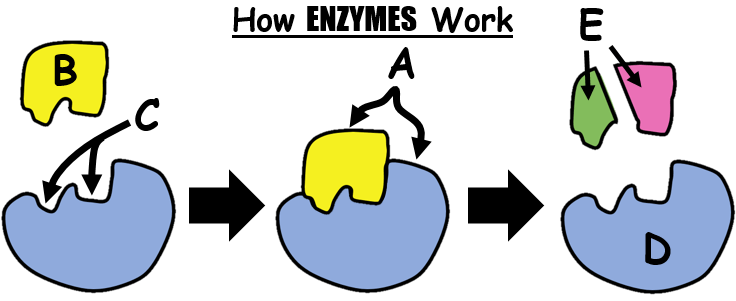
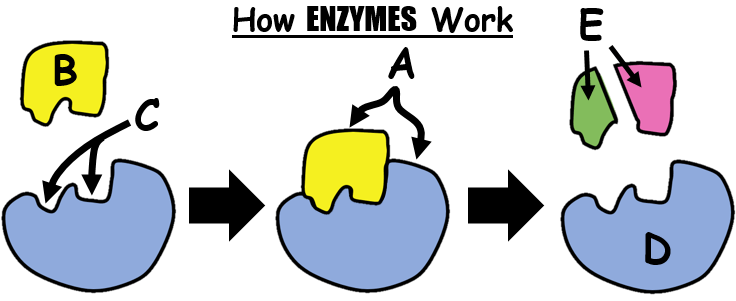
In the lock and key hypothesis, the shape of the active site matches the shape of its substrate molecules.
This makes enzymes highly specific.
Each type of enzyme can usually catalyse only one type of reaction (some may catalyse a few types of reactions).
29
Lock and Key Mechanism
The diagram shows how this works. In this example, the enzyme splits one molecule into two smaller ones.
30
Multiple Choice
Which molecule would most likely react with the enzyme?
A
B
C
D
31
Multiple Choice
What is being represented by the letter A in the image?
Substrate
Enzyme
Product
Complex
32
Multiple Choice
Letter E...
active site
enzyme
substrate
products
33
Multiple Choice
Letter C...
active site
enzymes
substrate
products
34
Multiple Choice
What is being represented by the letter B in the image?
Substrate
Enzyme
Substrate
Product
35
36
37
38
39
40
41
42
43
44
45
46
47
48
Multiple Choice
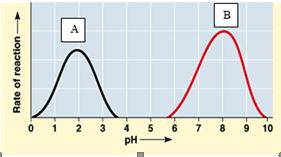
The graph shows the relative rates of action of four enzymes, A, B, C, and D. Which enzyme shows the greatest change in its rate of action with the least change in pH?
enzyme A
enzyme B
enzyme C
enzyme D
49
Multiple Choice
What is the optimal pH of enzyme A?
8
2
5.7-10
10
50
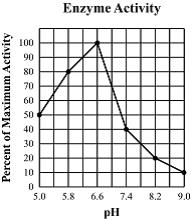
Multiple Choice
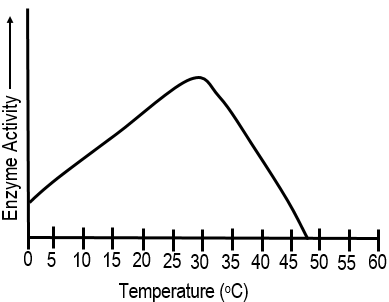
Based on the graph, what is the optimal temperature for this enzyme?
15oC
40oC
30oC
35oC
51
Multiple Choice
52
Multiple Choice
If an enzyme becomes over heated what effect, if any, will the heat have on the enzymatic activity?
The enzyme will not store much chemical energy.
The enzyme will not be able to catalyze reactions.
The enzyme will lose its net electrical charge.
The enzyme will lose stored genetic information.
53
54
55
Enzyme
Chapter 5
Show answer
Auto Play
Slide 1 / 55
SLIDE

Similar Resources on Wayground
50 questions
2022 - 2023 SOL Review MMQs from Mock
Presentation
•
7th Grade
49 questions
Adding Integers
Presentation
•
7th Grade
51 questions
Microorganisms
Presentation
•
7th Grade
49 questions
Measures of Variation 2020
Presentation
•
7th Grade
55 questions
Meiosis
Presentation
•
7th Grade
47 questions
Proportional Relationships
Presentation
•
7th Grade
49 questions
8th Grade 1-6 Scientific Measurement & Math
Presentation
•
8th Grade
52 questions
LEAP REVIEW #1
Presentation
•
6th Grade
Popular Resources on Wayground
10 questions
Safety Day 2026 – Student Review
Quiz
•
9th Grade
21 questions
Continents and Oceans
Quiz
•
6th Grade
20 questions
Parts of Speech
Quiz
•
5th Grade
16 questions
Subject & Predicate
Quiz
•
5th Grade
25 questions
Multiplication Facts
Quiz
•
5th Grade
12 questions
Map Skills
Quiz
•
3rd Grade
22 questions
Continents and Oceans
Quiz
•
5th Grade
15 questions
Rounding Decimals
Quiz
•
5th Grade
Discover more resources for Biology
10 questions
Exploring the Phases of Mitosis and Cell Division
Interactive video
•
6th - 10th Grade
14 questions
Autosomal Pedigree
Quiz
•
7th Grade
10 questions
Exploring Evidence of Evolution
Interactive video
•
6th - 10th Grade
6 questions
Levels of Organization
Presentation
•
7th Grade
10 questions
Exploring Cell Membrane Transport Mechanisms
Interactive video
•
6th - 10th Grade
13 questions
Fast and Curious: Cell Discovery and Cell Basics
Quiz
•
7th Grade
16 questions
Cellular Respiration
Quiz
•
7th - 8th Grade
40 questions
Human Body Systems
Quiz
•
7th Grade