
Biology 1_Unit 3_Milestone and Final Exam Review_Genetics
Presentation
•
Biology
•
9th - 12th Grade
•
Hard
+3
Standards-aligned
Mariz Rondina
Used 2+ times
FREE Resource
10 Slides • 29 Questions
1
Biology 1_Unit 3_Milestone and Final Exam Review_Genetics
2
3
Multiple Choice
Which sequence of DNA bases would pair with this partial strand
ATG TGA CAG
ATG TGA CAG
TAC ACT GTC
GTA AGT GAC
CAT TCA CTG
4
Multiple Choice
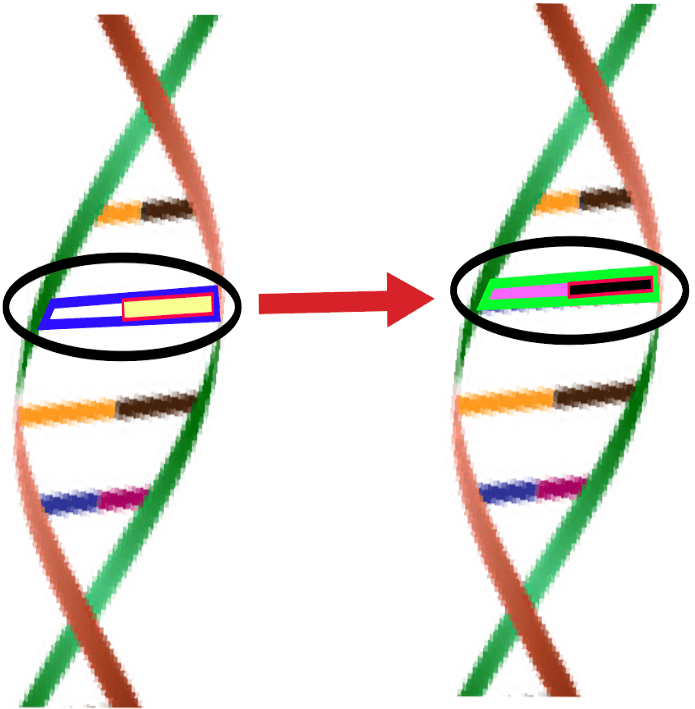
The following picture must be
DNA because it's double stranded
RNA because it's single stranded
DNA because it's single stranded
RNA because it's double stranded
5
Multiple Choice
I include the bases Guanine, Cytosine, Adenine and Uracil .
DNA
RNA
6
Multiple Choice
I include the bases Guanine, Cytosine, Adenine and Thymine.
DNA
RNA
7
8
Multiple Choice
The nucleic acid DNA is composed of
sugar, protein, and nitrogenous bases.
protein, nitrogenous bases, and phosphate.
nitrogenous bases, phosphate, and RNA.
sugar, phosphate, and nitrogenous bases.
9
Multiple Choice
Place the following in sequential order
1. Recoil
2. Straightens the double helix
3. Breaks Hydrogen bonds
4. Adds Free nucleotides
1, 2, 3, 4
3, 4, 2, 1
3, 2, 4, 1
2, 3, 4, 1
10
Multiple Choice
DNA replication results in two DNA molecules,
each one with two original strands
each one with two new strands
each one with one new strand and one original strand
one with two new strands and the other with two original strands
11
12
Multiple Choice
Which of the following is an example of a beneficial mutation?
When an organism's lifespan becomes shorter.
When an organism becomes unable to reproduce.
When an organism's body becomes deformed.
When an organism develops immunity to a disease.
13
Multiple Choice
A permanent change in the DNA sequence
which can affect a single gene or group of genes
Homeostasis
Somatic Cell
Chromosomal Mutation
Gene Mutation
14
Multiple Choice
A permanent change in the DNA sequence
which can affect a single gene or group of genes
Homeostasis
Somatic Cell
Chromosomal Mutation
Gene Mutation
15
16
Multiple Choice
Nondisjunction
When a segment of a chromosome breaks off.
When a segment of a chromosome breaks off, flips, and reattaches.
When a segment of a chromosome is copied or doubles.
When a segment of a chromosome breaks and attaches to a non homologous chromosome.
When entire chromosomes don't separate evenly during meiosis.
17
Multiple Choice
When can a mutation be passed on to offspring?
only when the mutation is present during or occurs during mitosis
only when the mutation is present during or occurs during meiosis
when the mutation occurs during mitosis or meiosis
when the mutation occurs in somatic cells
18
Multiple Choice
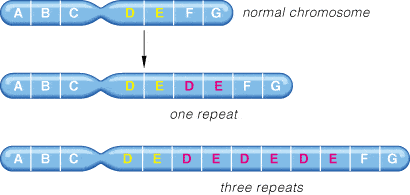
Identify the mutation in the picture.
Inversion
Duplication
Deletion
Translocation
19
Multiple Choice
Identify the mutation in the picture.
Inversion
Duplication
Deletion
Translocation
20
21
Multiple Choice
What causes mutations?
Mistakes in replication or environmental substances
The amino acids
Passed down by genetics
It's how your born
22
Multiple Choice
What causes mutations?
Mistakes in replication or environmental substances
The amino acids
Passed down by genetics
It's how your born
23
24
Multiple Choice
What is the effect of crossing over and independent assortment during meiosis?
increased genetic diversity of gametes
decreased genetic diversity of gametes
increased number of daughter cells
decreased number of daughter cells
25
Multiple Choice
During meiosis, nonsister chromatids of a homolgous pair exchange DNA. This is called _____________.
crossing over
trading places
criss cross apple sauce
breaking places
26
Multiple Choice
During meiosis, nonsister chromatids of a homolgous pair exchange DNA. This is called _____________.
crossing over
trading places
criss cross apple sauce
breaking places
27
28
Multiple Choice
In cacti, long arms (A) are dominant to short arms (a). Suppose 2 heterozygous cacti are crossed. What percentage of their offspring are expected to have short arms?
0%
25%
75%
100%
29
Multiple Choice
In cacti, long arms (A) are dominant to short arms (a). Suppose 2 heterozygous cacti are crossed. What percentage of their offspring are expected to have short arms?
0%
25%
75%
100%
30
31
Multiple Choice
This type of inheritance pattern shows BOTH traits in possible offspring
co-dominance
incomplete dominance
32
Multiple Choice
In cattle red coats are represented as RR, and white coats are represented as WW.
What is the genotype for Roan color?
RR
RW
WW
33
Multiple Choice
When one allele is not dominant over another, resulting in a blended phenotype for heterozygous offspring is considered....
Incomplete Dominance
Codominance
34
Multiple Choice
When one allele is not dominant over another, resulting in a blended phenotype for heterozygous offspring is considered....
Incomplete Dominance
Codominance
35
36
Multiple Choice
Very little genetic variation among offspring. Can result in extinction of species if the environment changes
advantages of asexual reproduction
advantages of sexual reproduction
disadvantages of asexual reproduction
37
Multiple Choice
Which of the following describes the main advantages of sexual reproduction?
requires lots of time/energy
no new gene combos can arise
diversity
looks identical to the parent
38
Multiple Choice
Where does an off spring get its traits in asexual reproduction?
From both parents
From only one parent
From neither parent
There are no traits handed down
39
Multiple Choice
Where does an off spring get its traits in asexual reproduction?
From both parents
From only one parent
From neither parent
There are no traits handed down
Biology 1_Unit 3_Milestone and Final Exam Review_Genetics

Show answer
Auto Play
Slide 1 / 39
SLIDE

Similar Resources on Wayground
34 questions
Finding Missing Sides and Angles Using Trig Ratios
Presentation
•
9th - 12th Grade
34 questions
Reconstruction
Presentation
•
9th - 12th Grade
35 questions
Figurative Language
Presentation
•
9th - 12th Grade
36 questions
Lab Safety Rules
Presentation
•
9th - 12th Grade
31 questions
Characteristics of Life & Biological Levels of Organization
Presentation
•
9th - 12th Grade
33 questions
Biomolecule terms part 2 (Enzymes)
Presentation
•
9th - 11th Grade
36 questions
Levels of Organization - Cells to Biome
Presentation
•
KG
35 questions
Chordates and Fish Notes Part 2
Presentation
•
9th - 12th Grade
Popular Resources on Wayground
24 questions
PBIS-HGMS Day 10
Quiz
•
6th - 8th Grade
10 questions
HCS SCI 03 Summer School Review 3
Quiz
•
3rd Grade
11 questions
Home Scope
Quiz
•
7th - 8th Grade
15 questions
HCS SCI 05 Summer School Assessment 3 Review
Quiz
•
5th Grade
35 questions
Lufkin Road Middle School Student Handbook & Policies Assessment
Quiz
•
7th Grade
18 questions
Geo 11.3 Area of Circles and Sectors
Quiz
•
9th - 11th Grade